
We thought we’d switch it up a bit with the mall postings and fire off a whole bunch of them at once, in an urban setting: downtown Chicago.
The following six malls are the largest and most cohesive retail centers in downtown Chicago, which we’re defining as extending beyond the Loop and including the neighborhoods of River North and Streeterville because, well, they’re downtown for all practical purposes.
There are other enclosed retail sMalls – clusters of enclosed shops – in downtown Chicago, and they’re too numerous to note, such as the shops inside and along the Chicago Pedway, an underground system of walkways connecting many downtown buildings, and sMalls also exist in the atriums of downtown office buildings. We typically set a threshhold of at least 100,000 square-feet for these to “count” – occasionally something pops out that is smaller than this – and it’s not a set-in-stone rule (I know at least somebody is going to comment or e-mail me and say something like, “You didn’t include Xxxx, it’s a mall!). So, with that in mind we’ll proceed into the depths of the urban jungle.
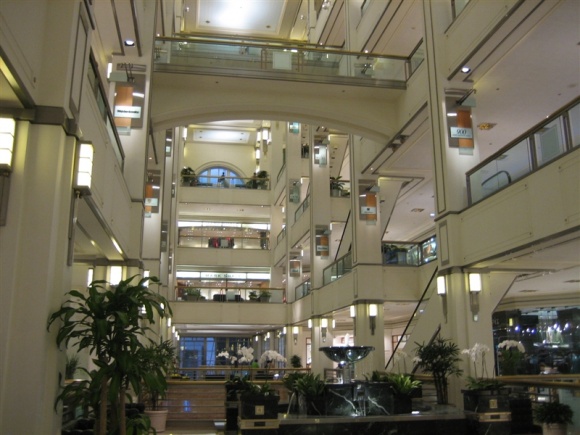
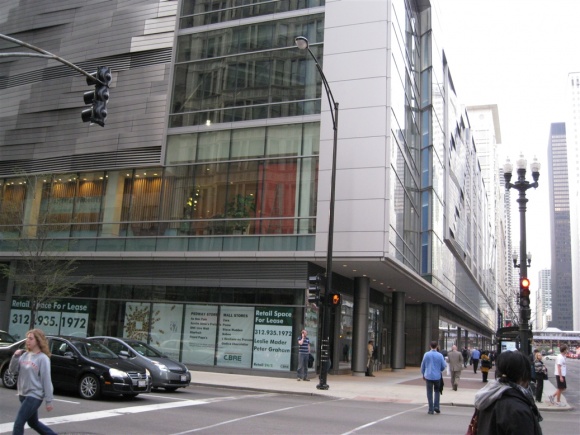
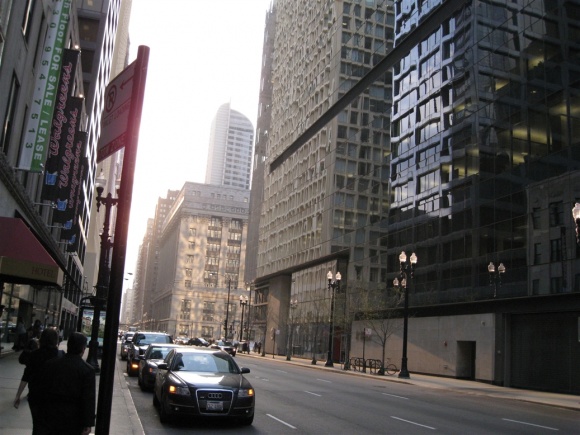
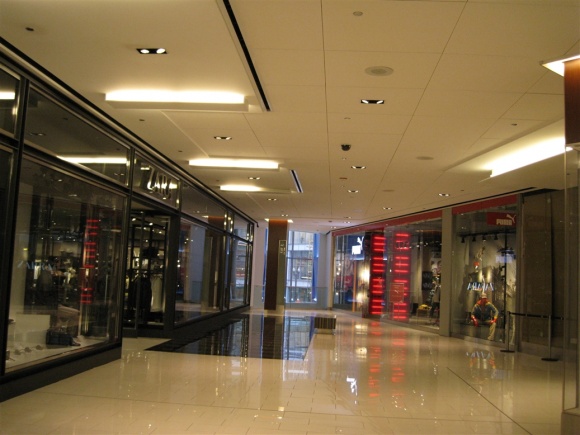
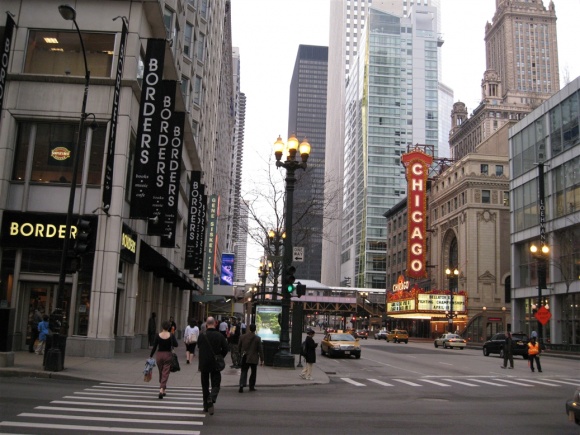
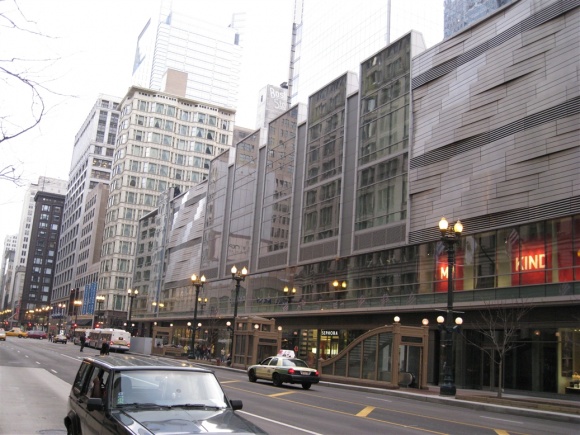
Block 37 – State Street is Chicago’s historic downtown shopping street. However, just as Frank Sinatra ingrained ‘State Street, that great street’ into America’s pop psyche, Michigan Avenue replaced State Street as Chicago’s most important shopping street. State Street became a secondary – yet still viable – destination. Nestled in the heart of downtown, and housing the flagship stores of both Carson Pirie Scott and Marshall Field’s, State Street retained its old-fashioned image of utility, while Michigan Avenue stole all the glitz and glamour.
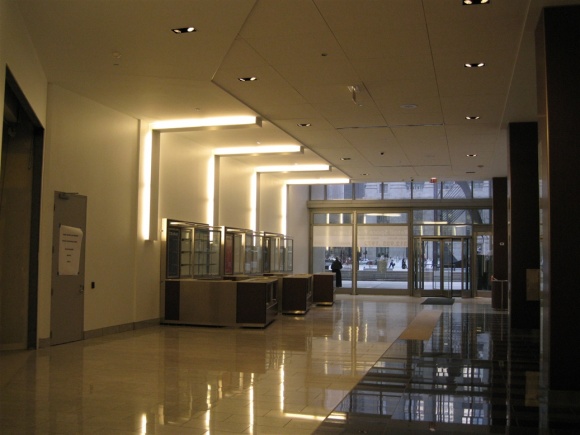
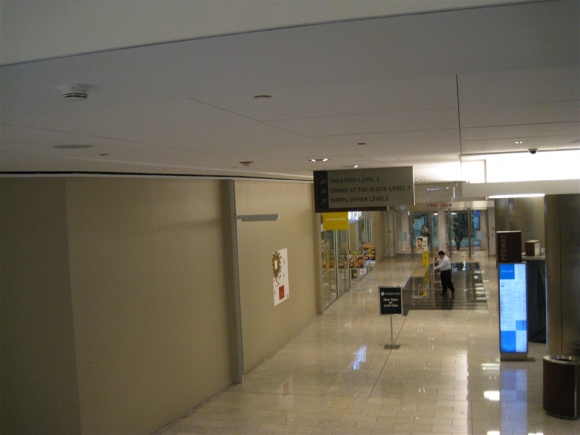
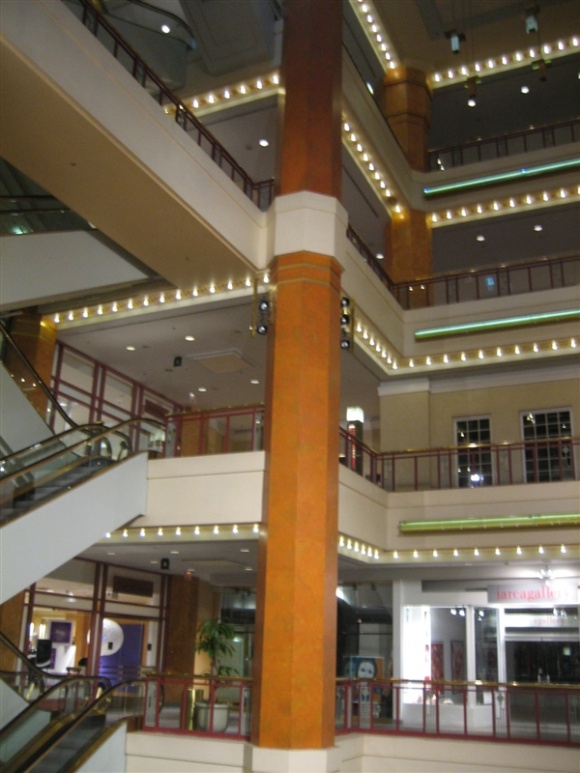
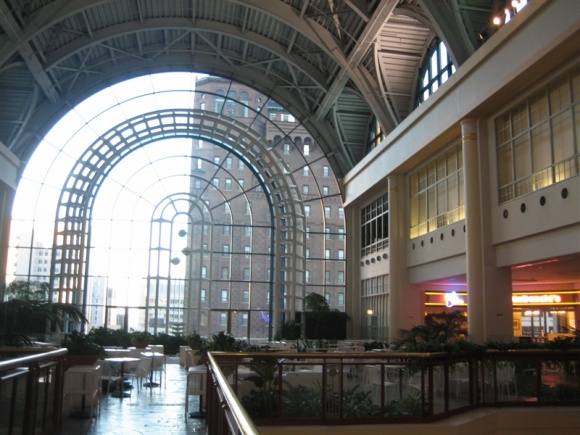
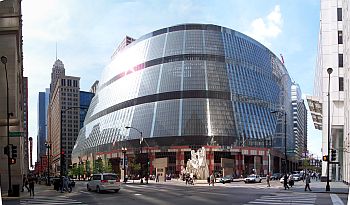 Atrium Mall – This is the smallest mall we’re choosing to include, and the only one technically in the Loop – at least for now. The Atrium Mall consists of the first three levels of the James R. Thompson Center, a government building housing the offices of the State of Illinois. It was built in 1985, and the 17-story building looks more like a Postmodernist museum rather than an office building housing government facilities. The building was named for former governor Jim Thompson in 1993, after being called State of Illinois Center until then. No clue why that creative name would ever get scrapped.
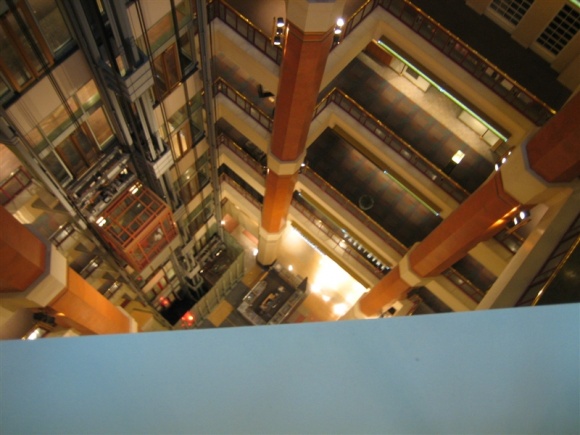
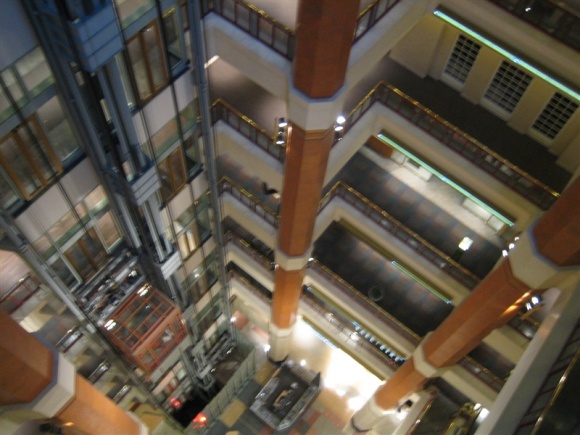
The enclosed space inside the James Thompson Center is really an impressive sight to behold. An atrium exposes all 17 stories up to the top of the all-glass center, and it is said to be one of the largest enclosed spaces in the world. The building takes up an entire city block, at 100 W. Randolph, and the basement connects to the lesser-known Chicago Pedway, an underground system of walkways connecting many downtown buildings, and the CTA Subway/El system.
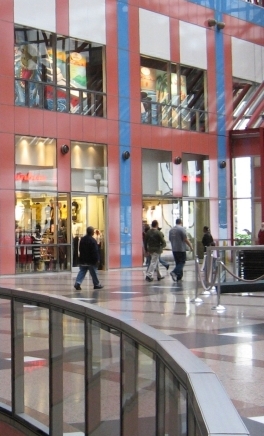 The Atrium Mall consists of 40 stores, restaurants, and services, catering mostly to the downtown working crowd, with about 140,000 square-feet of leasable space. There are no retail anchors to speak of, and the entire thing is closed after 6 on weekdays and all weekend, too, so the connection to the office crowd is the only reason this thing exists. The food choices are the largest component, and feature nothing too exciting, unless you consider the fact that there are two Dunkin Donuts exciting. And we admit, we kind of do.
We also find it amusing that the tiny Atrium Mall has its own Myspace page – erm, excuse me, her own Myspace page. She notes on it that she doesn’t watch too much TV, and doesn’t care for politics, but she does read one of our favorite authors – Paco Underhill. And why should she not? She’s a mall, after all…
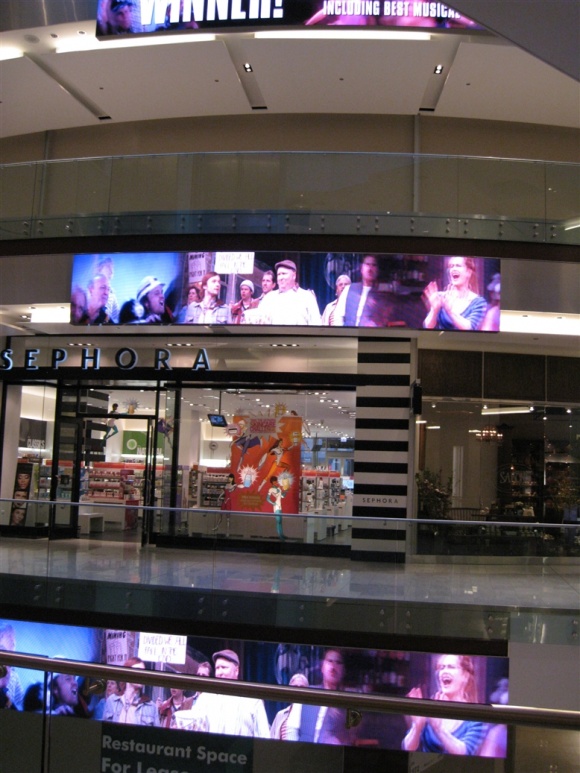
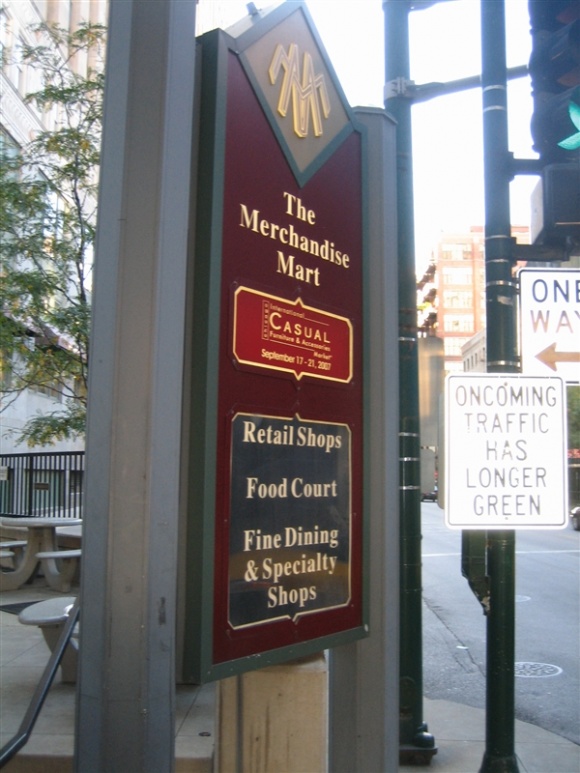
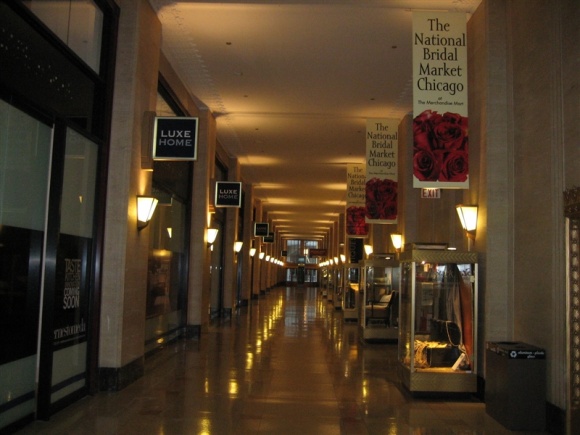
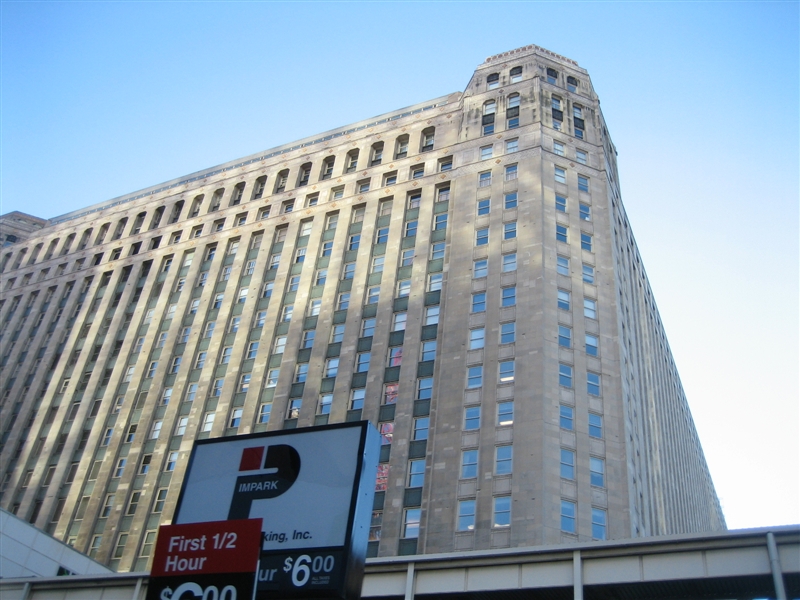 Shops at the Mart – The Merchandise Mart, constructed by Marshall Field and Company in 1930, occupies two entire city blocks in the River North neighborhood of downtown Chicago, bounded by Wells Street on the east, Kinzie on the north, Orleans and Franklin on the west, and the Chicago River on the south. With 4.2 million square feet of retail space on 25 stories, the Merchandise Mart is one of the largest commercial buildings in the world, and one of the most fascinating buildings in Chicago’s impressive store of architecture.
Oh, and the first two levels are a mall.
The Merchandise Mart building itself is an homage to trading partners of Chicago’s past, present, and the site’s history as a Native American trading post – 56 terra cotta Indian chiefs circled the tower’s crown; however, they were barely visible from street level and intended to be viewed from nearby skyscrapers in River North, most of which were never constructed. Thus, the Indian chiefs were removed in 1961 as part of a larger renovation project at the Mart. Other architectural features included department store windows sans department store – the Mart was, after all, a vision of department store magnate Marshall Field – and an elaborate interior featuring eight marble piers, storefronts embossed in bronze trim, and green and orange terazzo floors.
 As if all this wasn’t enough, the artwork inside the Mart essentially serves as a museum of retail. Famed Chicago artist Jules Guerin’s frieze of murals are the focal feature of the Mart’s lobby, and depict commerce throughout the world, focusing on the countries of origin for items sold in the building. In addition, along the Chicago River facing the Mart are eight bronze busts of retail magnates such as John Wanamaker, Marshall Field, Edward Filene, and Aaron Montgomery Ward.
But what businesses actually operate at the Mart?
Over the past 80 years the Mart has been home to radio stations, television station WMAQ, corporate offices, an el platform, and even a post office. Most of the space at the Mart, however, has been historically devoted to wholesale showrooms – mainly for interior design. Today, entire usable rooms are set up as showrooms, mostly for wholesalers and not open to the general public. In addition, the Mart is home to the world’s largest design expo and trade show, and also hosts Art Chicago’s international art fair. Also, the corporate offices of the Chicago Sun-Times relocated here in 2004when their old building was torn down for Trump Tower, and the corporate offices of Potbelly Sandwich Works – a fast-casual national chain – are located here as well.
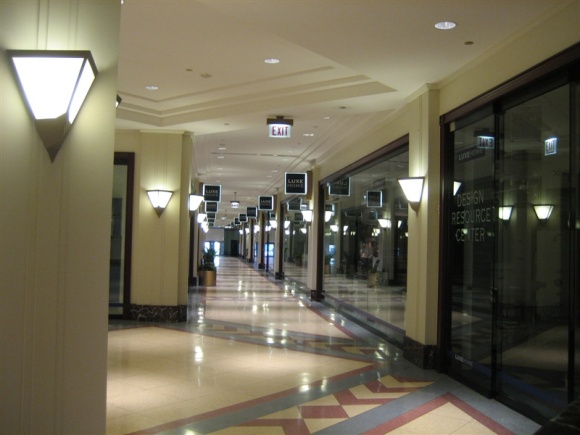
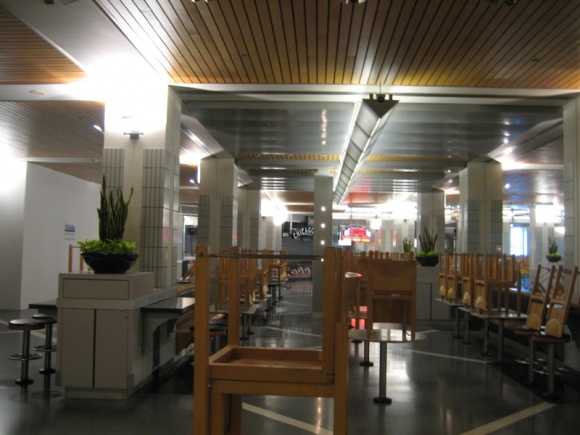 In addition to the above tenants, the Mart became home to a two-level shopping mall in 1991. Called Shops at the Mart, the shopping mall gave the Mart a wider visibility to the public, featuring a variety of shops and services. It was to be anchored by Chicago-based department store Carson Pirie Scott (did this ever open? If so, how long was it open?), and had a lot of apparel shops and traditional mall stores when it first debuted. The Limited opened a 23,000 square-foot space and divided it among its subsidiaries. Over the years, however, most of the traditional chain fodder found in suburban malls found its way out, and the mall began to focus on the downtown office crowd. The eclectic mix of stores today also suggests this. Most of the apparel stores, including The Limited, no longer operate at The Mart.
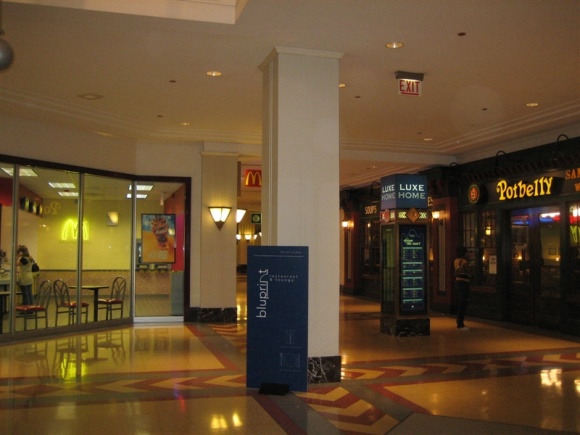
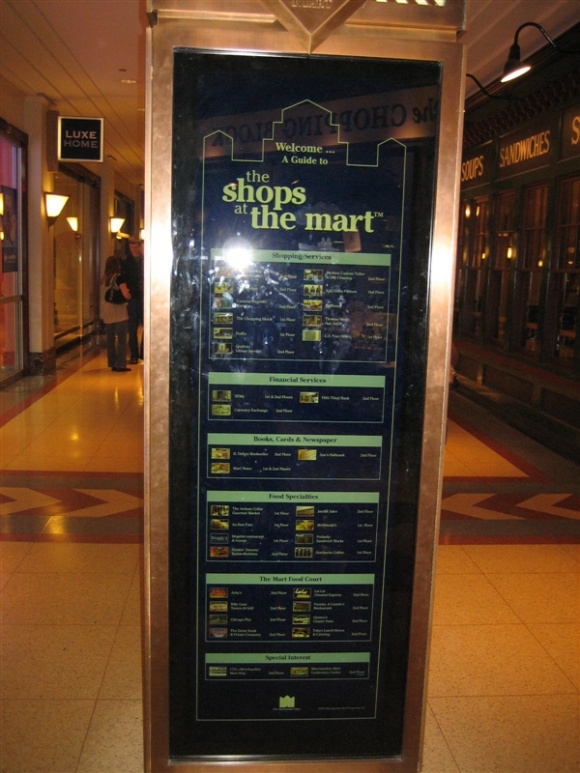
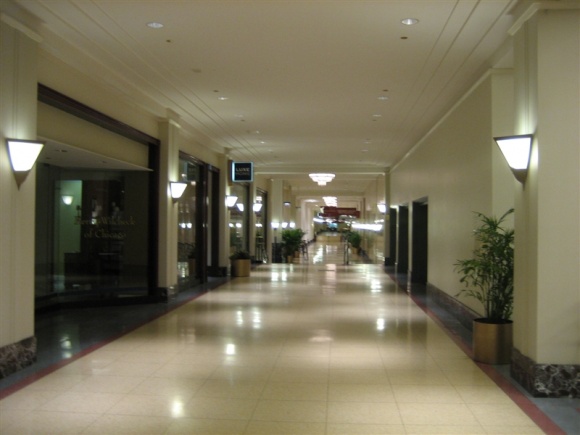
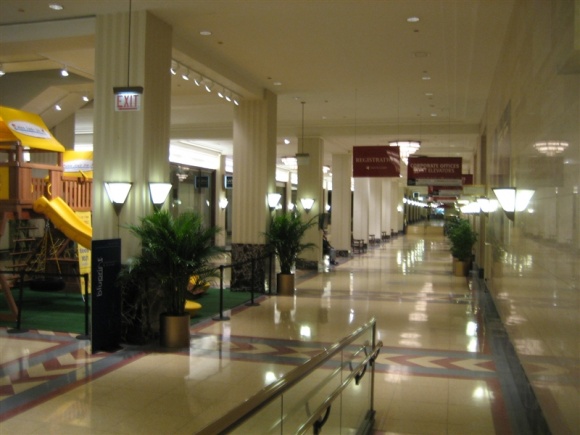
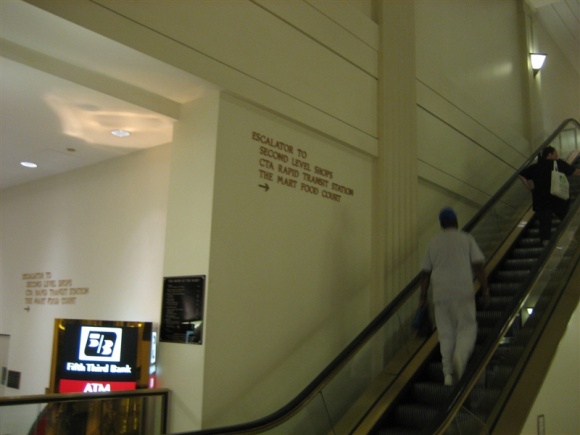
The mall exists on the first two levels of the behemoth 25-story Mart, and although the mall doesn’t feature anything you’d go out of your way for as a visitor, the various food stalls, the food court, and the services here serve the downtown office crowd well.
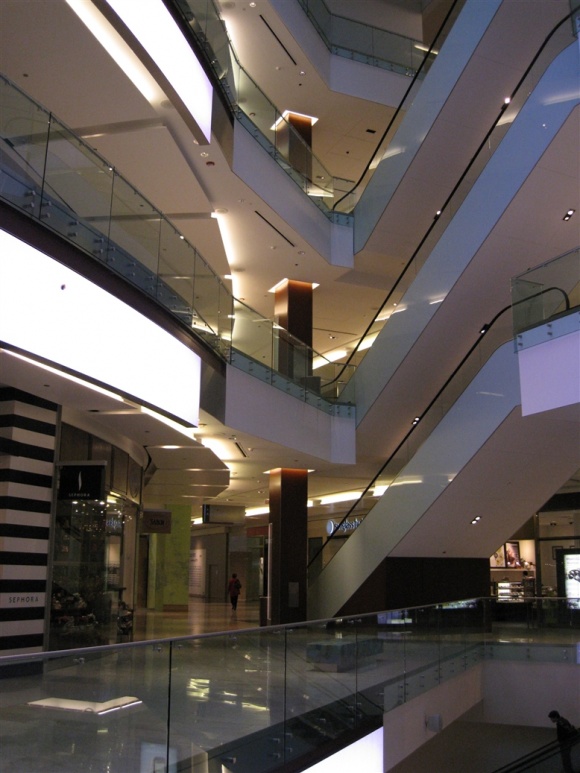
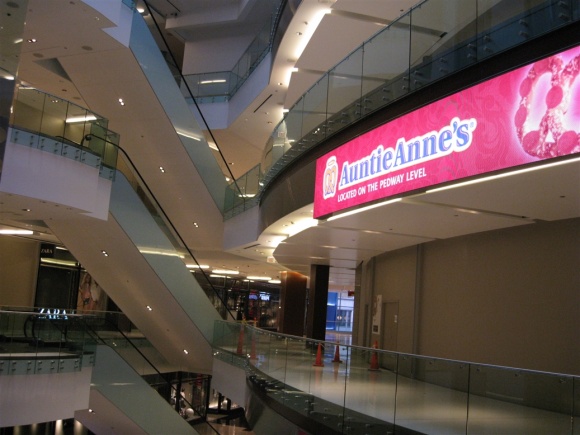
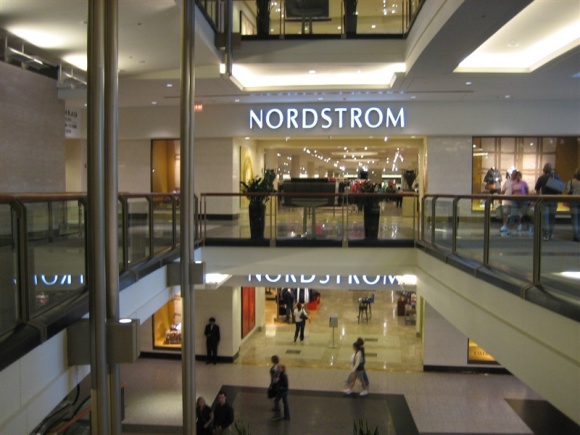
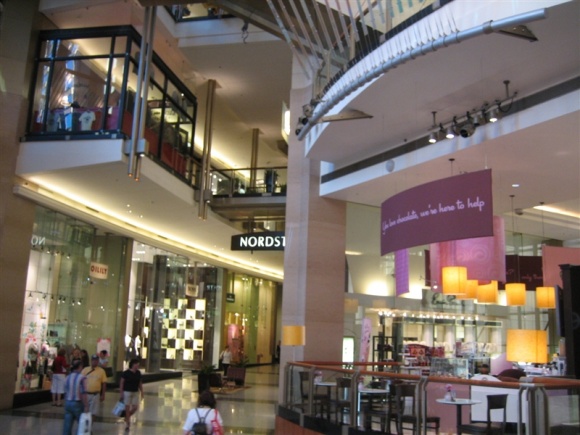
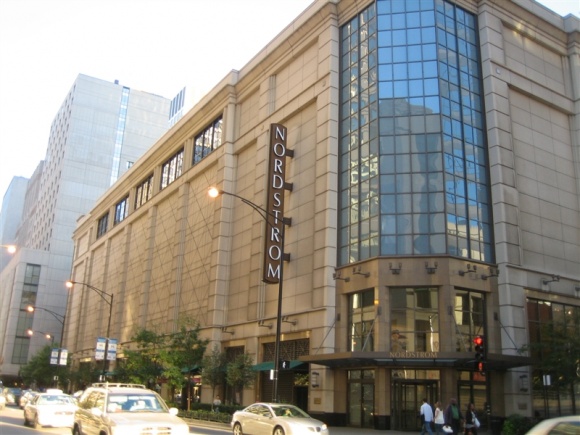 The Shops at North Bridge – Opened in 2000, this is not only the newest mall in downtown Chicago, but also the newest enclosed mall in the entire Chicagoland area. Located in the 500 block of North Michigan Avenue, The Shops at North Bridge is anchored by the midwest Nordstrom flagship – which is actually a block west, past Rush Street – and features a five-level enclosed concourse of upscale shops, connecting Nordstrom to Michigan Avenue at street level.
The site where North Bridge currently stands was, for over 70 years, the McGraw Hill Building – an art deco style construction, which opened in 1928. In 1997, the City of Chicago got wind of the impending redevelopment of this historic, iconic building, and quicky declared it a designated historical landmark so they couldn’t totally decimate it. So, when redevelopment time came, the developers had no choice but to incorporate large portions of the building into their new design. After the McGraw Hill Building’s insides were torn down, its front facade facing Michigan Avenue was saved and grafted onto the new retail mall.
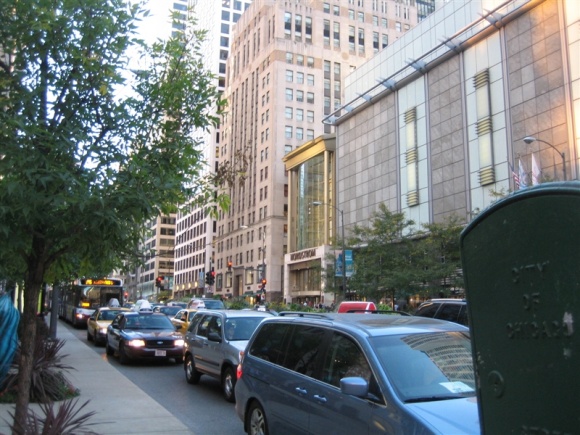
 The design and layout here are interesting, mostly out of the necessity of space restrictions in an urban downtown, but also due to Chicago’s history. Because of the great Chicago fire of 1871, much of downtown Chicago – including the “street level” of Michigan Avenue outside of the mall – was rebuilt one or more levels above the actual ground. However, some of the side streets to the west of the mall are actually located at actual ground level, a level beneath Michigan Avenue. These include Grand Avenue, which becomes an underpass under Michigan Avenue, and Rush Street where Nordstrom sits.
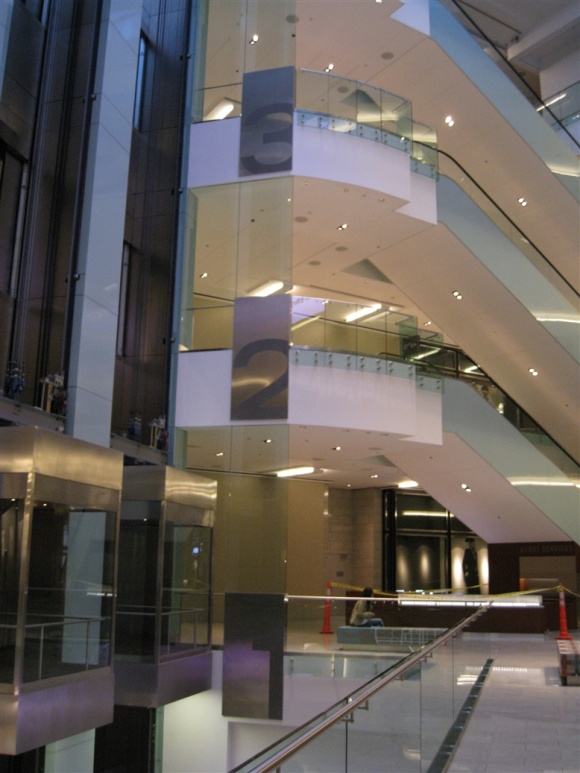
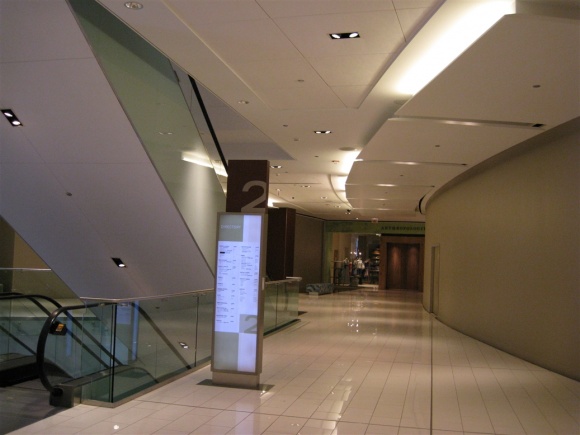
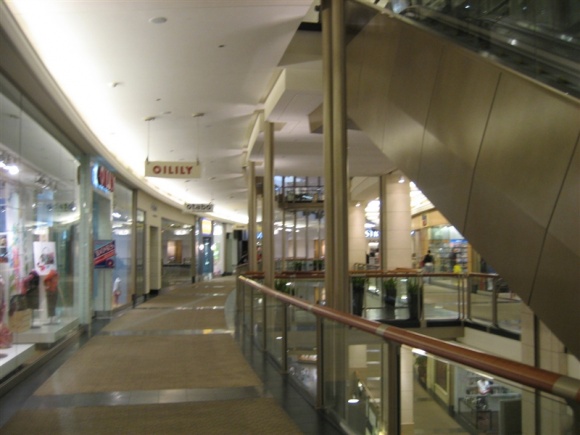
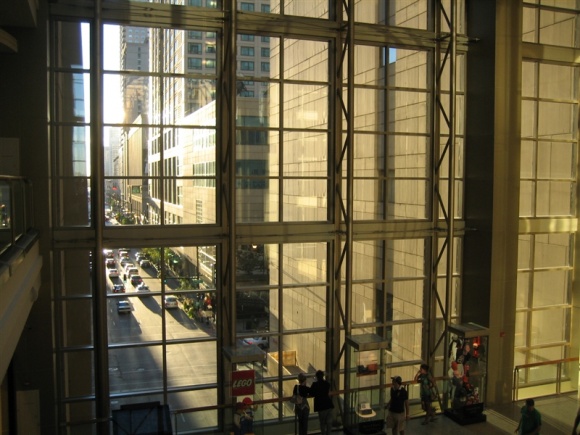
The mall itself is a four-level structure which curves between the Michigan Avenue entrance, which is actually on a bridge over Grand Avenue, and the entrance to Nordstrom, which is actually located on a bridge over Rush Street. The entrance on Michigan Avenue is, like Water Tower Place, an elaborate lobby. Guests must go up at least one level on an escalator to reach “Level 1” of the mall, and they may ascend via escalator to the other levels from there as well. The lobby also contains huge artistic sculptures, and windows on all sides featuring breathtaking urban views. Confused yet? Just visualize a mall, on a bridge, because that’s pretty much what it is.
The Shops at North Bridge’s tenants are mostly mid-range to upscale, including Kenneth Cole, Armani Exchange, and Louis Vuitton, and there’s a food court on the 4th level featuring nonstandard food court fare. Don’t expect McDonald’s and Sbarro here; instead, the offerings are mostly local and cater to upscale fast-casual dining.
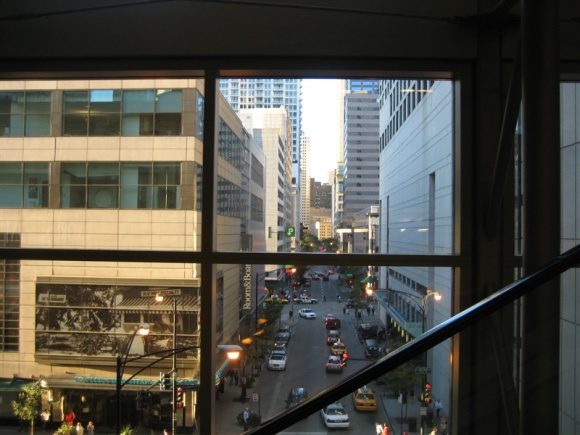 The mall is also part of the larger North Bridge complex, which spans several blocks, from Michigan all the way over to State Street, and from Ohio down to Illinois. Other businesses in the complex have street frontage and aren’t connected to the mall structure, and include restaurants like Weber Grill, PF Chang, and California Pizza Kitchen, as well as furniture store Room and Board, who presumably moved here from the failed Chicago Place mall up the street (see below). There are also a few hotels in the complex: Conrad Hilton, Homewood Suites, Hilton Garden Inn, and the Chicago Marriott Downtown Magnificent Mile. Say that one without running out of breath.
North Bridge has changed ownership a couple times since opening in 2000. In 2003, Westfield America gained an interest from original developer John Buck, and rebranded the mall Westfield Shoppingtown North Bridge, dropping the “Shoppingtown” moniker in 2005. Then, in 2008, Macerich acquired the mall from Westfield, and Macerich put back the original name to The Shops at North Bridge. North Bridge is Macerich’s first property in the Chicago area.
North Bridge has been successful because of its sheer, stunning beauty, design, and the popularity of anchor Nordstrom. Putting Nordstrom at the back, a block away, and funneling shoppers from Michigan Avenue to it has proved to be a good idea.
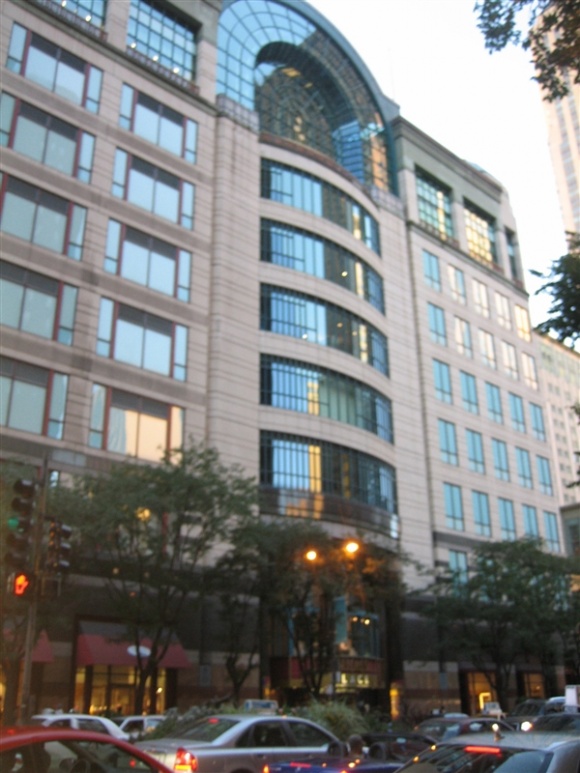
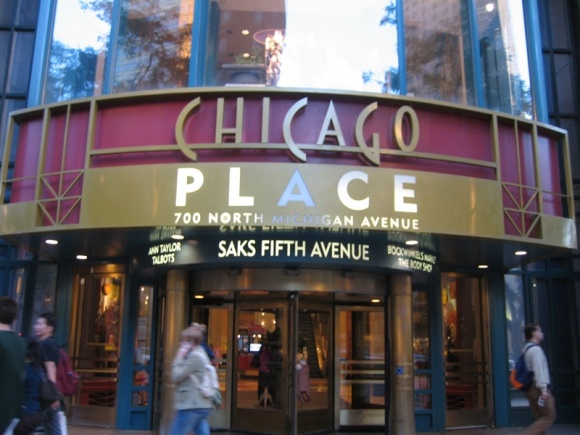 Chicago Place – A few blocks north of The Shops at North Bridge along Michigan Avenue brings us to the next stop on our downtown Chicago mall tour, Chicago Place. In contrast with the nuanced success of North Bridge, Chicago Place is a mostly-failed dead mall, sitting right in the middle of downtown Chicago on its most famous shopping street. What gives?
Most of the center is currently closed, save for the food court and one store (as of 2009), and plans are underway to transform most of the mall into office space – save for the Mag Mile frontage along Michigan Avenue, which will remain retail.
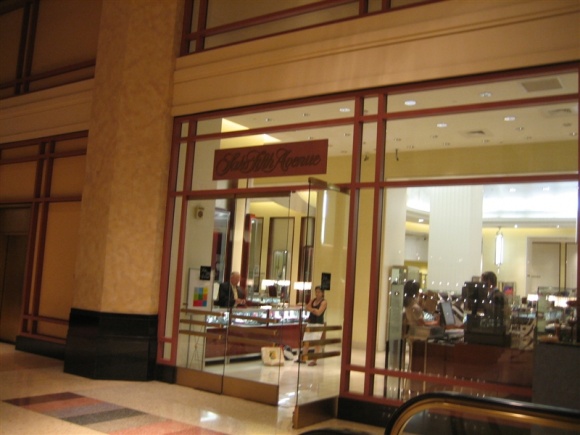
Chicago Place opened in 1990 as a 600-foot, 49-story behemoth, located at 700 N. Michigan Avenue, between Huron and Superior Streets. The bottom 8 floors of the tower consisted, until 2009, of a vertical mall, anchored by Saks Fifth Avenue, which also opened as part of this development (it moved from across the street). The rest of the floors are condos.
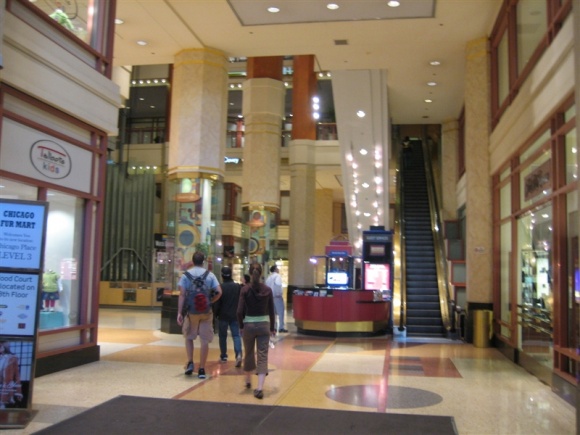 Shortly after debuting in 1990, Chicago Place – while experiencing a modicum of success and lease rates around 70 percent during the 1990s – fell dramatically short of expectations. After all, it was on Michigan Avenue – one of the toniest shopping streets in the entire country. Some stores, mainly on upper floors, never filled or had trouble filling, and the whole center certainly never felt as cohesive as Water Tower Place, just a few blocks north.
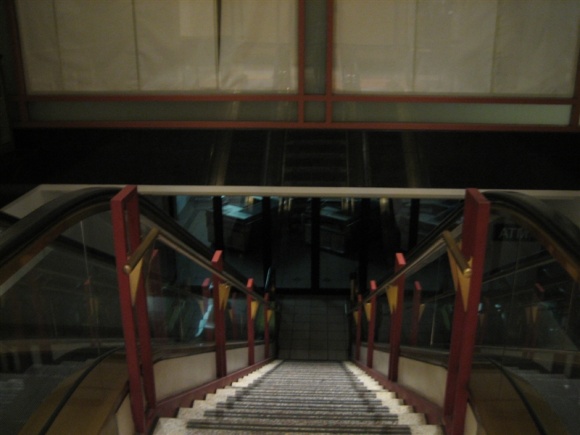
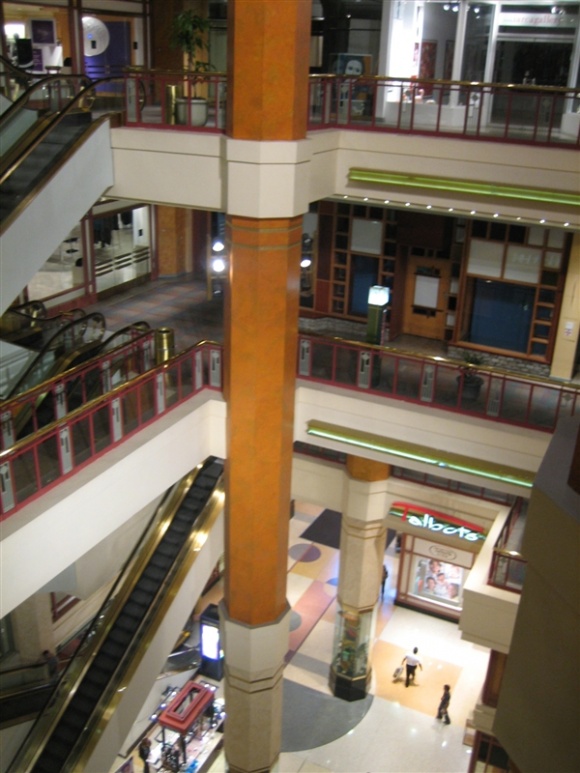
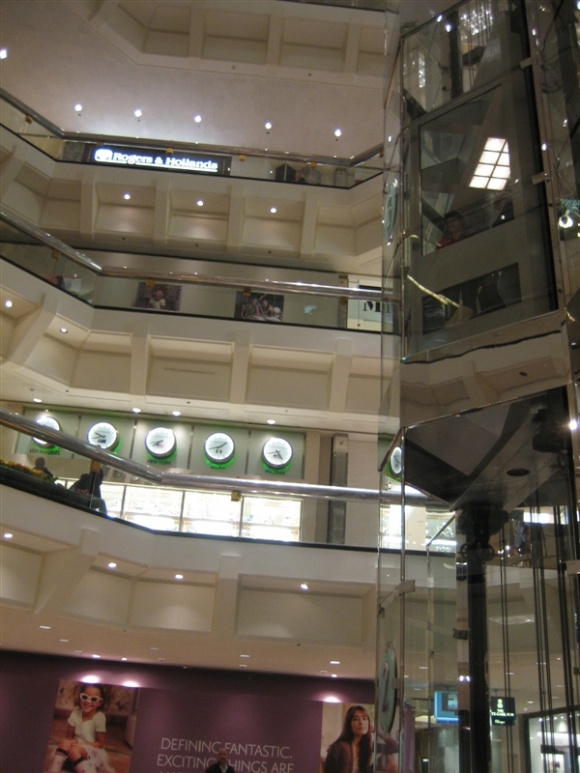
Despite being located on one of the nation’s premier shopping avenues, Chicago Place met its end through competition and poor design. The awkwardly small, jagged floors of the vertical mall allowed for awkward placement of the handful of stores on each level, and the escalators, hemmed into the tightest space imaginable, gave people vertigo. Also, the zig zag design had the unanticipated – and certainly unwanted – effect of alienating shoppers from the storefronts, pushing them away and past them. In addition, anchor Saks is hemmed in at the back corner of the center, and casts a cold, unwelcoming pall upon it; it’s not an obvious focal point of the mall, drawing shoppers through the mall and into it like the 900 North Michigan or North Bridge malls do.
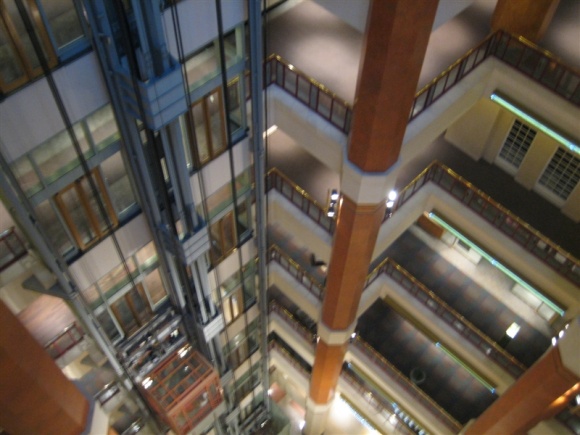 An express elevator near the rear of the mall, next to the Rush Street entrance, whisks people to and from the food court – the only truly inviting space in the mall – allowing them to pass the 7 stories between it and the ground level. Ostensibly, this was done to allow the food court to thrive on lunch patrons who didn’t have time to ascend each level or use the slower elevators in the middle of the mall’s atrium. It was a good idea, because the food court did indeed thrive, and is, rather oddly – as of late Summer 2009 – the only part of the mall still open for business. The food court is also, unlike the rest of the mall, a nice, refreshing open space full of huge windows with sweeping views of Michigan Avenue, downtown, and the lakefront to the north.
By the 2000s, Chicago Place’s days became clearly numbered. In 2004, a group of New York investors bought the mall for the price of $39 million – a steal. Or so they thought. Longtime tenants Ann Taylor and Room and Board had recently closed, as well as the tenants who brought life to the ground levels – Bockwinkel’s, an upscale grocer, a gourmet coffee place, and a flower shop.
 It became painfully clear toward the middle of the 2000s that Chicago Place could simply not keep up. It had neither the cachet of tourist-popular Water Tower Place, the upscale luxury of 900 N. Michigan Shops, nor the nuanced open floorplan of North Bridge. In January of 2009, the Talbots store finally closed, leaving only a Tall Girl shop on the third floor, and the food court as the only remaining tenants. According to Tall Girl’s website, the store is still open as of September 19, 2009 – is this true? Probably not for long.
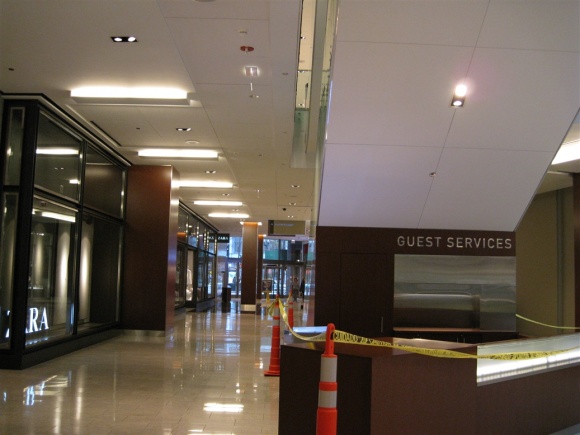
Long term plans are for the upper floors of Chicago Place to be gutted, but we’re not sure if this includes the food court or not. The food court, while still technically open, is now having vacancy issues of its own – McDonald’s couldn’t even survive here – and the hike up to he 8th floor is probably a bit of a time-waster for people in a lunch crunch. The street-level facade will be converted into a Zara store, and Saks will remain as well. A Best Buy was to come in as well, but that apparently fell through as Best Buy recently opened up in the John Hancock Center four blocks north.
So long, Chicago Place. You were a neat idea, if poorly executed.
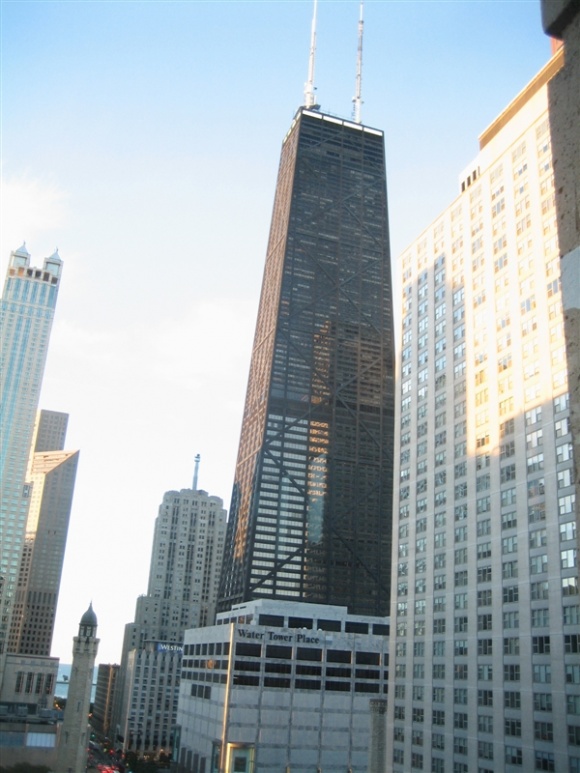
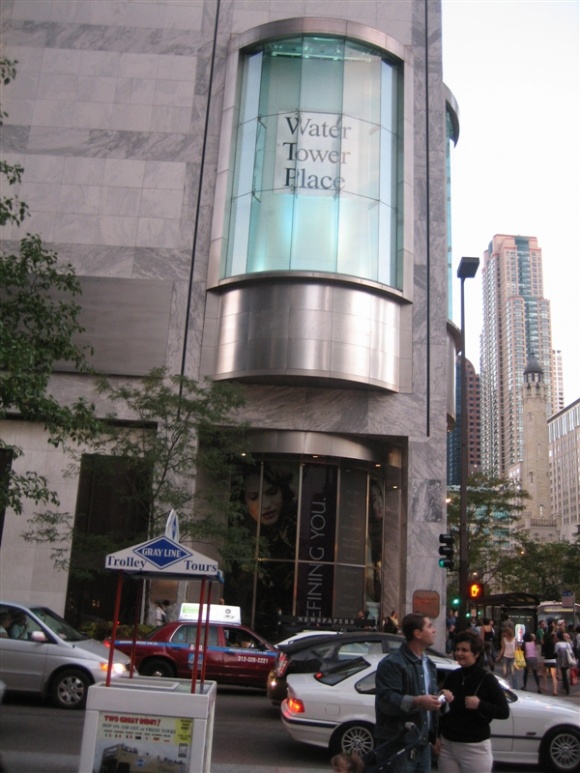
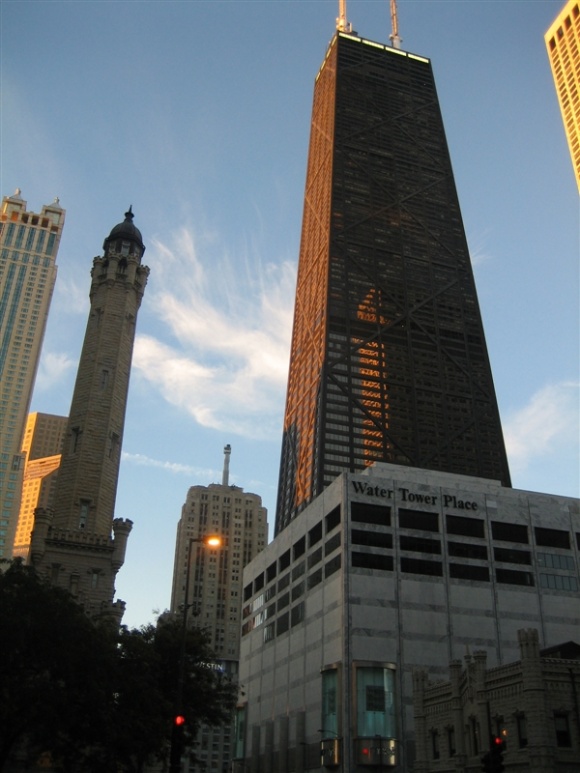 Water Tower Place – Three blocks north of Chicago Place, and across the street, lies Water Tower Place – a Chicago shopping institution since 1975. The 8-level, 750,000 square-foot mall lies at the base of an 859-foot, 74-story skyscraper housing a Ritz Carlton Hotel, condominiums, and one of Chicago’s most famous residents – Oprah Winfrey; however, rumors are constantly afoot that she may be leaving – or maybe not. Keep us on our toes, O.
Brushes with fame aside, Water Tower Place single-handedly changed retail patterns in Chicago after it opened in the 1970s, bringing accessibility as well as shifting Chicago’s retail center of gravity. Water Tower’s 100 stores weren’t – and still aren’t today – the exclusive, upscale boutiques seen on Michigan Avenue and nearby Oak Street. Instead, the stores at Water Tower Place are those found in successful, A-Tier suburban malls, such as Hollister, American Eagle, Chico’s, and Ann Taylor.
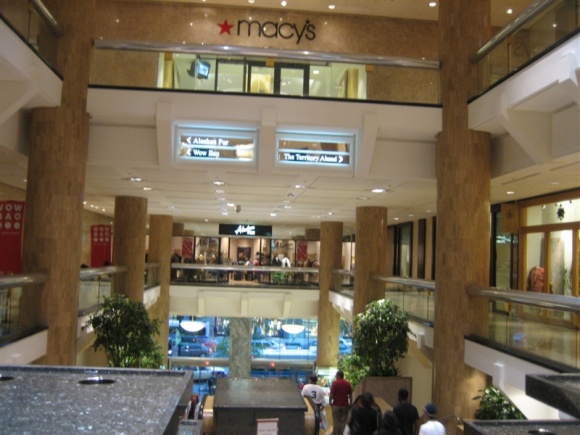
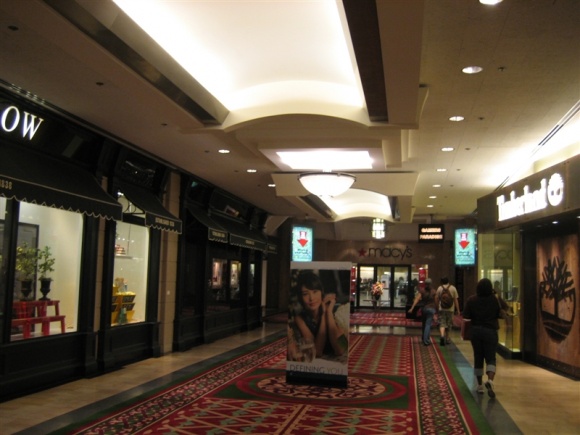
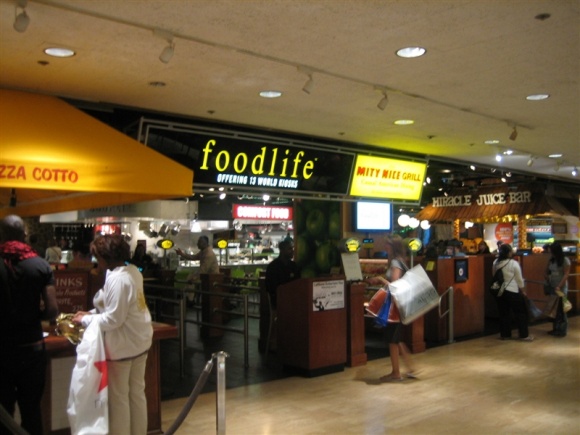
The major anchor at Water Tower is Macy’s, which was, until 2006, a Marshall Field’s (wistful shout out to MF) – and a Lord and Taylor anchored the other side of the mall until it closed in 2007. The L&T space is currently a huuuuge American Girl Place, in part, and the rest of it is being redeveloped for other retail uses. Also, in addition to stores, there’s a Drury Lane Theater for live performances, and although there is no traditional food court, there are fast food and sit down dining establishments scattered throughout the levels, including California Pizza Kitchen, Wow Bao, and Foodlife – a food court-esque area on the mezzanine (first level above the lobby).
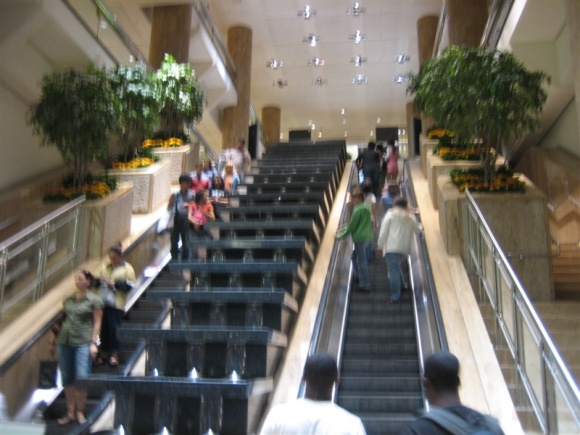
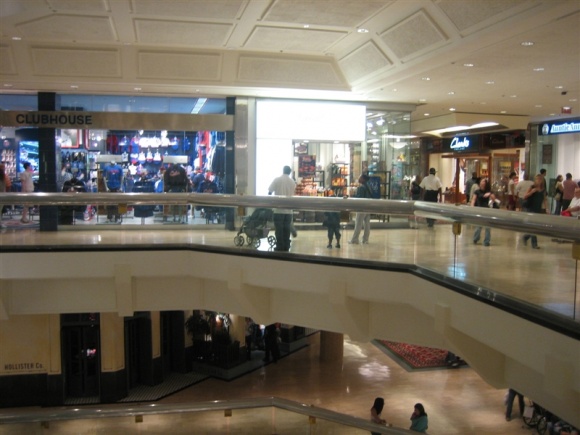
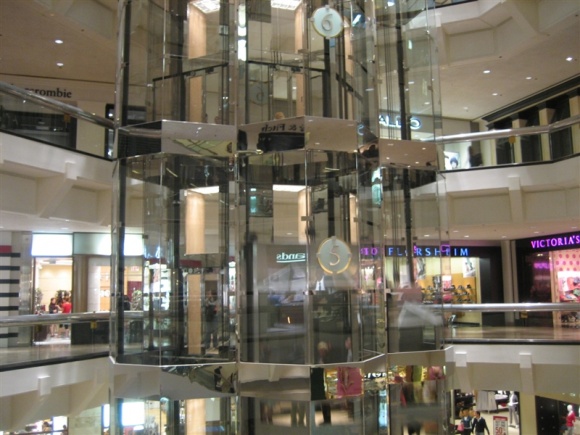
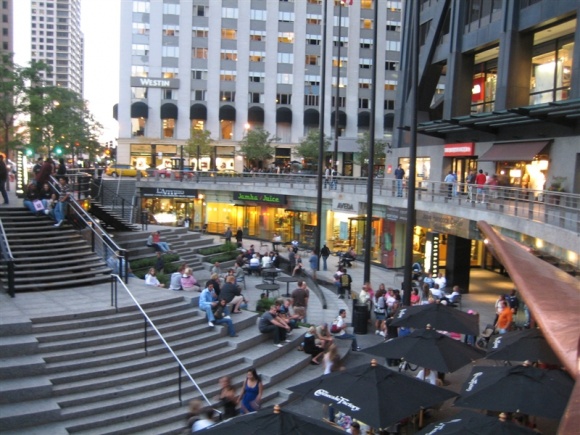
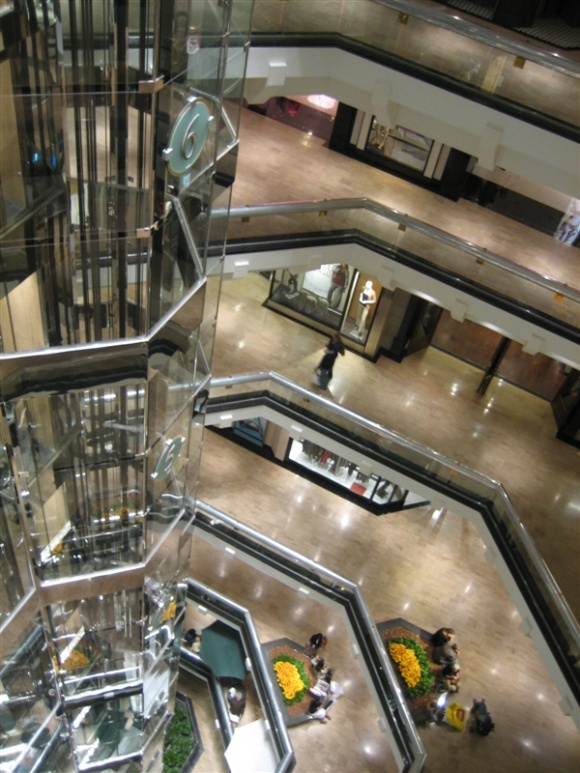 The design specs and layout of Water Tower Place also make it a unique place, unlike the awkwardly positioned space at failed Chicago Place, another vertical mall a few blocks south. From the Michigan Avenue main entrance lobby, guests are presented with escalators ascending upward featuring multiple tiers and a waterfall running beside them. The lobby itself only features entrances to American Girl, Macy’s, and Wow Bao – a counter service pa-Asian restaurant. Upon reaching the mezzanine level, guests are greeted with the Foodlife food court area, featuring multiple genres of cuisine in counter-service format, and a small market featuring fresh produce and other items. From the mezzanine level, the 8-level mall begins, and one can choose to ascend floor-by-floor using the escalators along one side of the atrium, or the elevators in the middle. The entire place is decked out in marble and shiny metal, and combined with the small space on each level, gives shoppers a frenetic urban vibe – that’s why they came to shop in downtown Chicago, I guess.
This accessible mix of stores brought other popular chains to Michigan Avenue, and helped Michigan Avenue replace State Street as Chicago’s all-purpose one-stop retail destination. The upscale shops and boutiques still exist, and even have their own niche over on Oak Street and in the 900 N. Michigan mall, but they have become the exception rather than the rule, and Water Tower Place was the impetus for this change.
By the way, the name Water Tower Place comes from the famous water tower located across the street, one of the only structures in Chicago to survive the great fire of 1871.
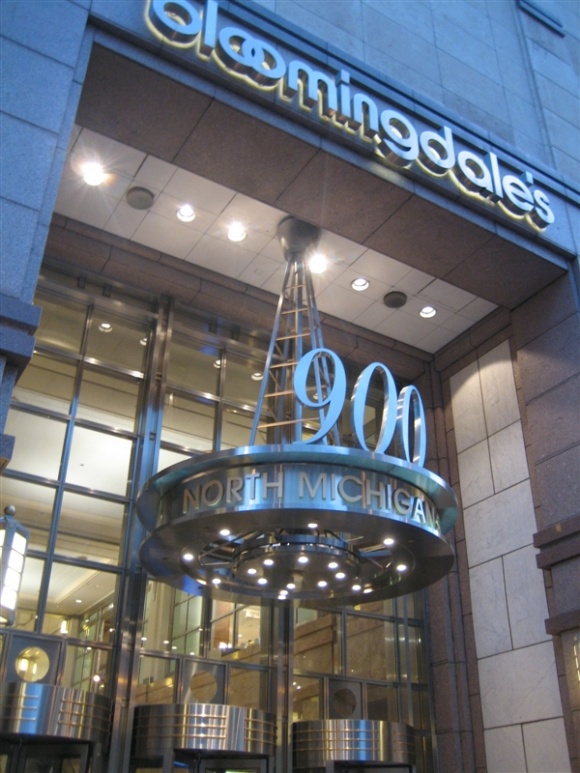
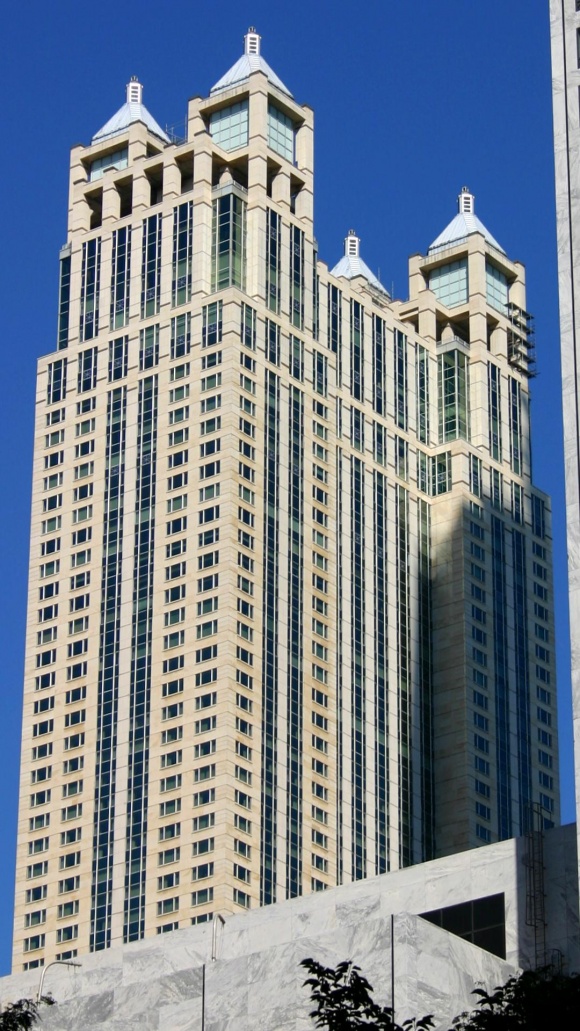 900 North Michigan Shops – In 1988, Urban Retail Properties, a Chicago-based developer, saw Water Tower Place’s immense success transforming the retail geography of Chicago and wanted a piece of the pie. They apparently recogized they couldn’t compete head-to-head with Water Tower, but they realized that Water Tower squeezed out the previous monopoly upscale retailers had prior to its existence, so they developed a plan. After signing Bloomingdale’s and junior anchor Henri Bendel (now clothing-box Mark Shale), they embarked on a massive, mixed-use development plan, featuring 7 levels of upscale retail in a vertical mall – much like Water Tower Place – along with condos and a Four Seasons Hotel.
Much like neighboring vertical malls Chicago Place and Water Tower Place, the building the mall is in is also a megatall skyscraper. At 871 feet tall, 900 North Michigan has 66 stories and is – as of September 11, 2001 – the tallest building in the U.S. housing a shopping mall.
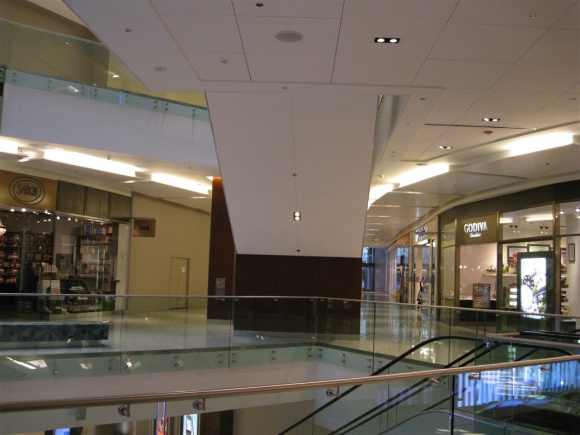
The design and layout of 900 North Michigan Shops is similar to that of its sister, Water Tower Place. T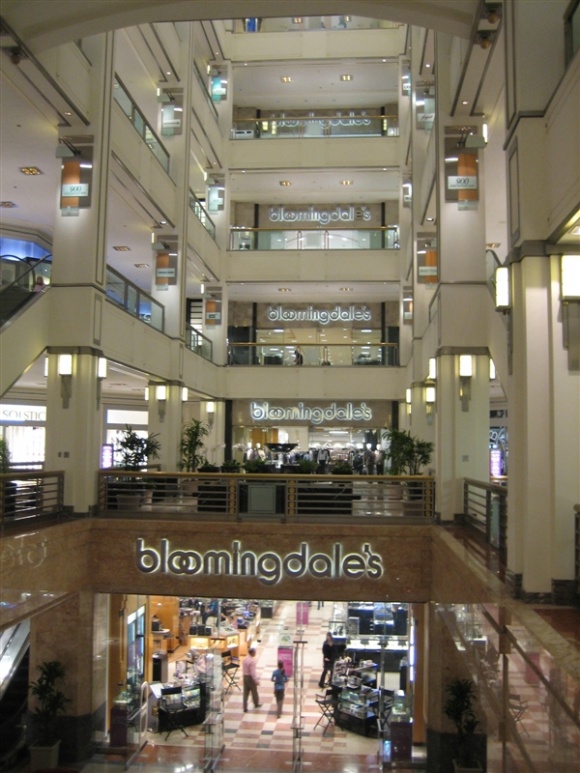 he 450,000 square-foot vertical mall is about half the size of Water Tower Place, and is accented with a mostly white facade on the inside. The angles aren’t intrusive either, unlike Chicago Place, with its failed zig zag design. 900 North Michigan encourages shoppers to actually shop in the stores. Anchor Bloomingdales is at the back (Rush Street side) of the center, and the anchor is a visible focal point upon entering from the Michigan Avenue main entrance. In addition, the arrangement of the escalators in a parallel pattern funnels shoppers past the shops, and not into a confusing spiral of vertigo.
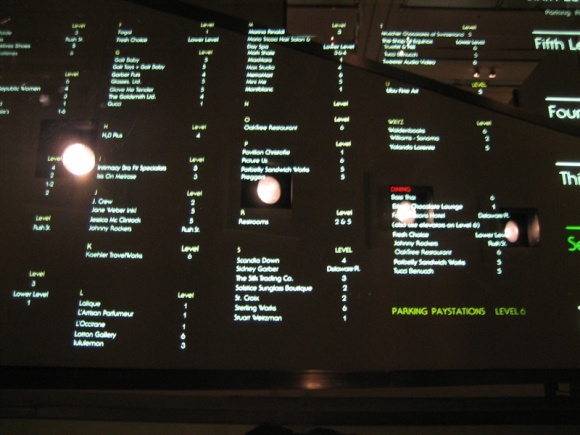
As noted above, the clientele 900 Norh Michigan wants is more indicative of Michigan Avenue’s historical place in Chicago’s retail history as an upscale shopping destination, rather than the current mish-mash of all different types of retailers represented in Water Tower Place and the environs. Also, 900 North Michigan is also closer to the upscale boutique district along Oak and Walton Streets. By capturing an upmarket niche and through an inviting design, they have been successful where Chicago Place failed. Only about half of the mall’s roster of stores are national, recognizable chains, like Gucci; the other half are smaller-scale exclusive upmarket boutiques.
We walked around downtown Chicago and visited all of these landmarks during an afternoon in Fall 2007. As usual, feel free to leave comments.

























Oooh, very nice. But does this mean these malls won’t get their own article? Never mind, it’s really cool. Is WTP the first mall that combined condos and mall? (it seemed to work!)
Within downtown Chicago, there were also Century Mall and River East Plaza. I don’t know much about either; did they ever have anchor stores?
@TenPoundHammer, As far as I can tell, River East Plaza only has two commercial tenants – a Latin restaurant and an upscale grocer. http://www.parkviewwestcondos.com/ViewCommercial.aspx?com=3
And, I’ve never heard of a Century Mall downtown. There’s a Century Mall (vertical mall) that I guess I would count at 2828 N. Clark St., in Lincoln Park. If it’s still there, that is. I haven’t been there in a few years, and its retail tenants were dwindling.
I’m told that River East used to have more than that. Also, I guess Century isn’t really downtown then.
This has to be one of my favorite Labelscar posts ever! Chicago has some of the coolest urban retail in the world, and the plethora of vertical malls is part of the reason. I have been to all of these except North Bridge (and that’s because I haven’t been to Chicago since the late 1990s).
Of all of the malls mentioned, my favorite is Water Tower Place. It is very much a product of its era, but it’s one of the best examples of 1970s-style retail out there. Remarkably well preserved as well.
Carson’s had a small branch in the Merchandise Mart in the 80s, which had been a round for quite awhile. I don’t know if they moved into the new mall. That was a round the time of one of their mergers. Carson’s had, at that time or just before concluded several unsuccessful experiments to boost downtown retail. These included a floor with women’s career wear in the basement of the State Street store that opened early in the am before the rest of the store and the Aracadia (maybe Acadia) store within a store with cards, novelties, and a cafe.
Great post!
Living in the Chicago area in the 90’s I do remember that Carson’s opened a store at the Shops at the Mart in 1991. It was heavily advertised, but didn’t offer much retail-wise different than the suburban malls. That Carson’s also was small, I believe it only offered women’s clothing and accessories- no mens and no home departments. I believe it closed by 1995.
Also, Water Tower place used to be more of a unique, upscale mall in the 80’s until 900 North opened. After that, the retailers became more common but upscale mall stores- while 900 North too its role.
Also Lord and Taylor closed there not because of bad business, but because the mall’s owner, GGP was able to get higher rents from smaller tenants than from a department store.
The mart is also home to the offices of the CTA.
At one time a Loews twin theatre was located at 900 North Michigan. From what I remember a health club took that space.
I think River East Center includes the AMC 21 Theatre.
From Retail Traffic
Retailers Look to Fill Vacancies in Chicago’s Loop and Affluent Shopping Districts
Sep 22, 2009 3:41 PM, By Jennifer Popovec
It’s time to move back to the city. That’s the conclusion that many national and local retailers seem to be drawing about Chicago. There, firms have responded to the downturn by reining in expansion plans in the suburbs in favor of pursuing urban locations that have opened up in Chicago’s Loop and North Side neighborhoods.
The interest from retailers can be summed up in two words: density and dollars. Despite the difficult economic conditions, the Loop and North Side neighborhoods continue to attract residents, employees and tourists, all of whom generate a steady flow of foot traffic, says Gary DeClark, managing director of Integra Realty Resources-Chicago. Throw in the roughly $81,000 in disposable income per household floating around Chicago’s urban core and you get a combination that’s tough to beat.
Apple, for example, recently inked a 10-year ground lease to build a 15,000-square-foot standalone location in the Clybourn Corridor, a patch of retail that caters to affluent residents of the Lincoln Park and Gold Coast neighborhoods. The company, in part, took advantage of the kinds of vacancies cropping up when retailers including Z Gallerie and Pottery Barn shut stores. As a result, retail sites command around $60 per square foot—similar to what retail spaces fetch in the Loop and down between 8 percent and 10 percent from the market’s peak, notes Greg Kirsch, principal of Newmark Knight Frank’s Chicago retail group.
Whole Foods also has stepped into the breach and chose Clybourn Corridor as the site for the third largest store in the company’s portfolio—a 75,000-square-foot behemoth on Kingsbury. Even retailers that traditionally prefer lower-income, suburban sites have been tempted. Discounter Aldi Inc., for example, leased a 16,000-square-foot space vacated by Bombay Furniture.
The trend is replicated around the city. Other retailers planning to open within Chicago’s city limits include West Elm and luxury brands such as Swarovski and Baccarat. Restaurant chains are in the mix as well including Wich Wich, a sandwich concept new to the Chicago market, and Qdoba Mexican Grill, which has leased three Loop locations. Even big box retailers such as Target and Kohl’s are rumored to be scouting for sites. So far, Target has committed to an 180,000-square-foot, two-level store at Wilson Yards Shopping Center on the city’s north side.
Outperforming the suburbs
Vacancies across the Chicagoland market have increased this year, growing to 11.6 percent at the end of the second quarter from 11 percent during the first quarter, according to CB Richard Ellis. Net asking lease rates dropped even further to $15.95 per square foot from $16.40 per square foot in the first quarter 2009. The picture is brighter, however, within city limits. The City North submarket, which CBRE defines as the Loop and Chicago’s inner neighborhoods, posted the lowest vacancy rate in the region at 6.3 percent. It also had the highest rents, ranging from $22.74 per square foot to $27.21 per square foot.
Still, that’s not to say that Chicago hasn’t faced its share of adversity, even if it is outperforming its suburbs. Consider Armitage Avenue, a tony strip of trendy boutiques and upscale restaurants on Chicago’s North side. Just 12 months ago, there were few vacancies. Today there are at least seven vacant spaces, according to Shannon Hormanski, an associate director of Chicagoland Retail Services for Cushman & Wakefield of Illinois Inc.
Yet by and large, retailers have taken advantage of the current conditions to vacate suburban locations and relocate within the city in “areas that they have been not been able to get into before,” says Stan Bobowski, president of Bobowski & Associates Inc., Chicago-based retail brokerage firm. Other retailers that already had a presence in Chicago are also upgrading their locations.
As a result, retail leasing activity in the Loop and near North neighborhoods, while not frenetic, continues to be lively, according to John Vance, vice president of the Chicago-based brokerage firm. Even so-so locations within the city are generating interest, especially if owners have dropped their rental rates to make it more affordable for retailers to operate.
The Magnificent Mile—a stretch of Michigan Avenue north of the Chicago River—remains Chicago’s premier retail district. It too has been dinged and affected by vacancies. But other retailers are taking advantage of newly discounted rents to score coveted slots. With all the shuffling, experts estimate the Michigan Avenue’s vacancy rate is approaching 10 percent, offering an opportunity for expanding retailers to grab prime space at discounted rates. Rents on the Magnificent Mile traditionally exceed $300 per square foot, but have dropped as much as 20 percent over the past 12 months, according to local players.
Borders Books & Music, for example, will close its 55,000-square foot store (the largest in the chain) in 2010. Bankrupt retailer CompUSA also closed it store nearby. Meanwhile, additions to the strip include Best Buy, which opened a 22,000-square-foot store in the John Hancock Building. And a former Bennigan’s space at 225 N. Michigan has been leased to Sweet Water Tavern & Grille.
The wildly popular American Girl Place also recently located, moving from a 40,000-square-foot location at 111 E. Chicago Ave to a 52,000-square-foot spot at Water Tower Place. Australia-based surfwear retailer Billabong joined American Girl with a 3,700-square-foot store at Water Tower and in the process made its Midwest debut. And Spanish apparel chain Zara, which has focused its Chicago expansion plans on urban sites, plans to open a 33,000-square-foot store at Chicago Place.
Star of the city
Some parts of the city are hanging in. But there is one area where rental rates are increasing. The area south of the river along Michigan Avenue between Wacker Drive and Washington Street just steps from Millennium Park has seen its rental rates double in the past several months with some deals having been inked for $100 per square foot or greater.
“Millennium Park is a huge traffic driver, pulling people south along Michigan Avenue,” Kirsch says. The area no longer attracts only a business-related lunch crowd, but a mix of local shoppers, business people and tourists.
Along with a number of residential projects such as Lakeshore East, new tenants include a local art gallery called Arts and Artisans, Noodles & Co.’s first urban restaurant, and Clearwire Corp.’s first Chicago store. The high-speed wireless Internet provider, which signed a long-term lease for 2,700 square feet at 180 N. Michigan Ave., has chosen mall locations for most of its stores in other markets, according to Kirsch, who represents the Kirkland, Wash.-based company. However, the foot traffic generated near Millennium Park compelled the company to open its doors on Michigan Avenue.
Ongoing development
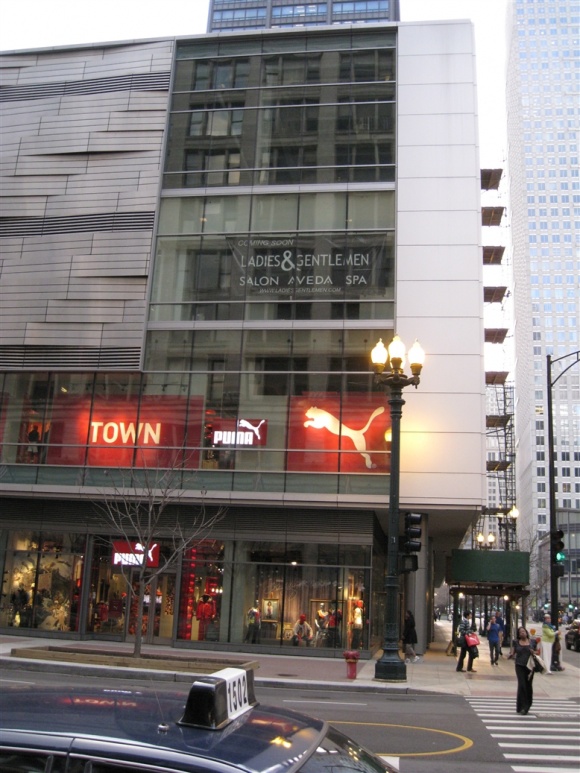
While development has slowed considerably in suburban Chicago, developers continue to move forward with 1.1 million square feet of new retail space in the City North submarket, according to CBRE. Joseph Freed & Associates, for example, is nearing completion on its Block 37 project, located at 108 N. State Street.
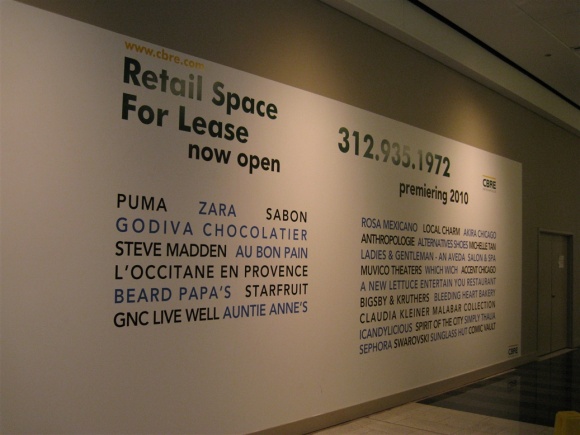
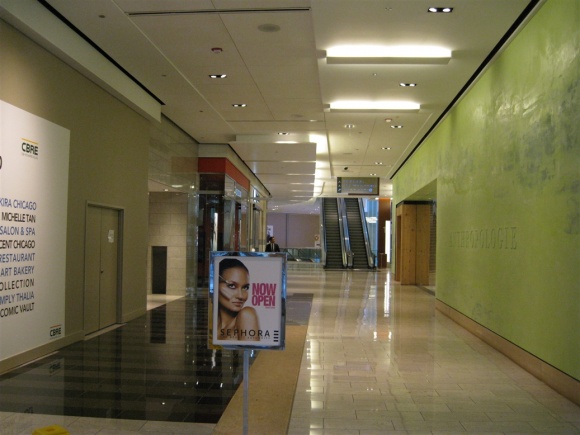
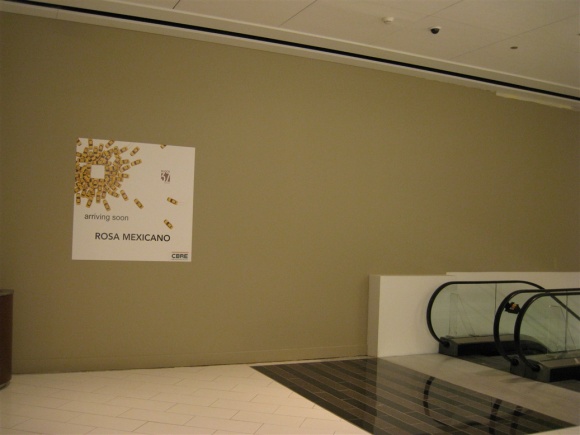
The mixed-use project, which features 280,000 square feet of retail space, is scheduled to open in November. Freed has inked leases with a number of retailers that prefer urban locales, Vance notes. Puma, for example, will debut a new format that will be the first U.S. store to carry its entire line of apparel, shoes and accessories. There, it will be joined by anthropologie, Zara, Aveda Salon & Spa, Rosa Mexicano restaurant, Bigsby & Kruthers and Swarovski.
Similarly, local developer Structured Development LLC continues to move forward with New City, a 1 million-square-foot project in the Clybourn Corridor that will include 400,000 square feet of street-front retail, a 196-unit luxury apartment tower and parking for 1,050 cars. The firm has already inked a lease with Milwaukee-based Roundy’s Inc. to anchor the project with an 80,000-square-foot European-style grocery store.
Jeff Berta, senior director of real estate development with Structured Development, says he is negotiating with two other retail anchors—one that is new to Chicago and one that is expanding within the city. With city approvals expected before the end of 2009, the firm plans to break ground on the project in mid-2010.
In the meantime, Structured Development continues to lease its recently completed project, Blackhawk on Halsted, a 225,000-square-foot mixed-use development. The retail portion of the project is anchored by outdoor retailer REI, which occupies 32,000 square feet.
Berta says the project has experienced a decline in leasing activity for its retail space, leaving about 49,000 square feet of retail space available. As a result, Structured Development has become a “bit more aggressive” with its rental rates to fill the remaining space.
“Ultimately, I believe the urban market is still strong in Chicago,” Berta says. “Even though retailers are focusing on fewer locations, there are still deals to be done in the city.”
Olympic Opportunity
Along with Rio de Janeiro, Tokyo, and Madrid, Chicago wants to host the 2016 Summer Olympics. The Windy City continues to refine its plan to host the Games, which would place the city on the world stage and welcome more than 200 nations.
The City of Chicago has hosted a number of festivals, celebrations, and events including two world’s fairs and the 1959 Pan Am Games. It also hosted the Democratic National Convention in 1968 and 1996.
Although Chicago 2016’s plan for the Games places the majority of the competition venues in the city’s parks, it also includes an Olympic Village that would cost about $1 billion to be built on the site of the old Michael Reese Hospital. The proposed site of the Village will become a mixed-income housing and retail community, with up to 30 percent affordable housing and will be developed regardless of whether Chicago hosts the Games, according to the Host City Committee.
According to a report commissioned by the Committee, the Olympic and Paralympic Games will generate $22.5 billion in economic development for Illinois over an 11-year period and create the equivalent of 315,000 full-time jobs for one year. More than half would be in Chicago and generate $7 billion in wages.
Chicago’s retail sector would likely benefit from the Games, expert say, but no one is sure to what degree.
Retailers that already have stores in the city will probably experience their best sales years, and the restaurant community will hit a “bonanza”, says Stan Bobowski, president of Bobowski & Associates Inc., Chicago-based retail brokerage firm.
However, Bobowski doubts the Olympics will compel many retailers to open stores in Chicago if they’ve never considered it before. “I just can’t see a lot of retailers signing multi-year leases just to take advantage of an event that lasts a few weeks,” he explains.
Shannon Hormanski, an associate director of Chicagoland Retail Services for Cushman & Wakefield of Illinois Inc., agrees: “I don’t think we’re going to have a huge surge in retail leasing or development just because of the Olympics—I don’t think there are Olympics chasers. But, the Olympics will push retailers that have been hemming and hawing about whether to open shop in Chicago to pull the trigger.”
“
I worked on Michigan Av. until this past January (and lived in Chicago till August), and am familiar with most of these places. Chicago Place has no stores-I recall seeing the Tall Girl signs, but the storefront looked empty. That whole space is badly executed, but it’s quite fascinating to ride down the normal elevator, just going through floor after floor of dark storefronts. (I should amend that-there is a Chicago souvenir shop and a watch shop in the food court, or there was last winter).
The Mart is basically restaurants and a few shops-there’s a B. Dalton-type of bookshop/magazine stand, and a couple of utility type of places. Unless you count things like the Kohler showroom as a store. It’s an attractive space, though-I used to ride the Brown Line down from the north side and stop at the Mart because I could run in and get a drink. It’s a good thing I don’t work there-the food court is awesome, I’d gain a ton of weight!
I agree with the others. This was a great post! I enjoyed all the malls being on one page. Especially an article about the great City of Chicago. Urban malls are often overlooked… or uninteresting from a suburban standpoint. Glad to see them get the recognition they deserve. Chicago in 2016!
Scott
@BIGMallRat, Your so right Scott, I couldn’t say it better. The best part is that most of them can be reached on foot or in the worst case by using public transit. Better yet get a Chicago Card & hit as many of the areas malls as possible just for the heck of it.
Excellent post guys. I haven’t been back to Chicago since I left in 98 except for a quick visit in 06 and these malls brought back tons of memories. Chicago is where I was born and lived for 29 years and it will always have a special place in my heart.
Wow, great job on this pack of posts. Before Coddingtown and this, Massachusetts and New York had the most malls on Labelscar, followed by New Jersey and Texas (tying), then California. Now Illinois has clenched a solid second place (well, technically third, since New York and Massachusetts are tied for first). It’s a three-way tie for New Jersey, Texas, and California, which is weird, because as of late (basically this year and last), California and Texas have gotten out of the less-than-half-a-dozen slums and are solid contenders, but NJ, which was making good progress, dropped out of the race, basically.
Me? I’m rooting for Texas.
@Jonah Norason (Pseudo3D), of course you realize some of this was because I moved from Boston to San Francisco 🙂
We both have lots of content from all over the country, and somewhat intentionally stagger it geographically to keep from dwelling on one place.
@Caldor, I know. But as far as I know, Prange still lives in the Wisconsin area, and there hasn’t been much new content from that recently (except, of course, this post). If you ever go down to Houston, there’s a number of malls you can get a good circuit by going north on I-45, then west SH-30, then north SH-6, west US-190, and north I-35 to Dallas. This puts a cool number of malls within reach (from south to north: Greenspoint Mall, The Woodlands Mall, West Hills Mall, Post Oak Mall, Temple Mall, Richland Mall). Or stay in Houston and check out the local specimens.
I was wondering when Labelscar would get around to the urban malls in Chicago. I’ve worked in downtown Chicago for 11 years. My office is actually in the 900 North Michigan Avenue building which houses Chicago’s priciest vertical mall shops- Gucci, Michael Kors, Mont Blanc, Monaco, Mark Shale, Williams Sonoma, etc.- anchored by the Bloomingdale’s store. Also in 900 North Michigan are floors of offices, floors of condominiums and the Four Seasons Hotel.
Even in the best of times, the 900 North Michigan mall always seemed, to me, to be unusually devoid of shoppers. Clearly, the stores in 900 North Michigan haven’t depended on volume for survival- just very pricey goods.
Admittedly, I don’t hang around 900 North Michigan on the weekends [commuting to the City each weekday leaves me with little desire to go to the City on weekends]- so, perhaps the weekend crowds are more impressive.
With the current recession, 900 North Michigan has become even quieter. Lots of empty stores. The mall management even has a woman whose primary job is to dress-up the vacant store windows so that they do not seem so- well, vacant. Her efforts are working- 900 North Michigan hands down has the nicest vacant storefronts in the City.
There is also a lot of store movement within the 900 North Michigan mall. By “store movement”, I mean that many of the still open stores have relocated within the mall in order to get more strategic locations. By strategic locations, I mean street-front on Michigan or the lower floors within the mall.
The upper floors in the 900 North Michigan Mall are mighty cold and empty these days – the vacant store window decorator has been very busy in the upper levels.
Why the decline of the vertical malls? The loss of discretionary income as a result of this current recession, coupled with Cook County’s confiscatory sales tax [10.25%, the highest in the country] clearly are having an impact. Sales tax rates in the suburban counties around Chicago are much lower.
Still, I wonder if something else is contributing to the decline of the vertical malls. For example, the Chicago Place vertical mall a couple of blocks south from 900 North Michigan began its fast decline well before this current recession began [currently, it is basically empty]. Do people, even with fat pocketbooks and job security, really have the time and interest to wander around 8 floors of vertical mall? How much “consuming” can a body take? Sure, the newest of the vertical malls, North Bridge, seems to be holding its own, but it’s still relatively shiny and new. May be we are just over-retailed, period.
@James-I think vertical malls are are generally going to be less successful than more traditional mall layouts, or lifestyle centers, because they’re difficult to shop. There’s usually only two ways to get from floor to floor, and they’re usually crowded. Once you’ve seen the few stores on one level, you have to stand in line to move.
I did some of my Christmas shopping at Water Tower-I literally had to go to two stores-and the crowds were so awful that it took over an hour to fight my way up the escalators. Heck even midweek over the spring and summer it was awkward to traverse levels (I was doing a lot of job hunting this spring, so I was in all of the malls downtown regularly). I can see why many wouldn’t want to shop there, at least not often.
There is a Neiman-Marcus at 737 N Michigan, I don’t believe it is connected to any of the malls. With the new Best Buy, the Hancock Center seems to be turning its lower levels into a retail hub. The River North area was still filled with shoppers despite the bad economy and Chicago high tax rate
The Magnificent Mile is still filed with shoppers. The Michigan Avenue sidewalks are crowded with folks, even with this recession. It is the most impressive shopping street in the Midwest.
So, the street is crowded. But are they crowds buying anything? Judging from the few who manage to make it beyond the street-front retail at 900 North Michigan, and the empty shell of Chicago Place, no. With the stock market crash of 08 and early 09, even the wealthy have been impacted by this recession. The stock market has picked-up greatly in the last few months, but few are feeling confident.
I will say it is nice to wander into Bloomingdale’s at 900 North and have the store help fawn over me. At last! A customer!
@Doug, I agree that vertical malls can be difficult to shop. The designers of the vertical malls would do well to design the malls so as to make movement within the malls easier.
You mention Water Tower Place. I find the escalators at Water Tower confusing. The food court is located on a mezzanine level which is sort of half-way between two shopping levels. If you get on the wrong escalator, you’ll miss it altogether. Granted, you can do some back-tracking to get to the mezzanine level, but should it be that difficult?
Chicago Place also had design issues. The food court, when the mall was a going concern, was on the 8th floor. The high floor made sense, since it took advantage of city views. But, only one elevator in the building would take shoppers directly from the first floor to the 8th floor. That one elevator would be overly crowded at the noon hour.
The biggest design issue with the vertical malls, in my opinion, is that the stores on the upper floors require a bit of effort for shoppers to seek and find them. This is fine if you are a lady (or gentleman) of leisure, with time to wander the mall. But not so fine for the office worker on his or her lunch hour, or the harried mom toting along kids and grandma.
The biggest anchor in Chicago Place (but for Saks) was Room and Board Furniture. They were hidden away on three of the upper floors. Eventually, Room and Board got wise and moved to a street-front location around the corner on Ohio Street where it appears to be thriving.
More on vertical mall design, and more on 900 North Michigan:
While the Labelscar anchors are correct that 900 North Michigan is better designed in terms of no zig-zagging (Chicago Place) and no confusing mezzanine level (Water Tower Place), the planners of the retail space within 900 North Michigan made a significant error. As we all know, Christmas is the peak retail season. Retail sales at Christmas can make or break a mall. Appropriately, then, the Urban Retail people at 900 North Michigan put up a magnificent Christmas tree each Christmas season in the atrium area of the mall- many stories high, and beatifully adorned with large ornaments. The problem? This beautiful soaring tree cannot be seen from Michigan Avenue. One must enter the mall from Michigan, walk past the street-front stores, the coffee/sandwich stand and sets of escalators in order to get into the atrium area and actually see this tree. This tree could not be placed up front because of the mall’s design, with pedestrian bridges and shops on the Michigan Avenue side, rather than the atrium. Imagine if this soaring tree was up-front, lit-up and easily viewed from Michigan Avenue. It would lure the shoppers into the mall like a magnet. As it is, the casual shopper on the Michigan Avenue sidewalk, if unfamiliar with 900 North Michigan, has no idea that such a tree exists.
@James, I figure if you are a tourist visiting Chicago for the first time, you would naturally walk along Michigan Av as you would go to Times Square while in New York. Now if it is around christmas there’s a greater chance you will end up visiting all of the malls if for no better reason then just getting out of the cold.
In New York these types of malls were built just south of Macy’s & both of them ended up being reconfiggured. Harrald Center an anchorless 8-story mall is now a handful of big box clothing stores & Manhattan Mall another 9-story center formerly anchored by A & S, then Sterns & now J C Penny. Over time the mall shrank down to 4 levels & the rest of the building has become offices. Manhattan Mall was a rehab of the Gimble’s flagship store. the location sits above the PATH 33rd Street station & the Harrald Square subway station making access extremely easy.
Also the “bulk post” has inspired me to make a Memorial City Mall/Town & Country Mall post. The problem is my MCM pictures are insufficient (they only have an exterior, the Target wing, and the food court) and I have no T&C Mall pictures (or even the nifty outdoor development that replaced it).
Actually, I need to take a trip down to Houston with my driver’s license from College Station and hit up a few malls.
-Chicago Place failed, in part, because it opened in a recession; it never was able to get the momentum. Part of the “bad design” you see there now is a lack of lighting for stores that aren’t there. It’s worthwhile to look at the finishes they used; you see lots of intricate stencil work, faux finishes, that sort of thing. Really expensive marble floors in the lobby. It was very carefully designed by Skidmore, Owings, and Merrill to recall Chicago’s architectural history. There’s more going on there design wise than you might notice, especially with the murals by the entrance and in the food court. Also notable is that the basement level of Chicago Place had a popular Bockwinkel’s grocery for a long time.
-River East’s history is worth researching. It’s all an arts center now with a couple of anchors, but its previous incarnation was North Pier, a “three-level, 200,000-square-foot retail mall containing a central rotunda, six atriums and glass-sided galleries overlooking Ogden Slip”. and a fascinating adaptive reuse by Booth/Hansen. It had high hopes pinned to it when it opened in 1988 for revitalizing the area, before Navy Pier was redone. It was essentially an entertainment mall on the Fanueil Hall festival marketplace model. Some of the stores were a candy store, a County Seat, a sports memorabilia store, fine art store, replica jewelry store, nautical gift store, a flag-themed store, Turin Bicycles, Cashmere, make your own videos, cowboy accessories, an outdoor ice rink, a CTA souvenir shop, a hologram gallery, a Children’s museum, mini-golf, a maritime museum, a virtual reality center, and a Schwinn museum. It was well-known for being about 40% restaurants and nightclubs, many of which overlooked the Ogden Slip on terraces, such as Baja Beach Club, Baja Live (dueling pianos), and Baja Grill, Dick’s Last Resort, Fresco’s Italian, The Boat Club, Old Carolina Crab House, and a food court. By 1997 Navy Pier was built, the parking prices skyrocketed, and the mall began being sectioned off for larger tenants; the rest of the River East project was delayed, so the mall closed up instead of converting to national retailers, got more upscale finishes, and became the River East Arts Center it is now.
Chicago Holds Up In Tough Market
Brokers, developers give a snapshot of activity in the area, while looking at nationwide trends.
Roundtable moderated by Jerrold France and Randall Shearin
Shopping Center Business recently held a Chicago Retail Roundtable, hosted by law firm Levenfeld Pearlstein LLC at its offices on LaSalle Street. Despite a lackluster year for retail, turnout at the roundtable was robust and the discussion was again lively, offering a snapshot of activity within the market, as well as a view of general industry trends. In attendance this year were: Adam Secher, Baum Realty Group; Peter Eisenberg, Clark Street Development; Peter Caruso, Intercontinental Real Estate & Development; Lew Kornberg, Jones Lang LaSalle; Marlon Stone, Katz & Associates; Richard Kahan, KB Real Estate; Marc Joseph, Brian Kozminski and Keith Ross, Levenfeld Pearlstein; John May, May Center Advisors; Terry McCollom, McCollom Realty, Ltd.; Ben Wineman, Mid-America Asset Management; Jim Schutter, Newmark Knight Frank; Robert Rowe, Sierra Realty Advisors; Marc Siegel, SJS Realty Services; Ryan Murphy; SRS Real Estate Partners; Tim Thanasouras, Thanasouras Commercial Properties; Aaron Gadiel and Jonathan Payne, The Jaffe Companies; James Turner, The PrivateBank; Sy Taxman, The Taxman Corporation; Richard Dube, Tri-Land Properties; Glen Todd, U.S. Cellular; and Camille Julmy, U.S. Equities.
SCB: How are retailers viewing the Chicago market as a whole?
Murphy: As retail brokers, are still busy. We have a pool of tenants that are active. The large box tenants — JC Penney, Lowe’s and the like — have slowed down. They are still looking but they are not as active as they were. Discount Tire, Famous Dave’s and Tilted Kilt are expanding. We are looking in multiple markets for them. Verizon is looking at some deals, as is Genghis Grill.
Stone: The economic reset has influenced site selection from the standpoint of asset class, gross occupancy and opportunity. There is no new development. Therefore, the older shopping center once bypassed has become relevant again. At the same time, our long overbuilt industry is now feeling the impact of fewer retail concepts to absorb a substantial inventory of space, and as a result, the supply-demand curve has shifted, and rents have compressed. Having a tenant who can take existing space is driving the business today. A retailer may very well secure a rare first tier location where high occupancy had prevented them in the past.
Lew Kornberg
Kornberg: Everyone is looking for things to turn to the positive. The discounters are in pretty good shape these days. Everyone else has hunkered down and is looking for more tangible signs of recovery before they are willing to emerge from the bunker and start doing deals aggressively again.
SCB: How is Chicago faring versus other national markets? Is it doing better or worse?
Kornberg: Historically, Chicago has fared better, and it continues to do so during these times. Chicago is healthier than most of the markets I’ve been to.
Stone: I’ve always described Chicago as the ‘anchor’ of the Midwest. We have an MSA approaching 10 million with significant growth projected. The economy remains diverse with employment generators that keep the city and suburban areas vibrant. The retailer understands the purchasing power of this marketplace and while store openings may be limited, temporarily, Chicago will always be on the radar for those companies seeking market share within the Midwestern United States.
SCB: You represent a lot of retailers, and you are national in scope. What is the feedback you are getting from your other offices regarding their markets?
Stone: In my estimation, until we see the condition of the American consumer improve, our industry will remain sluggish. The needs based retailers, such as Dollar General, are experiencing robust growth as customer’s trade down to save money. Generally speaking though, people are not spending and retail companies are reporting comp store decreases. It becomes increasingly difficult for a CFO to throw capital at store growth when the existing network of stores loses money.
SCB: Are the tenants looking more at urban areas?
Stone: There has been more focus on the urban trade areas throughout the country — and in Chicago — versus the greenfield, high growth suburban areas. Most of the greenfield areas were built and sold to retail companies on high growth. That growth has been curtailed. You don’t get a full bang for your buck in those areas. The areas that have sustained themselves over the years have density.
SCB: When you have a city like Chicago, are the neighborhoods still of interest to retailers?
Stone: I think so. If you go back to when residential was built on top of retail in the 1920s, ‘30s and ‘40s, you saw that come back into vogue in the past 10 years. It didn’t have to be regional per se, or down the street from a regional mall. If you have something that’s convenient for people and that fits into how they run the rest of their lives, you’ll be able to find a market for tenants. There is a niche in the neighborhoods for everyday needs retailers.
Kornberg: Many retailers, out of necessity, are being forced to go to landlords and ask for rent relief. A lot of landlords aren’t able to provide that relief because of restrictions — whether its loan covenants or something else. There are virtually no retailers in today’s market that aren’t being opportunistic to their leasehold agreements and looking for relief. If they are successful in 25 or 40 percent of leases, that’s a pretty good hit rate.
SCB: We’ve heard that a lot of retailers who are getting relief are causing their co-tenants — who are doing well — to ask for relief. Some think that because one gets it, everyone is entitled to it. Have you found that to be true?
Sy Taxman
Taxman: Unless a tenant has been with us a number of years and unless they can provide us financials, they won’t get it. On the other hand, if we are dealing with a local tenant that has been with us for a number of years, rent relief is granted almost automatically. We talk about this in theory. The problem is that those of us who actually own these properties know that these leases have been assigned as additional collateral to the lenders. Modifications of leases are not just a matter of calling your landlord. This is a process. There are many situations where the mortgages have been sold and you have no one to talk to about lease modification. Even though you may want to grant a modification to the tenant, technically, you’d be under default in your mortgage. It is a complex issue. As a general rule, we as a company will provide relief for local tenants if we know the tenants, if they’ve been with us for a number of years, if they are not in default and if they come to us before they are in significant trouble. If they default on their lease, don’t pay their rent and then want modifications, we won’t even talk about it. Our occupancy rate in the properties we own is just under 94 percent. That requires a lot of hands on work.
SCB: On the legal side, are you seeing issues like this from your clients?
(Left to right) Aaron Gadiel, Jonathan Payne, Marc Joseph, Glen Todd and Terry McCollom
Joseph: We are not seeing as much leasing work. We are seeing some restructuring work, and some times we see some concessions in leases while we are restructuring the rents. We have a deal now where the landlord client has a number of locations with a particular tenant and we are talking about restructuring all the leases [for that tenant]. Some of these will be terminations, some will be new leases and there will be some rent concessions and termination of option rights. Landlords are bending a little bit right now, but they also want to get something out of it. They want to help their stability and extend the lease terms to get something in return.
SCB: Are you seeing activity in the Chicago area improve?
Schutter: I have been leasing for a long time. At Newmark Knight Frank, we have over 40 projects — over 5 million square feet of retail — that we’ve picked up of third party leasing. From October to May was probably the deadest I’ve seen in my 20 years in the business. In the last 4 or 5 months, we’ve seen activity and we’re getting leases done. We’re sitting on 10 letters of intent that we’re negotiating right now. The activity is very much discount oriented. Location-location-location is still the bottom line. We had a high profile Michigan Avenue corner where we had three national tenants as back-ups. We completed a deal on the space. We have several great downtown listings and some suburban land.
(Left to right) Brian Kozminski and Adam Secher
Secher: In some of the outlying secondary and tertiary markets, there is certainly a lot of inventory. In some of the prime urban markets, whether that’s downtown Chicago or some of the regional markets like Old Orchard, Naperville and Schaumburg, there is still demand for space. Some of the deals that we are seeing are placeholders. We are not seeing any big, long term leases at market rates. We are seeing tenants take advantage of market conditions or signing short term leases with options so they can get in the market and test the waters. Landlords would rather have someone occupying the space, even if it is at a discounted rent.
SCB: Are there areas of the city where retailers are taking advantage of the lower rent rates and higher vacancy? Maybe somewhere that they wouldn’t have been able to go 3 years ago, but now they can afford to look?
Secher: There are certainly some active tenants. Some of the restaurants, specifically the quick casual restaurants like Chipotle, are looking at targeted markets and deciding now is the time to act.
(Left to right) Marlon Stone, Peter Eisenberg and Ben Wineman
Eisenberg: Aldi is also going crazy right now. Landlords who would not have considered Aldi are looking hard. Aldi has strong credit as well. Needs-based retailers are doing well. Jewel has also opened some new stores, like at 119th and Marshfield, and it is redeveloping a store near Southport and Addison.
Kahan: The stores who are expanding are being very selective. The locals, surprisingly enough, are strong; they have a lot of cash. There are a lot of independent grocers expanding. If you have a business that is not reliant on a bank, you can expand. Landlords are financing some retailers. It is a result of the economy. We are digging deeper into our pockets and we’re doing things we wouldn’t normally do. Some of our banks are going along with us. It requires more cash going into a deal than anyone wanted to put in. It is a reality we are going to have to deal with for a year or two. Expansion is going to be a joint venture between the retailer and developer.
Gadiel: Because of the national retailers’ shutdown, the local tenants have now had the opportunity to get into projects that they wouldn’t have been able to enter in previous years. In our case, we made a conscious decision to go after the local tenants.
SCB: Do local tenants have the financial staying power?
Gadiel: We will see. There are a lot of good local tenants that can operate a business as well, if not better, than some national tenants. They may not have the same credit rating. Right now, you have to think out of the box. You have to take a risk. We do our due diligence and we look at how long they’ve been in business and what their management is and who is behind them. We have a strong group of local tenants.
SCB: A lot of owners are riding with mom-and-pop tenants during this time. They feel it is better to have them underperforming than have a dark store.
Schutter: We represent a high profile center in Bloomington, Illinois, anchored by Jewel and Best Buy. We are out to lease with a 1,200-square-foot monument store. This is normally not a tenant you would look for in a strip center, but they have been in business for 65 years and they have three other locations. They are a long-term player.
McCollom: I had a 1,000-square-foot vacancy and a politician came to me about it. I’m getting low rent, but he is going to pay the electricity and gas through the winter.
SCB: Rob [Rowe], you are working with one of the biggest needs-based retailers who is making a push into Chicago.
Rowe: CVS is making a push here. Right now, CVS has targeted corners that we’re going after. We are about to close on one [site] that CVS has been looking at for 10 years. They are realizing that some of the locations are chances of a lifetime. CVS is trying to make deals. They scrutinize things a lot. They are one of the best credit tenants out there who’s making deals now. They try to buy more than do ground leases as they did in the past. That change was driven by the change in the net-lease sales market. To keep the coffers filled, they would rather do purchases today. The main targets are the urban areas; the dense areas where the people are. We have a site in Bucktown we never would have gotten before. There would have been five banks going for these corners before. They are out of the market. We are doing deals in the sticks, and we are land banking because we’re buying at a discount. Another client who is very active is Export Fitness. They have a new model they call their Express model. This is 10,000 to 12,000 square feet. We’re going into some of the areas where the population isn’t enough to do a 45,000-square-foot club. They payback is quick because they don’t have to put as much money and the landlord contributes. They are inexpensive entertainment. It is a bar without booze. They are taking a lot of box space. The biggest challenge I have today is co-tenancy. Some retailers are restricting health clubs.
Sy Taxman and Richard Kahan
Kahan: Using the health club as an example, there are very few businesses that are bringing the same customer back to the same location two to five times a week. They are also active early morning to late at night.
Todd: Parking is one of the most sensitive issues to a retailer’s business. We have centers that we are going to leave because the owner doesn’t have enough parking. If you are an older center with a huge parking field, that is great. But newer centers have the smallest parking lot they can. That will put you out of business faster than anything else. We have walked away from a lot of deals that we wanted to make because we were afraid the parking would kill us. It is a problem we can’t fix once we are in place.
SCB: As a retailer, how do you see the economic climate in general?
Todd: I’ll give you the corporate perspective. Perception is a huge thing right now. I have a lot more people touching our deals. The perception is that we are going to get rent reductions on every new and renewal deal we make right now. I have someone a few levels above me measuring my ability to make lower rent deals today than I made a few years ago. That’s part of our approval process. You’ll see deals are getting slower because everyone is being more cautious about the decisions that we’re making. I am doing renewals where I can’t get a rent reduction, but instead of taking a 5-year option I will take 3 years. A friend of mine also works for a publicly traded retailer. It was recently publicized that they had over 500 stores in the chain where half the stores have leases that are expiring in less than a year. I called him and asked him how he could possibly manage this. He said it wasn’t accurate; that they had a lot of kick-outs in the deals and they never give the leases up. He would just call the landlord and modify the leases. Half of his chain can say goodbye to anything at anytime. It is a priority of their concept — no lease liability.
SCB: As a retailer, do you see any issues with landlords?
Todd: I can’t tell you how many landlords I’ve seen where, when they lose a tenant or two, they can’t maintain the center anymore. We were in 10 properties owned by a TIC manager that went bankrupt. When the parking lot lights don’t go on anymore or the water doesn’t work, our salespeople call us. These issues accumulate so it becomes a topic.
SCB: As a retailer, do you see the glass as half full?
Todd: Absolutely. We are actually up this year a little bit. We have some markets that are not so good, but we have others that are well. We are still postured to look at opportunities that we can take advantage of right now.
John May
SCB: John [May], how are buyers looking at the retailers in the properties that you are selling?
May: Buyers are looking at [retailers’] credit, but they are also looking at rent levels. Whether it is a small center or large center, it doesn’t matter. The people at this table that did such a good job negotiating those $35 to $50 per square foot small shop rents; the investors are marking those down, even if the tenant is in there doing well. If you look at the junior box anchors, those rents were approaching $18 per square foot a few years ago. The most recent deals are being done in the single digits with big landlord contributions. As investors look at these assets, they are not accepting the rent roll as something they can count on for the next 10 years. They are looking at every parameter in the rent roll. The second item they are looking at is the capital stack. The retailers drive the financial side, but now we are going to see the financial side drive the retail side. Grocery-anchored centers were trading at low 6 cap rates 3 years ago. Now, they are at 10 cap rates. We just did the largest transaction in the Midwest, and we were right at a 10. This was a 6 cap asset in years past. Also, the financing world has changed. You can’t get 80 percent interest-only financing or non-recourse financing unless you are coming with a very high equity stake.
SCB: James [Turner], what are the equity requirements today?
Turner: I’m hearing a lot of things that are affecting the rates. If you want me to be at an 80 percent LTV [loan-to-value] ratio, I’m fine: let me trend down your pro-forma rents by 30 percent per year and then apply a 10 cap. You’ll get 80 percent on that value.
Taxman: I’ve closed a loan in the last 90 days. You have to have cash. If you want to be in this business going forward as a ground up developer you better have cash. When you talk about a 70 percent loan, 30 percent of the project costs are being contributed by the developer as cash, not as attributed value. What’s happening in the financial world may be a benefit to all of us. We have to eat up a significant amount of excess inventory that’s out there. In order to do that we need to have less development going forward. The concept of having to be in business with cash is not unique. When I went to buy the only home that I have ever lived in for $30,000, I went to a savings and loan, where a friend of mine’s father was the owner. I asked him for a loan for $25,000. He told me he would loan me $24,000. I told him I didn’t have the $1,000 difference. He said, ‘That’s not my problem. Go find the money and we’ll give you 80 percent and you put up 20 percent in cash.’ These rules are not new. We need to get some stability back into the market. I don’t think we will see a recovery in retail until we see a significant recovery in employment. We also need to get the banks on board. The last time I went to see the doctor for a physical, I didn’t have to hear about his problems. I thought the doctor was concerned about my problems. I don’t want to hear the bank’s problems when I go in for help.
Payne: We keep using the term ‘think outside the box.’ What we are really saying is that we were so far from the fundamentals of retail that today, thinking outside the box is returning to the fundamentals of retail. Ultimately, we are going to return there because, at the end of the day, to get the financing I will have to require retailers to sign a permanent lease, not something with a 1-year kickout or at 30 percent below market rate. What we are seeing is a return to the fundamentals of retail. That is exactly what the Export Fitness Express concept is — driving traffic and generating sales. We build shopping centers: what else is more fundamental to a center than having traffic and generating sales?
McCollom: We always put cash into our deals. If you don’t have your sweat and blood in the deal, what are you doing? It is that simple in my opinion. I am doing some due diligence for a bank right now. I do a lot of rural real estate. I am examining a group of dollar stores for them. The properties are in horrible condition. If you don’t have a landlord taking care of these properties, what is the broker and the retailer getting themselves into? Brokers have to make sure they are talking to good landlords. We are a small company. It is interesting how we have survived with the big guys [as competitors]. We have always kept to the basics and we’re still sitting here. I am the president of the Chicago Association of Shopping Center Owners (CASCO). We have 35 members, all owners of centers in the Chicago area. We’ve only lost one member recently, and we’ve added two new members. That says something about where our industry is.
(Left to right) Marc Siegel, Ryan Murphy, Robert Rowe and Richard Dube
Dube: I want to compliment James [Turner]. He is the only banker here. We have taken advantage of the tax increment financing programs available in the different areas where we are active. With regard to CMBS and the financing system, you must have some insight on how much capacity is in the system?
Turner: The banks have been spending the past 10 years figuring out how not to use the balance sheet [to lend]. That led to the creation of the CMBS market and collateralized debt obligations. The banks didn’t do long term mortgages; all of that paper was being pushed off. Now, to change the mentality of the banking system to utilize the balance sheet heavily in this economic environment — I don’t think it’s going to happen. The banks will not be there to replace the CMBS markets when those maturities come.
Julmy: That’s the perfect storm.
Turner: There has to be some answer created for the CMBS program, and it will come out of people in this room. There are smart individuals who still understand that there are values in these properties.
SCB: As a bank, what do you see in the future?
(Left to right) Camille Julmy, Peter Caruso, Jim Schutter, Tim Thanasouras, James Turner and Keith Ross
Turner: The big question is: when are people going to start shopping again? When retailers can expand again and can pay a market rate that makes sense and pays for the land, construction and gives a fair return to the owner. Once that all happens, banks will be right back in there. Until it happens, we are shooting in the dark.
Julmy: The capital system, as we knew it, died about a year ago. Who would have done a project with 30 to 50 percent of equity then? Now, we have an added problem of the rents going down, or the perception that rents will go down. We received our loan for MetraMarket on August 27, 2008, and, frankly speaking, if we had waited 2 weeks, we would have said forget it. We would not have put 50 percent equity in that deal. It’s not a large project. It’s 100,000 square feet that makes sense.
Schutter: It is a difficult environment. If you work hard, there are opportunities. It is about positioning yourself to take advantage of the opportunities. We are finding what is unique about every project and capitalizing on that unique opportunity.
SCB: How is Michigan Avenue faring in this economic climate?
Julmy: Michigan Avenue is still one of the great avenues of the world. It is going through a tough time. The sales are down anywhere from 10 to 30 percent or more. The retailers aren’t happy, but the avenue is crowded. People are not spending. Hopefully that will change when employment picks up. The occupancy is still high.
SCB: Tim [Thanasouras], you’ve started a new company during this time. How have you weathered the storm?
Thanasouras: I looked at the facts and the fundamentals of our business. The industry has been operating with a dual income [household] economy for a long time. For a lot of families, the primary income is gone. When I meet with my clients, I tell them the fundamental thing we must do is keep the lights on in the stores. Having dark tenants doesn’t help the tenants next to them. A full center is better than a vacant center. This economy will also wash out a lot of competitors. I went to a party a few years ago and someone asked me what I did. I told them I was in commercial real estate. The attorney that I was talking to also mentioned he owned some shopping centers. A restaurateur also said he owned some buildings. I think now people like that have been burned and they don’t want to be in the industry anymore. Those were the people who went to the bank for cheap money without knowing the fundamentals of the industry. They will be gone sooner or later.
Taxman: We also need the washout to happen in the product. After the Savings and Loan crisis, we had the creation of the Resolution Trust Corporation, a clearinghouse for excess properties. We are going to need that again.
@SEAN, thanks for the excerpt from the recent Chicago Retail Roundtable. Ms. Julmy’s comment on Michigan Avenue caught my eye: “The retailers aren’t happy, but the avenue is crowded. People are not spending.” How true! I work on Michigan Avenue and, based on the crowds on the street, all looks well. But, the scenes within the various vertical malls and individual retailers are much different. “Masoleum” is a word that comes to mind, particularly away from the street on the upper levels of the vertical malls.
@BWChicago, your point regarding the design of Chicago Place is well taken. Aesthetically, I do agree that the mall was attractive. SOW is no slacker, design-wise.
The real issue was the configuration of the mall, rather than the design aesthetics: food court all the way at the top, with only one express elevator, at rear of mall; big anchors like Room & Board buried in the upper floors. Also, Chicago Place has a very large revolving door which seems to intimidate a lot of tourists and other first time visitors to the mall, much to the amusement of passersby. One has to move with the door, rather than move the door. Of course the door is easily figured out, but should one’s first time visit to a mall be frustrated by having to figure out a revolving door?
If a vertical mall is to succeed, then it seems there must be something to lure the shoppers off the street and into the mall and its upper stories (in additon to easy ingress!). Chicago Place just didn’t have that something, not even the easy ingress…
@James, You got it. As soon as I saw this I tried to post it, but it took five atemps.
Let me cut through all the spin. Retail in the suburbs for the most part is on life support & what growth there is, is taking place in urbanized areas as cities get rediscovered. You can also add suburban cities that have vibrent downtowns with activity at all times of the day.
@SEAN, the suburban city with the most vibrant downtown, in my neck of the woods, is Naperville, some 25+ miles west of Chicago. In return for such vibrancy, the trade-off is that these suburban towns begin to seem more and more urban- with traffic tie-ups and parking garages. But what a downtown! Naperville is great. Especially for folks like me who live in smaller suburbs with sleepier downtowns. We get all of the shopping and entertainment options of a vibrant downtown in Naperville, without the hassle of having to go to downtown Chicago. And, then, after we’ve “done the town” in Naperville, we go home to our smaller, sleepier suburb just a couple of towns away.
@James, Click on my name above any post.
White Plains NY has been in growth mode for close to a decade untill the ressession hit. Has naperville been adding housing units to it’s downtown core? Also does the CTA or it’s sister agencies Pace or Metra serve the city with frequent service? I hope so, it will keep the traffic levels down plus garage parking keeps cars out of site while keeping streets active with people throughout the day & night.
Naperville is served by Metra, although the main station is several blocks north of the downtown section. There is Pace service, too, but it is likely under-utilized. Pace is definitely under-utilized where I live, a couple of towns to the north and east of Naperville, in Glen Ellyn. I honestly think most people access downtown Naperville by car.
The thing about suburban Chicago is that it has excellent mass transit to and from downtown Chicago. But, using mass transit, such as Pace, between suburbs, just doesn’t occur to most people (including me).
Naperville, like nearly all of the towns along the train lines in suburban Chicago, has been adding housing units to its core area, frequently with retail spaces on the street level. That activity, I believe, has slowed in the current recession. The center-piece of Glen Ellyn’s new downtown development plan (yet to be officially adopted by the Village Board) is the addition of a lot of downtown housing. Implementing that aspect of the plan may be frustrated by the current economic climate.
@James, Over time those housing units will be filled do to the fact that preferences are changing. Downtown living with frequent transit & local shopping is in, meanwhile suburban sprawl is slowly falling out of favor with worsening traffic condissions.
These towns know this, but the question is how quickly can these communities react to sed market prefferences.
@SEAN, when the housing industry recovers from this current recession, I agree that condo and similar denser types of housing developments near the downtowns of our suburban cities will take off. And that will be a good thing.
However, I also believe the kind of suburban sprawl that we saw pre-recession will resume when the economy recovers, but not at nearly the same rate. There are just too many costs associated with sprawl- in terms of time, fuel, and wear and tear on cars and roads, etc. So, let’s hope one positive aspect of the recession is that suburban sprawl will be permanently slowed down, even if not stopped altogether.
@James, You are almost there with one minor detail. do to the ecconomic downturn housing prices fell the sharpest the further away you went from a cities core. In those areas the population is starting to move back toward the cities. As the population ages independence for our seniors is key & these new housing developments are a primary reason there popularity has been increasing. If there is a mall & other retail projects nearby or within bus distence, a towns vibrency also increases. This also applies to younger ages as well by allowing everybody to be able to travel without. car dependence.
@SEAN, true enough. The older set by and large won’t want the tract house McMansion but instead will opt for the convenience of a condo or townhouse within walking distance or a short drive to retail areas.
But, the suburban fringe could continue to be attractive to younger people with families because housing is cheaper in the outskirts, especially when measured by square footage. You and I and the urban planners recognize that the suburban fringe is not so affordable when the time and expense of a long commute and long drive times to basic conveniences are considered, but others may be blinded by the shiny promise of lots of square footage in a brand new package.
@James, Well said. I’m glad that someone gets it.
Lets go another step. What about the areas around Old Orchard, Oakbrook, Northbrook Court & Hawthorn Center. Do any of those malls have neighborhoods ripe for dencer redevelopment? I intentionally left off Woodfield do to the existing development around I-290 & Woodfield Road.
FYI check out the Victoria Transport policy Institute at vtpi.org That is where I did a lot of my research. The information is quite valuable.
@SEAN, http://www.vtpi.org is the adress.
Sean, of the suburban Chicago shopping centers that you list, I am most familiar with Oakbrook. There is definitely potential for denser development around Oakbrook. It may take some tearing down of existing housing in nearby Oakbrook Terrace,but the potential is there. However, Oakbrook will need some improvements before it can be truly be a walkable destination from nearby neighborhoods. Sidewalks along the major streets are needed, as well as some kind of pedestrian promenade through the parking areas and ring road so that walkers can navigate their way across the asphalt in relative safety.
Once within the open air Oakbrook mall areas, Oakbrook is very pedestrian friendly. But, the neighborhood surrounding Oakbrook is not pedestrian friendly.
West of Oakbrook on 22nd Street is Yorktown Mall. Yorktown is a more traditional shopping venue for suburban Chicago (it’s enclosed) and like Oakbrook seems to be in relatively healthy economic footing, even with this recession. There has been a lot of mutli-family condo/townhouse development around Yorktown in the past 10 to 15 years, and (unlike Oakbrook) this denser type of housing is within easy walking distance of the shopping center. While there are acres of asphalt surrounding Yorktown, there are condos abutting the mall property, unlike Oakbrook. To the north of Yorktown, there are a lot of ranch-tpe homes on large lots- I could see that area being redeveloped with denser housing.
@SEAN,
Teardowns have been a major problem in the Chicago burbs. Perfectly good pre-WWII houses get razed for McMansions. Naperville, Hinsdale and Downers Grove seem to be hardest hit by this problem. Ripping out older homes for cookie-cutters is no way to build a sense of community.
@Chip, You misunderstand. I don’t want that kind of development. I’m talking about padestrian friendly development that is walkable & is transit accessable. Reusing existing blocks & lots to provide new housing & or retail in downtown areas where transit already opperates.
Many mall parking lots could be redeveloped in the same manor. It just takes some out of the box ideas.
When you think about it, communities are desperite for new sources of tax revenues. What a way to achieve such a goal & stop the sprawl machine at the same time.
Infact let me ask a question. How do you like having rows apon rows of sprawling subdivisions that all look the same? Add to that not having anything of importence within walking distence. People deal with this on a daily basis & it is worsening. I’m saying there is a better way.
@James, Thanks. Take alook around this http://www.vtpi.org. Tell me what you think.
@SEAN, I read the “Where We Want to Be” article and found it very interesting. It touches upon the subjects that we have discussed. I do believe that there is a demand for Smart Growth types of neighborhoods and housing. My personal observations of suburban Chicago, while anecdotal, definitely suggest a demand for Smart Growth living.
For example, there is great demand for housing in the older established suburbs along the train lines in Chicago (of course that demand recently has been depressed, like all demand for housing, because of the recession).
Evidence of this demand: (1)Housing prices are higher in the “train towns”, even if the houses are smaller or less modern than houses in the far flung car dependent suburbs. (2) developers and individual homeowners like the train towns so much that they will go to the expense of buying & razing the older houses, replacing them with larger modern structures (the “tear down” phenomenon, which I do not necessarily support). (3) Most of the downtowns in the train towns have seen new condo and retail developments in recent years.
One might conclude that the thing behind the popularity of the train towns is, well, access to the train to downtown Chicago. That is undoubtedly a major factor. But, I think that is becoming less of a factor. Many people who live in the train towns do not use the train to commute to work. They work in the suburbs (Oak Brook, Schaumburg, Fermilab, the I-88 corridor, etc.) and don’t need the train, but for the occasional weekend jaunt into the City. These non-train folks are moving to the train towns, I believe, because of the pedestrian scale of the towns- the walkable streets, unique retail shops within a short walk or drive from their homes, and the general ambience of a village as opposed to a housing development. In short, these folks are attracted to a Smart Growth kind of living.
Right on!
Take a look at this from the same site.
Online TDM Encyclopedia
Updated May 2009
Transportation Demand Management (TDM, also called Mobility Management) is a general term for strategies that result in more efficient use of transportation resources. This Encyclopedia is a comprehensive source of information about innovative management solutions to transportation problems. It provides detailed information on dozens of demand management strategies, plus general information on TDM planning and evaluation techniques. It is produced by the Victoria Transport Policy Institute to increase understanding and implementation of TDM.
Contents
Overview
Strategies To Achieve Specific Objectives
Best Strategies For Various Organizations and Stakeholder Groups
TDM Strategies
Improved Transport Options
Incentives To Use Alternative Modes and Reduce Driving
Parking and Land Use Management
Policy And Institutional Reforms
TDM Programs and Program Support
TDM Planning and Evaluation
Reference Information
The research here is fantastic. It has come quite handy at times.
Sean, another point made in the “Where We Want to Be” article is that the demand for living in Smart Growth communities has driven up the housing prices in those communities, making them unaffordable for a lot of people. Again, my observation of suburban Chicago bears this out.
The train towns in DuPage County are, by and large, expensive towns to live in. Housing is more expensive in these towns, and that expense is driven by demand. In the further reaches of DuPage and adjacent counties like Will, Kane and Kendall, the sprawl is created by subdivisions housing people who cannot afford to live in the train towns. These subdivisions have fancy names and elaborately landscaped entranceways, but the houses are of the tract type.
Granted, I am simplifying things a bit. There are undoubtedly people who live in the far corners of Chicagoland because they like the auto-mobile-oriented semi-rural lifestyle. But, I believe many of these people are driven to the outer-sprawl areas simply because they cannot afford to live closer-in.
@James, To illistrate your point, according to the TTI Texas Transportation Institute at UT Austin a residential property becomes 40% more valuable when rapid transit is within a half mile or so of that property. Likewise for commercial property. The figure is around 50%.
example
In 1995 NJ Transit started service on the Morris & essex Lines from Dover NJ to Penn Station NY. prior to this a transfer to PATH at Hoboken was required, As a result of the service change home prices along the line increased 20% right out of the box. This includes areas such as Maplewood, Milburn, Summit, Madison & Chatham.
I’m sure Chicago has similar communities.
The good news is that there is demand for the more densely built, transit-oriented communities.
The flip side of that demand is that prices are driven up and the communities are made unaffordable to much of the middle class and lower middle class. The need, then, is for affordable smart growth communities.
@James, Legislation is often put into place to combat such issues. In Portland Oregon for example the “Metropolitan Housing Rule” requires developers to construct below market rate buildings in the same neighborhood as there market rate counterparts. The Pearl District just outside downtown is the cities most expencive area in the city for housing. However there are several buildings that are below market rate & you wouldn’t know it because they blend in.
In many cases a Developer is required to either make a fixed percentage of units afortable or pay a buyout fee per unit to be used to construct such units.
In Arlington VA & White Plains NY 10% are required to be afordable. When such a requirement is in place developers tend to go somewhere else where it is more profitable for them. That is a tipicle move.
In the WP example, condo & apartment construction vertually came to a halt when the requirement for afordable units whent from 6% to 10% & the buyout fees more then doubled. So there’s a flipside to that flipside. Mind you this happend in 2007 before the ressession began.
I will always remember Chicago Place as the shopping center where I unexpectedly spotted my ex-wife less than six months after our divorce — moments after she spotted me, evidently, since when I saw her she was hastening in the other direction, not making eye contact.
From the NYT SQUARE FEET
Bank’s Action Rattles a New Mall in Chicago
By TERRY PRISTIN
CHICAGO — It took nearly two decades to get to this day, but on Nov. 20, Block 37, a five-level mall in the heart of this city’s downtown, got the green light to open its public areas. However, the developer, Joseph Freed & Associates, was not celebrating.
That afternoon — in what real estate specialists say was an extraordinary event for a mall on the verge of welcoming its first shoppers — a judge named a receiver from CB Richard Ellis, the real estate services giant, to take control of this 285,000-square-foot project away from Freed, which is based here.
The request for a receiver came from Bank of America, the lead lender in the $205 million construction loan. In October, the bank sued to foreclose, saying the developer lacked the funds to complete the mall. Situated on State Street, between Randolph and Washington Streets, the glassy new mall stands opposite the former Marshall Field flagship store, now a Macy’s.
Developing Block 37, named for the site’s designation as one of Chicago’s original blocks, has long been a priority for Mayor Richard M. Daley, whose office faces the site.
Beginning in 1989, several older buildings were demolished to make room for a mixed-use development with an underground walkway linking two subway lines. Successive developers failed to make their projects work, however.
In 2006, the owner at the time, the struggling Mills Corporation, sold the retail portion of the site to Freed and the office portion to Golub & Company, a local firm, and its financial partner, BlackRock, an investment firm in New York. Last year, Golub completed a 16-story office building overlooking Daley Plaza. It is anchored by CBS and Morningstar, the financial services company.
Like other developers trying to complete projects in the worst recession in decades, Freed has experienced defections by retailers. Yet by the time the foreclosure lawsuit was filed, more than 70 percent of the space was spoken for — either through signed leases or commitments, said Laurance H. Freed, the president of the family-owned business. A Steve Madden shoe store opened the Saturday before Thanksgiving. A few other stores, including the athletic apparel retailer Puma, followed on the Friday after Thanksgiving.
Mr. Freed said he had been working with the bank to modify the loan when he was surprised with the suit. “To us it seems suspicious that a month before you’re opening for the bank to do this,” Mr. Freed said in an interview in the former Carson Pirie Scott department store on State Street, which he is redeveloping. “We felt very good about what we were doing, but they lost confidence in us.” The company said it had invested $20 million in the project and assigned 20 professionals to work on it full time.
But Shirley Norton, a bank spokeswoman, said Freed had been in default since “at least” March 2008. “We have been in negotiations with the developer since March 2009, but cost overruns have continued to rise,” she said in an e-mail message. “The banks believe that the appointment of a receiver is the right step to ensure that construction and management continue uninterrupted.”
The bank’s foreclosure suit also caught city officials off guard, said Steven J. Holler, a deputy corporation counsel. Based on “competence and capacity,” Mr. Holler told Judge Margaret Ann Brennan of Cook County Circuit Court, “Freed is better positioned to finish this project than CBRE.” CB Richard Ellis said it could not comment.
In a telephone interview, Mr. Holler said: “Our view is that Freed has done about as good a job as you can do in this economy, but that ultimately the project is dependent on funding from Bank of America, so we took a neutral position on the receivership.” Mr. Holler said $71.9 million was needed to complete the project.
In court papers, Freed said that it had not actually missed any loan payments. The developer did acknowledge two defaults but characterized them as insignificant.
One default took place when Freed failed to invest more equity to correct what the bank says is now a $41.6 million loan imbalance, resulting from cost overruns. A second default occurred when Freed did not maintain the required $5 million in unencumbered funds. Before filing its suit, Bank of America unsuccessfully tried to persuade Freed to repay the $135 million it has received so far.
Mr. Freed attributed the cost overruns and delays to the state of the economy; enhancements to Mills’s design, including expanded elevators and a larger sky-lighted atrium; and inconsistent actions by the bank. Muvico, a movie theater chain, had agreed to open a theater on the fourth floor, but when it ran into financial trouble and sought to modify the terms, the bank did not go along, according to court papers.
Though the city has imposed a number of conditions, including a requirement for a mix of local and national tenants, Mr. Freed said these had no bearing on the delays.
At the Nov. 20 hearing, John H. Anderson, a lawyer for the bank, told the judge that the settlement talks had failed. Freed “simply doesn’t have the cash to make this project a go,” he said.
Daniel Lynch, one of Freed’s lawyers, said his client was seeking additional sources of equity. “He’s been a couple of hundreds of thousand dollars short at various times,” Mr. Lynch acknowledged.
For technical reasons, the receiver is not yet in charge of the mall but is expected to take over soon.
The change will inevitably cause more delays, said David Stone, president of Stone Real Estate, a Chicago company that specializes in urban retail real estate. “It’s going to take any leasing agent time to get up to speed,” he said. “If there’s something retailers like, it’s consistency and predictability.”
More than money is at stake in this dispute, said Mr. Freed, who plans to appeal the receivership order. “We’ve had a group dedicated to this project, with a lot of rightful pride,” he said. “It’s been 20 years in the making. There’s a lot of emotion invested in this site.”
Wait…so this mall, Block 37, is the first and last enclosed mall of the year, following the dry years of 2007 and 2008. Congratulations! Let’s hope more follow.
Block 37 is off to a bumpy start, being nearly half vacant. And, the Tribune’s architecture critic pretty much panned the design in a recent article. Still, I think ultimately, if our economy recovers [note the use of “if”], Block 37 should fill-up and be successful. It is in a prime “Loop” location and I think the mix of stores is intended more to cater to the proletariat shopper, unlike the high-end vertical malls on North Michigan Avenue.
Another new downtown Chicago mall just opened this week, with much less hoopla. It is located on the ground level of the old Chicago & Northwestern railroad station (now called Oglevie Center), in the block bounded by Clinton, Canal, Randolph and Washington. It is essentially the “back door” entrance to the station, heavily used by train commuters (including me) who walk north from the station to their jobs. So far, there is the “French Market” and a CVS Pharmacy, but more is scheduled to open. I think this mall (or, more accurately, mini-mall) will work. Tons of commuters never use the “front” entrance to Oglevie- the atrium area bounded by Clinton, Canal, Washington & Madison- but pass through the “back door” at least twice daily. Plus, there is a lot of nearby residential development to the west of the station.
Chicago’s Block 37 Receivership Sits in Limbo
Dec 21, 2009 2:19 PM
Block 37, the infamous lot in downtown Chicago, has drawn controversy for the past two decades as a series of developers have struggled to turn it into a mixed-use project. The latest drama surrounding the 285,000 sq. ft. retail development took place in late November when Cook County Circuit Court Judge Margaret Brennan appointed CB Richard Ellis (CBRE) as receiver for the property.
The story has been far from straightforward. The developer, Joseph Freed and Associates, remains in control is in the midst of an effort to contest the appointment while CBRE, the Los Angeles-based brokerage giant, has been in limbo pending the resolution of a key insurance transfer, delaying handover of Block 37.
Brennan’s ruling was the result of tensions that have been brewing for the last two years between Freed and primary lender Bank of America. So far, Freed has received $135 million of the $205 million construction loan from the bank in addition to putting about $20 million of its own equity into the project. Both sides agree that the project will require about $72 million to complete, but the bank is loath to continue funding it with Freed in control.
The parties have had disputes over leasing decisions, most prominently in late October when the bank refused to approve a revised lease that Freed had signed with movie theater operator Muvico. More troubling, the bank said that Freed had been in default on its construction loan since March 2008 and that the project was about $42 million over budget.
In part, the project seems to be a victim of timing. Tenant demand for new retail real estate space has dried up and in cases where retailers are moving, they are asking for cheaper rents. A project coming on line in these conditions faces stiff challenges.
For the rest of the story, please go to NREI.
@SEAN, thanks for the Block 37 summary.
Here’s my take on Block 37: Early on, the City and the developers wanted a very upscale retail development- something like the stores and “vertical” malls on North Michigan Avenue. Nothing but the best for this prime space on State Street opposite the Marshall Field flagship store. For a time, Mayor Daley was even talking about a Harrods of London branch opening at Block 37.
Several developers and financiers later, they finally figured out that Michigan Avenue-style retail at Block 37 really was not going to work and, instead, a more down-to-earth retail mall would make more sense. Unfortunately, by the time this was figured out, the economy sank into recession. And, here we are, with the half empty mall sitting in receivership.
@James, The more I think about it the more rediculous this mall project looks. If several malls are struggling on one of the worlds premere streets, then how can another mall expect to function nearby?
What does the interior of Block 37 look like anyway?
I’m sure it’s nothing like this rendering…
http://www.dpcaltd.com/firm/images/block37_interior_practice.jpg
@SEAN, the long term prospects for Block 37 might be positive. There is a lot of new residential development in and near the Loop. True, the residential development has slowed, but it has continued, even in this recession.
This pool of downtown residents might find Block 37- with a more practical mix of stores than Michigan Avenue- very attractive.
When the economy recovers, Block 37 may very well prove to be a popular retail spot on State Street.
@James, that’s great! Like New York, Chicago is rediscovering it’s downtown core & new housing will aid in the success of that goal.
What retailers are in the area in terms of everyday nessessaties Walgreens, Whole Foods, Trader Joe’s, Jewl, Dominics…
Best Buy should have taken Chicago Place, and then Saks could have combined, and move a new store at the John Hancock Center. It’s insulting to have big box stores such as Best Buy under one of the most famous structures in Chicago, while the upscale chains take up ugly postmodern buildings.
The empty Saks across from the Chicago Place location could then be a new American Girl Place (which is more appropriate with The Disney Store next to it), and the Water Tower place location could become Neiman Marcus, while Barneys New York could move from its inconvenient and puny location on Oak Street to the space it would leave behind.
That’s the problem with “revitalized” downtowns these days. The stores are scattered everywhere, unlike organized times decades ago.
@Prange Way, Century Mall is still there and going strong, but it doesn’t feel much like a mall anymore. It’s main attraction is a large independent movie theater and a Bally’s. I worked there for about a year in 1998/1999. Before then it did feel like a real mall with a food court on the bottom floor and a mix of local and national stores. I worked at a weird gift shop called Temptations, kind of like Spencers gifts but with a lot of touristy stuff like Chicago ash trays and shot glasses. The mall was right next to a hotel so that made sense… The top floor was a Bally’s fitness so we had a lot of sweaty customers. There was a Native American art store, a silver jewery store, a Lady foot locker (but no regular shoe store), and a United Audio Center.
As for Merchandise Mart, I loved that place because it had an El station (Chicagos sometimes above ground subway) inside. Back in the 90’s I used to go to K-B Toys and but Nintendo 64 games, so convenient! Besides all the office space there are a lot of furniture and home remodeling show rooms. But there’s still a decent food court, starbucks, and my favorite what must be one of the last remaining B-Dalton book stores.
@Doug, Water Tower’s a tourist trap these days.
@James, Here’s the newest Chicago roundtable.
Chicago Roundtable Shows Area’s Resilience
New activity in grocery sector, landlord-tenant relations highlight conversation.
Roundtable moderated by Jerrold France and Randall Shearin
Shopping Center Business held its annual Chicago Retail Roundtable recently to see how Chicago’s retail market is recovering and progressing. More than 20 Chicago-area development, brokerage, financial and legal firms joined in the discussion and lent their expert opinion on what is happening in the marketplace. The law firm of Levenfeld Pearlstein graciously hosted the roundtable again this year.
Attendees this year were: James Schutter, Newmark Knight Frank; Chad Firsel, Quantum Real Estate Advisors; Peter Caruso, Inter Continental Real Estate & Development; Brian Kozminski, Levenfeld Pearlstein; Chris Ilekis, SRS Real Estate Partners; Tim Thanasouras, Thanasouras Commercial Properties; Robert Miller, MILLCO Investments; Sy Taxman, The Taxman Company; Rob Rowe, Sierra Realty; Glen Todd, U.S. Cellular; James Turner, The Private Bank; Geoff Kerth, DLC Management; Jason Berngard, Baum Realty Group; Andrew Margolick, ARM Consulting; John Melaniphy, Melaniphy & Associates; Mike Meksto, Hiffman & Company; Keith Ross, Levenfeld Pearlstein; Peter Eisenberg, Clark Street Development; Marc Joseph, Levenfeld Pearlstein; Tom Jaros, Levenfeld Pearlstein; Peter Borzak, Pine Tree Commercial; John May, May Center Advisors; Terry McCollom, McCollom Realty LTD; Michael Eizenga, Jaffe Companies; Todd Caruso, CB Richard Ellis; and Marlon Stone, Katz & Associates.
SCB: Todd [Caruso], since you cover the industry nationally, how would you say the retail industry is faring nationwide and regionally?
(left to right) Marlon Stone, Todd Caruso, Michael Eizenga and Terry McCollom.
Todd Caruso: I continue to be amazed as to how resilient it is. There is a lot of negativity out there. Certainly, Chicago has been resilient as compared to many markets in the U.S. We were smacked around last year when we found out that we had nearly 10 million square feet of big box space that was closed and on the market. Through the end of the first quarter [of 2010], we had filled more than 30 percent of those vacant big boxes. By the end of this year, we will probably have half that 10 million square feet occupied or committed. The discount/value retailers are thriving. The fast casual restaurants, like Five Guys, and grocers are doing well. Other retail users, like Ross Dress For Less and Urban Active Fitness, are moving ahead in this market. Also, who would have thought we would see cap rates south of 8 percent? Some of that is due to scarcity, while some of it is the availability of assets that are for sale. I’m glad to see that assets values are holding. I saw the largest special servicer in the country at the ICSC Florida Dealmaking. I asked him where we were, and he reported that we were in the fourth inning. There’s still going to be a boatload of assets to hit the market. While some people might view that as being negative, I like the idea that there is more infusion into the market that will spurn some activity. There is a lot of capital sitting on the sidelines. From a store closure standpoint, we recently completed a study. I would have predicted that 2009 would have been the worse year ever, but there were actually 2 or 3 years that were worse than 2009. Retailers are getting smaller. They are gearing up for the next wave of expansion.
SCB: John [Melaniphy], you perform a large study of the Chicago market every year. What are you seeing in those numbers?
Melaniphy: Chicago has done pretty well, even though we dropped $13 billion in retail sales in 2008 and 2009. During the first quarter of 2010, things improved. The trend changed, and that is the real positive thing. Retail sales only went up a total of $44.5 million in the first quarter. It is really not a whole lot. Eating and drinking sales were a big part of the drop. They went down $604 million in 2008 and 2009. That is huge. General merchandise went down by about $300 million. What surprised me was food sales. They went down by almost $350 million. During a recession, food sales usually stay stable or they go up a little bit, yet they went down in this recession. That is a sign that the consumer has really pulled in, not just in durable goods and apparel, but what she is buying in the grocery store. The consumer is getting stingier. This was seen most recently in the back-to-school selling season. This was almost a non-event this year. Lastly, retailers are starting to look around. Many of them are public companies and they have to build new stores. We are seeing them come off the fence and pull new projects off the shelves.
SCB: Marlon [Stone], what’s driving the retailers’ decisions? Are they looking for good deals or space that they couldn’t get 2 or 3 years ago?
Stone: Two are really two things driving decision making. The first is the lack of the traditional enclosed regional mall. There are few, if any, malls being built today. As a result, retailers like Bloomingdale’s, Saks and other department stores do not have the growth vehicle that they once did. They are turning to outlet and off-price concepts for growth. So far, the results have been very successful. If you look at any of the regional, off-price discounters — the TJX brands, Ross, DSW — they are all performing very well. We will see a continued trend in off-price discounted retail. High-end is on the low-end of consumers’ radar. In Chicago, I think next year this time when Todd gives his state of the state on absorption, you are going to see a substantial increase. In the last year, we’ve seen a commitment from Gordman’s, Ross, hhgregg and Walmart Neighborhood Market. These are all discounters who are soaking up space in centers that were overbuilt. Because of them, we will see a healthier asset. As far as dealmaking, the burden of capital is being placed on ownership. The tenants either lack the ability to get financing themselves, or the pro-forma is so aggressive that they must turn to the landlord ot subsidize the store. With Chicago being perceived on discount, you have people driving single-digit rents with substantial tenant improvement dollars. Regardless of whether that is right or wrong, it is good for the market that we have less vacancy.
(left to right) Chris Ilekis, Chad Firsel, Brian Kozminski, Peter Caruso and James Schutter.
Ilekis: We are seeing a lot of discounters, as well as a lot of cell phone retailers in urban markets. I am on the landlord end, so I am seeing a lot of relocations. For retailers today, it is a great opportunity to penetrate markets that were very difficult in the past.
Kerth: If you are a landlord, a lot depends on your ability to adjust your rents and your willingness to realize that this is not just a blip. If you are a landlord that says ‘my pro-forma is $25 per square foot and I need $25 per square foot,’ your center is going to back to the bank. If you are a landlord who has a $10 pro-forma and you have to do a $7 deal, that flexibility will mean you are in good shape. There are a lot of painful deals getting done.
Eisenberg: One of the exciting stories that we need to address is big box expansion in the city of Chicago. The announcement of Walmart getting approved was a major breakthrough. Walmart, from what we are hearing, is really trying to seize that opportunity and has a number of deals on the boards from 20,000 to 100,000 square feet. Target has just opened at Wilson Yard in a two-story format and my understanding is that they are doing very well. Meijer is rumored to be coming to the city as well. They are expanding around the suburbs. Roundy’s, which is now Mariano’s, just opened its first market in Arlington Heights and they have several planned for the city of Chicago. Aldi continues to expand, as do the drugstores.
SCB: Are these all new stores or are they reusing existing space?
Eisenberg: The preference, because of zoning issues, is to use existing footprints. The issue for the big boxes is that those footprints really don’t exist in the city.
Stone: Density tends to really preserve sales, regardless of the recession.
Borzak: We have had an exceptionally good 12 to 18 months on the leasing side. It has been primarily discounters. We have opened a lot of Dollar Tree stores.
SCB: Glen [Todd], as a retailer, how are you perceiving the marketplace?
Todd: We are competing a lot for certain deals. I’m not sure if that is because landlords feel they need to back-up deals or not. We have a lost a few deals where we were the lead guy. We haven’t experienced that kind of treatment in a long time. We generally get tenant improvement allowances with the deals that we make. We don’t get a check anymore; probably two-thirds of the time we are offsetting the rent because the landlord cannot afford the TI. That is a weird environment. In some cases, we have asked the landlord to put the TI dollars in an escrow account. We are sitting on half a dozen deals now where the landlord needs to have more tenant to get his financing to build the center. In one case, the developer has a 100 percent pre-leased center, but he can’t get the deal he wants from the lender, so he is not going to put up the building until he finds that deal. Landlords are also not maintaining the properties. I can’t tell you how often that we are doing self-help on things. It is my biggest headache now. We are fixing parking lots and we have even had to takeover water bills on a center. If your employees can’t flush the toilet, you have an instant problem.
Rowe: We do a lot of urban work, representing tenants and landlords. There are a lot of tenants that we are working with who want to come into the urban environment. They want to be where the people are and get a better chance of success. One of the biggest challenges that tenants have today is that when they sign a lease, they want to make sure they have an opportunity to open the store. I can’t tell you how many leases we have signed on behalf of tenants where we are waiting for a bank to take the building back or a developer to get money. Almost every deal that we are doing the landlord wants us to take money in rent versus cash. The restaurants have been hit hard. We are working with a number of restaurants from New York who want to come in. Our rents in Chicago look pretty attractive compared to Boston and New York. They see Chicago as an opportunity, especially with the number of built restaurants that are sitting here today. On the positive side, I will say that there are a number of deals we signed last year or the year before where we were waiting for the landlord to perform. Now, those centers are in the hands of those who are performing, so the good news is some of these centers are getting built and opened.
SCB: Is some of this behavior the retailer adjusting to the new normal? Is this the way we are going to have to conduct business now?
Rowe: At least for the foreseeable future.
(left to right) Tom Jaros, Robert Rowe, John Melaniphy, James Turner and Glen Todd.
Todd: Timing is critical. I get a capital budget for this year. What we don’t spend is gone; it is like we never had it. That is a big issue with us, because our capital has been reduced. It is a huge priority. What we think we are going to spend, we spend. We don’t get to roll it in to next year. Any deal that doesn’t happen this year, costs me a deal next year.
Stone: The solvency of the developer was never an issue within the real estate community. Ten years ago, it was never brought up whether someone had the money and the know-how. What happened is, in the last 10 years, so many brokers decided they wanted to become developers without the brick-and-mortar training and they got in over their heads. I see Sy Taxman sitting here; I have never worried if it is his property and he tells you he is going to deliver the keys on March 11 at 10 a.m., it will be delivered. That is not the case with many other people.
McCollom: We were recently finishing up an office lease and the tenant demanded to know whether I had money. I’ve never had that asked of me in my 40-year career in real estate. The guy called the bank to make sure the money was in the account. That is unusual.
SCB: Marc [Joseph], on the legal side of things, how are you seeing things from both sides?
Joseph: We are in the middle of that debate. We represent landlords and tenants. A lot of it depends on the creditworthiness of the tenant. I am working on a lease now where the client is putting $6 million in renovations into a building and wants a letter of credit from the tenant of somewhere between $1 million and $6 million to give some comfort as to whether the tenant will stay there. It is a Catch-22 about whose creditworthiness is more important. This environment has been very shaky. You can usually find some middle ground where everyone is satisfied, but the lender is driving most of the bargain. They are the ones who need to know if the deal can get done.
(left to right) Terry McCollom, Sy Taxman, Robert Miller, Tim Thanasouras, Chris Ilekis, Chad Firsel, Brian Kozminski, Peter Caruso and James Schutter.Brian Kozminski, Peter Caruso and James Schutter.
Taxman: I say this very humbly: we were very fortunate. We were one of those developers who kept things close to the vest. We did not over leverage our properties. I do have some problem properties where the value has depreciated. However, I’m also under construction with new product. In this market, based on the number of contractors coming forth to bid it, it seems we are the only ones building anything. The reality is, everyone is hunkered down. The big disconnect, which has driven the retail industry for the last 50 years, has been the mom-and-pop retailer. They are getting lunch served to them. They don’t have the resources, the lines of credit and the expertise to navigate this. If they don’t have a landlord who believes them and has enough equity to keep them in existence, they are going to fall by the wayside. As much as I enjoy the potential of having Walmart as a tenant, mom-and-pop tenants energize me. The vast majority of [strip] retail properties, are really driven by small tenants. The developer-owner has to have a sufficient balance sheet in order to carry these tenants in terms of finance. It has been a difficult year for us as well. I just had to build a building with no financing. Luckily, a major bank gave us a construction loan after the fact. I think we will have more retailers waking up to the fact that if their brokers show them 30 properties in a particular area, they are going to have to go with the landlord who can deliver the property. It is just a change in attitude. We have been very fortunate year in and year out to meet those responsibilities, and that has become a big asset for us. No one had a gun to these developers’ heads to take all that money to over finance and over leverage the properties. To put all the responsibility on the lender is just not being honest. We are all guilty and we will all suffer together in the process.
(left to right) Chris Ilekis, Chad Firsel, Brian Kozminski, Peter Caruso and James Schutter.
SCB: How is the big box market? Are deals getting done? If so, who is making them?
Schutter: We are dealing with a number of big box tenants and one of the biggest problems I have is whether we can put the deal together economically to make sense. I did a restaurant deal downtown where the owner and the tenant each escrowed $400,000 to make sure that everyone was happy and the deal could get done. I have had more interface with lenders than I have had in my entire life. We are representing some tenants at Newmark who are getting deals done, like Pret á Manger, Clear and Andy’s Frozen Custard. Anyone with a decent size piece of land in Chicago has got it in front of Walmart. There are a number of people trying to get some outlet centers going. There is a deal at 355 and I-80; one at Country Club Hills; and another one in Rosemont. The outlet center at Aurora is doing over $600 per square foot in sales. The outlets are all looking at Chicago for another center.
SCB: Andrew [Margolick], can you talk about what you are seeing in terms of tenant and landlord relationships?
(left to right) Jason Berngard, Andrew Margolick, Marc Joseph, John May and Peter Borzak.
Margolick: Enclosed regional mall landlords are less protective of the [mall’s] brand. A mall can be anything and everything. Soon, I think you will see tenants who come in and run clearance stores in the malls. They are filling space and they are paying their rents. The malls do not seem to be as concerned about the tenants anymore. Regarding the landlord-tenant relationship, we are at an interesting crossroads. Things are looking better. Landlords are trying to do 2012 rents at better rates, because they believe things will be better than. Tenants are trying to cut deals at 2009 prices. There is a disconnect, but the relationship is getting better. The one positive of this recession is that retailers looked at how they made money and landlords looked at how they made money from retailers, and it is more of a partnership now. You are seeing more creative deals getting done. A lot of landlords in the enclosed mall world are going to account-based leasing. It is helpful for the national retailers, but it will squeeze the mom-and-pop retailers. The landlord will cut a better deal if you are doing 25 deals across the country than a single deal in a single mall.
SCB: Among the mall REITs, you really haven’t seen any drop in occupancy. That says that someone is cutting deals.
Margolick: What kind of deals are they cutting? There were less closures in 2009 than in other years. Landlords woke up and realized they needed to preserve these tenants.
Miller: It is also partnership with your lender as well, not just with the landlord and the retailer. Prior to the recession, I felt that alternative use was making a play at retail space. The writing has been on the wall for years that the video stores will be closing. Most of these are in excellent locations, and the rents were set 15 or 20 years ago. By today’s standards, they may be at market rents, but by yesterday’s standards they were at below market rents. Those 4,500 to 6,500 square feet boxes lend themselves to many alternative uses even in today’s world where there are fewer tenants. They are great sites.
Berngard: I represent Advance Auto Parts and a lot of those deals were done 10 or 15 years ago. Now, we are doing deals at a lesser price, so there is definitely a discount in value. For the past 12 months, landlords have been holding us off because they think rents are going to come back. I think they now realize that we are 12 to 24 months until we get back into those rents that were achieved 5 to 10 years ago.
Taxman: A lot of communities have gotten used to getting retail sales tax. It is a critical part of their budgets. Some communities live off their retail sales tax. In order to stem the alternative use concept, they have enacted moratoriums. The moratorium says that non-retail sales tax producing entities will not be permitted in spaces that were previously zoned for retail use. That is a minefield. There is a huge demand for medical services, and retailers like cellular phone carriers. Many communities have not figured out how to replace that revenue stream.
Todd: The mall landlords have recognized their A, B and C properties. Large owners have leasing people who work on their more distressed properties. They are more open book and there are more alternative uses. They also have their strong properties. In a portfolio relationship, leverage comes into play. If you want to renew, move or close something, there is generally two sides to a meeting like that. Generally, they will say ‘you have 20 stores with me and your renewals are coming up; here are my expectations with you.’ There is a tradeoff that happens.
Margolick: The retailers will say, ‘I will take your C center but I will pay C rents.’ That is the tradeoff in those types of deals.
(left to right) Andrew Margolick, Marc Joseph and John May.
Joseph: We had a client who had a number of leases with the same retailer. The retailer wanted concessions, specifically rent reductions. We wrapped all the leases into a single lease so that, if the retailer went bankrupt, that the retailer couldn’t pick and choose which leases it wanted to hold. That process took about a year to get done. It was an interesting give and take.
Kerth: That shows you that there are deals that can be done when you have two rational sides.
SCB: James [Turner], as the only lender in the room, thank you for coming. You always put on a brave face. Can you tell us about the lending climate today?
Turner: Sy [Taxman], you said last year that when you go to visit your doctor you didn’t like to hear him complain about himself. I will try not to do that today, but I’ll remind you that your doctor doesn’t have a mortgage on your liver. As the banks are working through the lending issues, one of the topics that has been brought up here that is important to us is sponsorship. We think about that all the time. When we are meeting with our clients, including those who owe us money, we are looking at that sponsorship. The banks are acting in extremely weird ways at times. We find ourselves to be very schizophrenic in this environment. At one point we are trying to do new business, while at another we are being forced into being landlords. We are more of a partner than we have ever been with our clients. We are trying to do the best for everyone. Unfortunately, when we are in an environment where unemployment is at 17 percent, we don’t know where retail sales are going. Tenants are asking for less and less rent, and values are questionable at this point. It is difficult to figure out when to let tenants have TI. Are we putting good money after bad here? Is it a better decision to say ‘what can we get?’ and move on. The banks are constantly trying to work through their balance sheets. If you need time on your real estate, and continue to pay down and amortize your debt, you are effectively allowing the bank to mark that debt down over time. Once it gets down and we get to an equilibrium, I think the business will come back, especially if the jobs come back. We still have a big fear of other banks and lenders dumping properties. If you have a good center, but the center across the street goes back to the lender and they dump it at 50 or 60 cents on the dollar, that is now your new comp price. When your appraisal comes out, you will now have an issue on your loan-to-value with your property. Even if you are keeping your loan current, that doesn’t mean that your bank views your loan as being a great asset. People always brag to us, ‘I’ve never missed a payment!’ Well, you are not supposed to miss payments. As we are trying to work through this, communication is very important. Banks are looking to do new deals, but the equity part is out there. If it is new construction, you will be looking at significant amounts of equity. You have to pencil that in when you are looking at your overall deal. There has to be an economic reason for us to do the deal.
SCB: John May, your firm is active in the investment market. Give us some of the trends taking place there.
May: A year and a half ago, those of us in the capital markets and investment sales world knew where things were going. We didn’t have data points to be able to tell investment committees to prepare them. Now we have those data points. The last 6 to 12 months have been very active. The investment sale world is much that of the haves and have nots. If you are an owner, and you have major market, high performing grocery-anchored centers, you have a wonderful piece of real estate that someone today will pay you a low- to mid-6 cap rate for. That is amazing. If you have single-tenant assets that are credit, long-term lease, they will go for low cap rates. We have McDonald’s going for mid-5 cap rates. Those are the haves. The have nots are the properties in secondary and tertiary markets. They might be high performing assets, but unfortunately investment criteria today shies away from secondary and tertiary markets. Investors have been burned in those markets. There is always a site down the road that is wide open where a supermarket can go to. Other have nots are those that are valued just under institutional grade, around $8 million to $15 in purchase price. The typical buyer for that has been the private syndicators. Those buyers today cannot get appropriate non-recourse financing. They can go to a bank, or put a lot of equity into the deal if they want it.
SCB: You do a lot of work with banks and special servicers. How is that market?
May: There has been a major change in that world over the last year. Let’s take CMBS for example. Capmark did a prepackaged bankruptcy with Warren Buffet and is now known as Berkadia. Centerline is now known as C3 Management. These special servicers, their models were broken and they had to fix them. They brought in new capital. The new capital properly valued what was going on in today’s new reality. Whereas 2 years ago, those of us in the investment sales world had done a number of BOVs [broker’s opinion of value] on properties and the special servicers weren’t selling anything. Now, they are selling and they are selling a lot of product. It is based on the new economic reset that has occurred. On the banking side, their other business lines, like investment banking and securities, are booming. That has allowed their capital reserves to recover. They are not kicking the can with real estate. They are cleaning up their real estate portfolios on a systematic basis. About 50 percent of what we are doing is CMBS or bank related work. Now, we are starting to get to some solutions.
SCB: Who are the buyers in today’s market?
May: We are seeing a lot of institutional players. Many pension funds are trying t add to their real estate portfolios. There is wonderful debt if you have the right, magical asset. If you have a strong grocery anchored asset, you can get a sub-5 percent rate for 30 years non-recourse. You can’t get that for anything else except single-tenant financing. A lot of the funds that were raised have given a lot of money back because they couldn’t deploy the capital.
SCB: What about foreign investors?
May: The most active foreign money, by far, has been from Canada. They were very conservative and their economy is strong. Their lending environment was not the non-recourse mess that we have. Companies like Rio-Can and other funds are coming to the U.S. through domestic companies, whether it is Cedar Shopping Centers or others, to invest. Israel and Germany have also been a big source of capital.
Stone: May Center Advisors does a lot of due diligence work around the country. Are you seeing any use and restriction covenants within leases impacting the sales or cap rate of the centers? I’m referring to a group of retailers who won’t let each other in the same asset, despite the fact they are not in the same business, but they have lines that cross. You can have a center that is 50 percent vacant with one of these tenants and has the potential to fill it, but is blocked out by this kind of clause?
May: If you go back to leases that were cut 2, 3 and 4 years ago, they were very onerous. The co-tenancy clauses have contributed to a rash of $6, $7 and $8 junior box deals throughout the market. Those are painful numbers that make no sense. The reason landlords are doing those deals is that, if they don’t do them, they are going to have co-tenancy issues and they are going to open the door for everyone else to come at them. They might also start to impact loan covenants at that point. What we are seeing a lot of landlords do on the new $6, $8 or $9 net deals, is not give the farm away on the non-economic rights.
Kerth: I’ve had a few situations with that as a landlord rep. We ended up going back to the tenant that had the restriction. In one case, we got a retailer to let another retailer into a particular center because that second retailer let them in to another center.
Taxman: In the early 1960s, I co-authored a monologue on anti-trust enforcement for businessmen. I think the economic conditions in this country are ripe for a resurgence of free trade laws. Restrictive covenants were challenged through the courts for years and years. The pendulum went with the restrictive covenants. That’s when times were great. Times aren’t great now. If that issue starts to get challenged on a more regular basis today, a lot of these covenants will fall. It is difficult for a small owner/developer to challenge because of the legal cost.
Miller: The co-occupancy clauses are similar to what we are talking about. Two big boxes in the same category can take down an entire center.
Friesel: There are only so many people who can only buy these grocery anchored centers and high profile center. The majority of the people in this industry make their money through the sale of their assets. If you look at why those assets are brought to market, that pressure has been alleviated. We don’t see a lot of seller pressure. As much as people want core assets, there is little pressure to sell. In cases where there is a strong center with no grocery anchor, like a power center, those buyers are really lifting the veil and really checking out each business. I’ve encountered questions I’ve never heard before in my career.
Thanasouras: There is still a lot of business being done in the centers that we have. We have grocery-anchored centers, discount centers and some with mom-and-pop tenants. Yes, their sales are down. Again, everyone seems to be making money. We have to make our tenants our Number 1 partners. You have to get to the tenants’ stores, see what they are doing and talk to them about where they can increase their sales. Everyone is talking about dropping their operating costs, but you have to talk to them about getting their sales increased. Our second most important partner is our banker. We cross our Ts and dot our Is on everything we are doing with them. When they want to have inspections of the property, we let them. We give them our rent rolls. We want them to understand where we are so that they are not surprised if we have to come knocking. Lastly, the villages that we work in have become easier to work with. They are humbled. We are also working on getting our property taxes lowered. We are getting appraisals and we are meeting with the tax assessor’s offices to get the costs down. It’s no secret that the values of the properties are lower because the rental rates have gone down.
Eizenga: There is a new reality in the pricing of space in the last 2 years. We have had to make an adjustment there. We have shied away from traditional lifestyle tenancy. We have a gymnastics academy that went into a Circuit City box. We have a private pre-school. We have had to market like crazy to increase the gravitational pull of the center. It has really helped.
SCB: What is going on with the grocery market here?
Taxman: What you are seeing is the recognition that we were anything but overcrowded; we were underserved. The metropolitan Chicago market was down to two grocery chains. I did the second Whole Foods in the market in River Forest. I’ve expanded that store three times. It was right down the street from a Jewel that was doing $30 million a year. What does that tell you? There was plenty of grocery business to be done at a particular level. Now, you have Mariano’s. This is a guy who grew up in the grocery business. He became the chairman of Dominick’s and now the chairman of Roundy’s. Chicago is his town. He saw a need and a niche that can be filled at a higher level in terms of marketing of groceries. I have not been to the [Mariano’s] store in Arlington Heights, but I have an employee who lives there. Her comment to me was that she is not going back there on weekends again because it is too crowded. The Fresh Market is also coming. Trader Joe’s is specialized and they have done fine.
Peter Caruso: You had guys like Pete’s Produce, Caputo’s, Michael’s – specialty private grocers — who are coming in and studying the areas. They are carrying the products for those areas.
I think the Chicago vertical malls have deteriorated somewhat since this (very comprehensive) survey was written a few years back. It could be the local Chicago economy, which is in pretty rough shape, even relative to the rest of the country.
I work near 900 N. Michigan, and it’s emptier than ever. Lots of vacancies, especially on the upper floors. I would not be surprised if it eventually became a dead mall.
Water Tower Place is still going strong, and is (by far) the most successful Chicago urban mall. Very touristy, though, and contains nothing unique.
Chicago Place is (of course) gone.
North Bridge is doing ok, but there are vacancies. I think it’s fairly successful, but not a “home run”. I know the Nordstrom does very average business (my wife is in retail brokerage), which is a bit disappointing for such a prominent location. The mall has a fairly good layout, and appears to draw a similar demographic as Water Tower Place (tourists, mostly).
Block 37 has improved a bit, but is still pretty pathetic. They really shouldn’t have built this thing.
IMO, downtown malls generally don’t work. The problem is that malls generally have the same generic feel, whether in suburban Chicago, Michigan Ave. or even in Brazil or China for that matter. They’re all basically the same once you’re inside.
The reason folks shop in downtowns is to experience something different; i.e. a non-mall environment. The highest retail rents in the U.S. are along a number of Manhattan avenues, where the environment is basically the polar opposite of the enclosed mall.
BTW, the previously posted articles are really just brokerbabble. They’re interesting, but never believe what a broker tells you about his market. When he says “Michigan Ave. is doing great”, he’s protecting his turf.
Last week, I had the pleasure visiting Chicago and I made sure to stop at the Miracle Mile. First the street itself has a Fifth Avenue/Madison Avenue vibe to it and was wall to wall people even though it was foggy, and overcast most of the day. I started at the top of Michigan Avenue and worked my way south.
900 Shops:
This vertical mall is architecturally stunning with its marble, lighting and visibility of every store from the bottom level. The mall also moves traffic well as a result of the escalator design, and the Bloomingdale’s is pretty massive (the home store is in a separate building a little closer to the Chicago River)
Water Tower Place:
This is the one that started it all! The lobby and fountains are very unique, the marble shines and even though it seemed quite busy, the design and the classical music made it feel peaceful and serene.
Shops at North Bridge:
I very much like the curved design of this mall, and it works even better as Michigan Avenue is higher than Rush Street and streets to its west. The sculptures at the main entrance are rather stunning. I think it was covered above, but Nordstrom is technically on the next block and the mall acts as a feeder into Nordstrom from Michigan Avenue.
Also deserving honorable mention are the Neiman Marcus on Michigan (the biggest one I have been in…note, haven’t been to TX yet, as I know they’re really big down there). The Macy’s/Marshall Field building is also very impressive and frankly, I like it better than the Macy’s in Herald Square!
Those were the 3 I made it to and in the end, I was very impressed with Chicago, both of what, as a city, it has to offer, as well as the fact that it is the major retail destination of the Midwest!
@mallguy, Interesting, I remember when Marshall Fields changed to mACYS I GUESS people there in Chicago got used to macys or still boycott it. I remember seeing people picketing outside the store back in 2006.They didnt want Macys to take away Marshall Fields. I felt the same way when they took away Filenes here in ny I liked them better than Macys.
@rob, I heard the same thing, however, when I went in there, it was buzzing. Apparently, they were also doing a flower show. And to tell the truth, I am glad something is open in that building…it is absolutely stunning between the atriums, the Tiffany style design and the overall ornate state of the building, again, more so than the Herald Square Macys. And to assuage the contempt of the Chicagoans, Macys still sells Frangos, they still kept the restaurants open and they continue the Marshall Field Christmas traditions.
Latest from the Chicago roundtable.
Chicago Retail Pushes Forward
New retail expansion, decrease in big box vacancy highlight Chicago roundtable.
Moderated by Randall Shearin and Jerrold France
The 2011 Shopping Center Business Chicago roundtable was attended by more than 30 retail real estate experts.
Shopping Center Business recently held its annual Chicago Retail Roundtable at the offices of BMO Harris Bank in downtown Chicago. More than 30 retail real estate executives attended the event, and discussed a wide range of topics from retailer expansion to financing. Attendees of this year’s event were: Kathleen Cullinan, Cullinan Properties; Meredith Oliver, Cushman & Wakefield; Dan Hampton, BMO Harris Bank; Thomas Borow, BMO Harris Bank; Mamie Yee, MY Real Estate; Stuart Lenhoff, Horizon Realty Services; Allen Joffe, Baum Realty Group; John May, May Center Advisors; James Schutter, Newmark Knight Frank Retail; Barry Schain, Center Creek Development LLC; Marlon Stone, Colliers International; Andrew Witherell, Witherell Real Estate; Stan Bobowski, Bobowski Commercial Real Estate; Sy Taxman, The Taxman Corporation; Nick Wibbenmeyer, Regency Centers; Michael Eizenga, The Jaffe Companies; Chad Firsel, Quantum Real Estate Advisors; Scott Carr, Inland Commercial; Richard Dube, Tri-Land Properties; Tim Thanasouras, Thanasouras Commercial Properties; Todd Caruso, CB Richard Ellis; Andrew Margolick, ARM Consulting; Mel Melaniphy, Site Location Specialists; Peter Eisenberg, Clark Street Development; Dick Spinnell, Mid America Real Estate Group; John Melaniphy, Melaniphy & Associates; Ben Greazel, Grubb & Ellis; Camille Julmy, U.S. Equities Realty; Donald Shapiro, Foresite Realty Partners; and Martin Norkett, Coldwell Banker Commercial NRT.
SCB: Melaniphy & Associates does a study of Chicago retail sales quarterly and annually. John [Melaniphy], what are the sales trends in the market?
John Melaniphy: We’ve gone through the most difficult recession I’ve ever experienced. In the metro area, retail sales in 2008 and 2009 declined by $14 billion, a 13 percent reduction from $106 billion in total sales. In 2010, we had an increase in retail sales of about $4 billion. In the first quarter of 2011, retail sales improved by 6.8 percent for an increase of $1.4 billion. Second quarter numbers are looking softer than the first quarter. The fourth quarter should be better than last year’s fourth quarter, but not by a wide margin.
SCB: Todd [Caruso], can you compare the U.S. market as a whole to the -Chicago market?
Caruso: In Chicago, our second quarter vacancy study was just completed. We are at 10 percent in the market; the national average is about 11.5 percent. Last year, Chicago was at about 11.5 percent vacancy at this time of the year. There is improvement. We see 2011 as the first full year of positive absorption, but we don’t see rents correcting and increasing until about 2015. When you look at names like Five Guys, hh gregg, Charming Charlie’s, Aldi, Five Below, Savers and Ross Dress For Less who are expanding into this market, you can make the case that Chicago remains one of the more stable markets in the U.S. Cap rates have fallen significantly. Whether it is a retailer who is looking for the right location or an investor that is looking for the right asset to buy, everyone wants to buy prime [real estate] today. For the better centers, the cap rates seem to be 6 to 7.5 percent. The B and C centers are trading in the neighborhood of 8.5 to 9 percent. There’s a wide spread between the A and B centers. Today, if it is financeable, it’s obviously saleable. The debt markets have just improved dramatically compared to what they were. The pension funds are under-allocated as it relates to retail. We are going to see a lot of activity from some institutional folks that we haven’t seen in years. Some large buyers have an ‘open to buy’ — there is a voracious appetite from investors looking for retail assets. The foreign capital looking to buy is primarily Canadian, Israeli and German. The tidal wave of distressed assets has crested; our big box vacancy in Chicago attests to that. We had 10 million square feet vacant at one point; we are probably through half of that stock from a re-leasing standpoint. The lenders have gotten to the point where they are selling assets, or assets are being restructured.
SCB: Ben [Greazel], what do you see as you relate the CMBS market to retail -assets in Chicago?
Greazel: As Todd [Caruso] said, if it’s financeable, it’s saleable. With regards to CMBS, whatever I tell you today will be outdated by this afternoon. The conduits have been in and out half a dozen times this year. It’s interesting that the originators of CMBS paper are taking zero risk. You won’t get a financing commitment until 24 hours before it is funded. On the other side, life company financing has been incredibly active this year. It is responsible for the low 6 to low 7 cap rates on retail deals that you are seeing. We had an unanchored retail deal on the North Shore this week that priced at 4.5 percent with 10 years, interest-only with a 60 percent loan. For the right real estate, life companies are aggressive.
SCB: From Harris Bank’s perspective, how do you view retail today?
Hampton: If there is a demand generator, a necessity-based retailer, with credit or a shadow anchor, we are looking at those situations favorably. Particularly when a center is in an infill location.
SCB: How is Michigan Avenue performing?
Peter Eisenberg, Donald Shapiro and Camille Julmy.
Julmy: Michigan Avenue is the bright star of the retail in Chicago. When I was the chairman of the Greater North Michigan Avenue Association I tried to brand it as one of the great avenues of the world. Borders closed and was filled in right away with Top Shop. The entrance to the vertical mall at 700 N. Michigan was converted to All Saints Spitalfields. Zara took 32,000 square feet as well. The owner is making much more money than before because there was all this vacant space on the ground floor. Also on Michigan Avenue, Burberry is taking down a two-story building and creating a five-story flagship store at the same location. Michigan Avenue is showing very little vacancy and a lot of interest. If you have volume, you will get the sales.
SCB: Scott [Carr], as a public company, Inland has been buying a lot of properties. How are you looking at the market today?
Carr: This year, we’ve seen a tremendous amount of assets come to market. We had anticipated that a lot of properties would come to market through distressed situations. That has not been the case. The major impetus has been valuation. Sellers are realizing that cap rates are at an all-time low. The capital gains tax is at an all-time low. You are seeing a lot of property flow to the market. The demand is strong. There are institutional buyers and there are REIT buyers. Couple the demand with the debt that’s available and the velocity has been strong. The disconnect has been between the A and the B and C assets. We have seen several B and C assets that were offered to us, both on and off market, and they ultimately did not trade. The demand for A assets — that flight to quality — is strong. The cap rate environment is competitive.
From left to right: Todd Caruso, Chad Firsel, Jim Schutter, Mike Einzenga and Barry Schain.
Caruso: Scott [Carr], do you think the term ‘Class A center’ is being redefined? The institutional push has always been for grocery-anchored, dominant, infill centers. There was a day when there were only two grocers in this market. Now, there are seven or eight. I feel we are going to redefine what ‘core’ is.
Carr: That is a great point. Power centers are more attractive as an A asset. That’s because the power center anchors are much healthier than they were. You don’t have the Number 1, 2 and 3 players in the categories anymore. You have one and two; and the Number 1s have migrated to all be with each other. When you replace a bad anchor with a Ross Dress For Less, what you do to the balance sheet of that rent roll is fantastic. Power centers are coming back into vogue. An A power center is a core asset, especially when you see the pressures that the grocers are under. It used to be that the Number 1 or 2 grocer was bulletproof. Now, there marketshare is being eroded and their margins are under great pressure.
SCB: Stan [Bobowski], you represent Meijer in the market. They are moving forward here and doing things differently than they have in the past.
Bobowski: Meijer has been different with their approach to the market. Because of the vacancies that are available in the marketplace now, they are going to more densely populated areas. They’ve experimented with a new concept that is a little bit smaller than their traditional 192,000-square-foot locations. They are seeing this as an opportunity to get to shoppers that they can’t find enough land to get to. They are opening a new store in Melrose Park; it’s a terrific opportunity for them.
SCB: John [May], how are you seeing the investment sales market in the area?
May: While the narrow band of A assets is trading at unbelievably low cap rates, that only describes a fraction of the real estate that most of the people in this room work with. There is choppy water out there for the rest. Smaller credit, single-tenant assets are selling at low cap rates as well. Small, well located strip centers in the range of 10,000 square feet that someone can pay all-cash for, are going at low cap rates. Everything in between is in turmoil right now.
SCB: Are these assets sitting there, or are they moving?
May: They are not moving. They can’t get financed and the owners are pulling them off the market rather than take the market bearing price. We see a continued amount of distressed assets. We thought that the servicers would step in and clear the tables like they did in the RTC days. They are not doing that. What is also interesting is that a number of the servicers have started their own brokerage companies. There are a lot of owners who are doing their best to hang in there. They are well intentioned; they are not just walking away.
Norkett: The readers are going to want to know why they cannot get financing for a ‘normal’ shopping center.
May: I think you can get it refinanced, but the parameters for which you are forced to do so are dramatically different. Non-recourse financing is not available for the bulk of the assets that are out there. How many private syndicators today are willing to put their signatures on paper? Not many. That group of buyers who would have played under a different set of rules 5 years ago will not do it today.
Taxman: We have been building consistently through this recession. It hasn’t been easy, and we were able to do it only by committing a significant amount of personal liquidity. In addition, when we finally did get the project financed, notwithstanding credit, we are on the book for at least a portion of that debt repayment. We are dealing with a market that is not much different than it was in 2005 and 2006. We had a bidding war then for high quality retail assets. The single biggest sale I ever made in my career was in January 2006 at a number that was $10 million more than our highest estimate. I was pleasantly shocked.
SCB: Are there good opportunities with municipalities for public-private partnerships?
Taxman: We have done as much public-private structure as anyone in the market. The municipalities today are faced with a serious financial shortfall. The days of being able to go in and ‘create’ a TIF and deal with those funds on a long-term basis have been narrowed dramatically. If you can find a location where there is an existing TIF district, and where there are existing excess funds in the TIF that will burn off in 2 to 5 years, that is an opportunity to seek. We are starting a project soon along Halsted Street. We’re happy to have Mariano’s as our anchor. Most of our spec space is committed at this point. That was an existing TIF district. In Vernon Hills, we are completing a project at [Highways] 45 and 21. The village wanted to have a showcase entrance to their community. We loaned the money to the village so that as it started to generate money, they pay us back. This is sophisticated stuff for relatively small projects. The legal and accounting costs for doing this can go off the charts.
SCB: Sy [Taxman], you mentioned Mariano’s Fresh Market, and we have their representative here.
Witherell: I represent Mariano’s, a division of Roundy’s. Roundy’s has about 155 stores; Mariano’s is a concept created by Bob Mariano, the former CEO of Dominick’s. We have been working on projects in the Chicago market since 2006. Our first store in Arlington Heights opened last year and we just opened a store in Vernon Hills also. We will have two more stores opening this summer; one with Nick Wibbenmeyer at Regency at Roscoe and Western, and an exciting project at Randolph and Michigan. Mariano’s is trying to take advantage of an opportunity in Chicago. Other grocery players have let service and presentation fall by the wayside. That gap has been filled over the years by some independent players. Mariano’s is distinguishing itself as a high-end store with reasonable prices. We are aggressive in our expansion plans; we have about 20 projects that we are working on.
Schutter: In a really tough retail environment, Mariano’s has come in and reinvented the grocery store.
SCB: What makes Mariano’s so exciting?
Witherell: It fills a vacuum. People have grown leery of prices at high end markets; they have grown weary at the presentation at the neighborhood supermarkets. Bob Mariano has created a store that has an exciting front end. It has sushi, wood-burning pizza. It has all the things that sizzle. It doesn’t have mirrors and marble floors; the consumer gets a sense that while it is exciting at the front end, when they go to the middle the pricing will be essentially the same as Costco. Supermarkets are a bit like the fashion industry. Right now, we are the hot model on the runway. There is a lot of room in Chicago for new supermarkets. In Barrington, Heinen’s [Cleveland-based] is moving in and Standard Market is entering Downers Grove. Bob Mariano is a born-and-bred Chicagoan and loves the city. He has a lot of experience in this market during his time at Dominick’s.
Yee: Having been in the grocery business myself for a long time, one of the reasons Mariano’s is so successful is the way they operate. They have all the specialty items; it is an experience to go to Mariano’s. If you are a value shopper who can’t afford the specialty items, and all you want is meat and potatoes, those items are value priced. The experience and the value create the excitement, and it’s the only grocery store that is creating that in this market.
SCB: We have two people here who are launching satellite brokerage offices in Chicago. Marlon Stone is helping to launch a retail office for Colliers International, and Meredith Oliver is launching for Cushman & Wakefield. We congratulate you and wish you well. What is your reading on the market and why is the time right for you to enter Chicago?
From left to right: Mamie Yee, Tim Thanasouras, Allan Joffe and Meredith Oliver.
Oliver: Where I’m seeing the difference in small company to big company is the breadth of resources that we can offer now. If you need comps, you can immediately get them. Cushman has traditionally been focused on the high-end in Chicago. We are continuing to do business in the suburbs, as we had always done before joining. We’re going to focus on the high street and suburban markets in the future.
Stone: It has been my observation over the last decade that there are fewer internal real estate employees at the particular real estate companies putting the reliance on brokerage services. Aligning yourself with a larger company that has a seamless transition of talent between states provides a strategic advantage. Colliers has been in this town for 70 years. It has been successful in every sector that it has entered, from industrial, office to corporate solutions. They didn’t have retail. We are poised to grow very quickly.
Taxman: Can the tenant reps give us an idea of what the matrix of your retail tenants look like? There used to be a lot of traditional tenants: softgoods, shoes, those types of goods. Who are those tenants today?
Joffe: There’s a long list of tenants who are expanding. In 2010, there were about 85 companies and last year there were over 135. Pretty much every sector and every category was expanding, from the value oriented retailers to the grocery stores to the auto parts guys to the dry cleaners.
Taxman: Traditional retailers who we used to go to, including the shoe store or a kids store, we don’t see them anymore.
Spinnell: At the core investments that Scott [Carr] was talking about earlier, a lot of the retailers who may have gone into the neighborhood locations aren’t looking them at anymore. The neighborhood locations are looking at more service type uses. We are having to get a lot more creative. We are looking at users and categories that we otherwise probably wouldn’t have wanted to do deals with. We have had to go back and renegotiate with a lot of the anchor tenants because they have a lot of restrictions and exclusives that prohibit us from deals. But they also want full shopping centers. Twenty-five years ago, you had malls, neighborhood centers and power centers were just starting. Tenants migrated to one of those categories. Today, all tenants are considering different types of product. You have to dig deeper for different types of uses, especially for food- and drug-anchored neighborhood shopping centers.
SCB: What are tenants looking for today in the Chicago market?
Spinnell: They are looking at the urban market for sure. It is very active in the suburbs right now. Randall Road for the last 20 years was very active and continues to be active on re-leasing. Route 47 is completely quiet. Everything inside Randall Road is a potential location, as long as you are open to the types of tenants you would consider. We’ve been tracking new developments for the past 25 years. We have averaged 4.5 to 5 million square feet of new development for the past 25 years. Today, we are showing that it is about 500,000 to 1 million for the past few years. That is basically a few big box users who have some carry over deals that are just getting opened. There isn’t any new supply coming to the market, and I don’t see any until 2014 or 2015. If the demand keeps coming the way it is, we will be back in balance from an economic standpoint where landlords will be back to the rates they were 3 to 5 years ago. There were about 180 vacant mid-size boxes vacant throughout our market 2 or 3 years ago. By the end of this year, we think we will be down to about 25 vacant mid-size boxes throughout the Chicagoland area.
Lenhoff: We represent a lot of landlords of neighborhood centers. The national fashion tenants are going to the power centers and staying with each other. The shoe stores and clothing stores that come to our centers are mom-and-pop who have a boutique. They may have shoes and clothing and other softgoods, but they are putting it all under the ‘boutique’ banner.
Wibbenmeyer: We have a lot of discount fashion and shoe tenants in our centers. We have focused our attention on the service tenants, like medical and automotive. Some of those uses aren’t sexy, but they are great credit. We have done a couple deals with Advance Auto and we have done several deals with Cardinal Fitness locally.
Taxman: Many communities have had robust growth with retail and they’ve enacted moratoriums that say if a space was retail it has to continue to be retail.
Wibbenmeyer: We have that battle everyday. We have to sit down with them and explain that they may have given up a portion of the sales tax in the shopping center, but without this user its daily traffic, you are going to be giving up a lot more. We converted a space at one of our centers and we had to get letters from all our existing tenants and meet with all the council members. It was similar to a development transaction.
SCB: Marty [Norkett], you are working with the Village of Hanover Park. They will sit with retailers and brokers to get deals done.
Norkett: To exemplify what Sy [Taxman] said, they have money in their TIF funds. They will turnaround and help landlords keep tenants in place. With TIF funds, you can give rent to the landlord that reimburses to the tenant to keep him in place. With all my clients, not just Hanover Park, I’ve probably kept 10 tenants in place. Municipalities have their door wide open for developers to work with them. When financing isn’t available for developers, the municipalities are stepping up to the plate with the public-private partnership angle that we are creating. It is a wonderful instrument through lenders, foundations and corporations. Most of the municipalities today have pretty good [credit] ratings.
SCB: Cullinan Properties is involved in a lot of development just outside the Chicago area. Can you give us insight on what you are seeing as you are developing?
Cullinan: Chicago comes first with a lot of retailers. Once they enter the market, they’ll move to central Illinois. We feel that we are not as heavily impacted by the recession as some other markets. Central Illinois stayed a little more insulated. We are doing a grocery deal and a lot of the franchise-driven deals are expanding. A handful of deals we were working right before the recession hit that were on hold have come back now. We have closings scheduled in the next 3 months. That is encouraging.
Dube: We are in Atlanta and Kansas City with TIFs. We just completed our third TIF in Kansas City, one on the Missouri side and one on the Kansas side. The municipalities have gotten creative. In Smyrna, Georgia, we are building a 100,000-square-foot Kroger. The town couldn’t get a TAD [tax allocation district], so they did some of the allocation out of their general account. I spent last summer in 28 different banks putting together a project that we finally got financed. If you don’t have your project 70 percent leased, you are going nowhere with the banks. The risk proposition there is continuing to scramble to move forward. Everything we have is 2 years behind schedule. I feel that there is no grease — there’s no money out there, other than for these A products.
Eisenberg: Retailers are becoming a lot more active and repricing. For a player like us, those are the two items that need to occur for us to be more active. As an example, we bought a Wickes in North Riverside on Cermak. A lot of these boxes are getting reused. We signed a lease with hh gregg. Other players who are going into empty boxes include LA Fitness and Savers. We also just closed on 15 acres on Touhy across from the Lowe’s. We closed without retailers because we are fairly confident there will be strong retailer interest there. We haven’t heard much about Walmart at the table today, but Walmart Express just opened a few weeks ago. It is a 10,000- to 15,000-square-foot player coming to the city. I’ve also seen Meijer and Roundy’s also be active in the market.
Caruso: CBRE does represent Walmart in the market, but I’d defer to that side of our business for information. Watching them work that account, I am shocked at how flexible a large, massive firm like Walmart has been. They are living up to their word. They are contemplating several different formats for Chicago. That flexibility has helped them tremendously to enter the market.
Eisenberg: Don [Shapiro], I’d be interested in your thoughts on the distressed market.
Shapiro: Historically, we’ve seen multiple projects on a weekly basis going into receivership. Today, it is the more sophisticated and complicated deals. The developer and owner who has lasted for 4 or 5 years and is getting to the end of the line. The life companies don’t have any problem taking properties back. They are not in at a high loan-to-value [ratio] and they think they have a good opportunity. The servicers are, like John [May] said, going into the brokerage business. They are also planning on going into the property management business. That is a huge difference from what they were doing five years ago. A lot of them are run by investment bankers and they have a completely different way of looking at things. Frankly, for most of the brokers in this room, they are planning to maximize the fees coming out of these deals. They won’t just be taking an asset management fee on a monthly basis. They are setting up their own REO brokerage firm; they are setting up agreements with some of the larger [commercial] brokerages to sell deals and split the fees. They’ve made offers to some firms about doing property management. In the last week, we have had 110 requests for BOVs [broker’s opinion of value].
SCB: Jim [Schutter], in what segments of retail do you see activity in the market?
Schutter: We have a box available in Joliet and an owner who was reluctant to do the $8 deal. Now, we have a $10 deal with no tenant improvement allowance. The owner waited to market the deal and passed up two strong tenants. Restaurants — there is a lot of restaurant activity. I’m negotiating an Eddie Merlot’s, Five Guys, Chipotle and a Chinese buffet. There is not too much ground-up development. I’m doing some work with Barry Schain, who is planning an outlet mall in New Lenox. That is an area near I-355 and I-80, where a lot of developers had plans pre-recession. Barry [Schain] and his partner Jeff Middlebrook wanted to get creative with a great site and make something happen.
Schain: The outlet malls are providing experience and value. That’s why the outlet mall in Aurora are $200 per square foot up in the recession. That’s why we are looking to build an outlet mall in New Lenox. We want to provide experience and value to a trade area that is under-retailed and underserved. Someone also asked where the independent retailers have gone. They are the ones who got clobbered in the recession. They couldn’t get money to keep inventories full or pay their rents. Twice a month, we do Dose Market at River East Arts Center. We are up to 84 vendors and we draw 8,000 people. We charge people $10 to enter. We also use Groupon and others to discount that. Those are the retailers who are going from zero to 20 shops.
Mel Melaniphy: The restaurant industry is picking up a little bit the last 2 years. It really bottomed out in 2008 and 2009. Everyone starting trading down; the tablecloth restaurants started going to upscale casual and upscale casual went to casual. The vast majority of them are coming back, albeit slowly. They are seeing small increases [in sales], with exception of fast food. The hamburger guys are controlling the market right now. The vast majority of the deals are in the 1,200- to 3,000-square foot spaces in strip centers. They are not capital intensive.
SCB: Michael [Eizenga], you work with a center that has seen a change of fortune lately.
Eizenga: What we’ve noticed at The Arboretum at South Barrington is that conversion inside the stores is up. That means there’s less browsing and more purchasing. The concern with job growth and the volatility in the markets is whether or not consumers will revert to their 2008 spending habits.
Thanasouras: The group of investors and partners that I have are still optimistic about buying shopping centers. Sales are what drives our business, and they are down. The mom and pops are really what are hurting the most, in my opinion. That is what creates the biggest compression of rental rates that we have. There used to be so many people in our business — from architects to lawyers to restaurant owners — who were developing or buying shopping centers. They have all left the industry. That is a good thing for everyone at this table. We have to figure out what to do with all these buildings, not only in retail but housing, industrial and office buildings. There are fewer people to take care of them as well. That’s why it’s a good time to be buying in the industry.
Yee: All the retailers, even the grocers, want the A properties. Where there is a need in the city for grocers, it is tough. There aren’t any players who want to go to those B and C locations.
I’m surprised that nobody’s mentioned it, but many of the older high-rises downtown used to be vertical malls (or at least their forerunners), especially on Wabash, State and near the inner train stations. People had to break their journeys in Chicago when they traveled by train, sometimes having to change stations (think North by Northwest) and would use the time to shop, hence State Street being the queen & king of it all. There would be tailor shops (when few people bought off the rack) and the like in these buildings, both specialists and their workshops.
Chicago Place now has a new ground floor anchor and the rest is being remodeled into office space for Northwestern. I’ve found that Michigan Avenue has deteriorated (even Oak Street has, despite the new Barneys) lately with more lower end, generic stores (Nordstrom Rack, Top Shop, etc). The real retailing powerhouse in the city is North and Clybourn/Clybourn Corridor which is dense big box and strip center with the highest volume Crate & Barrel, CB2, West Elm, Binny’s, Whole Foods, etc.
Century Mall (converted movie palace) never really took off, many of the stores that I remember catered to the gay community (le Chateau, etc – teh mall was heavy on men’s clothing, as well as club kid clothes – big crossover in Chicago at the time) which by that time, the mid-90’s, the gay shopping epicenter had already moved north and was beginning to show up even further north in Andersonville. The mall now hosts an art cinema and the gym, yet lies in the midst of a popular shopping district.
Historic Chicago Site has New Owner
CIM Group is the new owner and manager of Block 37, a property that fits the firm’s model of investment in urban centers.
Chicago — CIM Group has purchased Block 37, a five story retail center on the State Street retail corridor in Chicago’s Central Loop. The development’s namesake comes from being one of the original 58 city blocks established in 1820, bordered by State, Randolph, Dearborn and Washington streets.
The Los Angeles-based investment firm acquired the 30-percent-leased center at the iconic address from Bank of America Corp., which foreclosed on the property after developer Joseph Freed & Associates defaulted on an approximately $206 million debt, according to Chicago media reports.
The 275,000-square-foot retail center is leased to tenants including Anthropologie, Sephora, Disney, Eileen Fisher, Zara, Magnolia Bakery and Puma.
CIM, which specializes in investments in urban communities, will handle property management and oversee leasing. The firm says it plans to lease the balance of the building to national and local retailers.
SCT News
Westfield Group sells 7 properties to Starwood for $1.154 billion
The Westfield Group will sell majority stakes in seven U.S. retail properties to Greenwich, Conn.–based private investment firm Starwood Capital Group for $1.154 billion.
Starwood Capital Group will take ninety-percent stakes in the 838,608-square-foot Westfield Chicago Ridge, the 969,524-square-foot Westfield Gateway in Lincoln, Neb.; the 281,933-square-foot Metreon in San Francisco; the 1 million-square-foot Westfield Solano in Fairfield, Calif.; the 1.6 million-square-foot Westfield SouthPark in Cleveland, Ohio; and the 836,215-square-foot Westfield Westland in Miami. Starwood, whose focus is commercial real estate, will form a new retail property division to manage the properties. Sydney, Australia–based Westfield will retain a 10-percent stake in the properties, which have aggregate sales per square foot of $373 and were 93.8 percent leased as of 31 December 2011, excluding Metreon, which is currently under redevelopment with a new Target opening this fall.
“Today’s announcement represents a further step in our strategic plan to increase return on equity and long term earnings growth. The proceeds from the transactions will initially pay down corporate debt and then be redeployed in higher return redevelopment opportunities in the U.S., including the World Trade Center,” said Westfield Group Co-CEO Peter Lowy in a press release. “We have previously flagged the potential divestment of non-core assets in the U.S. and this transaction is an important step in the repositioning of our portfolio to major retail assets with strong franchise characteristics.”
In a separate deal, Westfield agreed to sell an 844,297-square-foot power center in West Covina, Calif., called Eastland, to an undisclosed buyer for $147 million.
@SEAN,
They’re also selling my local mall, Louis Joliet Mall (over 95% leased), to Starwood. IMHO, Westfield is more about branding than anything else.
@Brandon, I had posted articles in the not to distent past regarding Westfield’s intention to sell as many as 17 malls to raise capital. I figgured that properties that were in outer suburbs or those in smaller markets would be the most likely targets. but as the article above from ICSC indicates, that wasn’t nessessarily the case.
A few that caught my eye included San Francisco Center & Northbridge.
@SEAN, Sorry I ment Metreon.
@SEAN, Boy I’m careless tonight, it was Chicago Ridge not Northbridge.
@James, Suburban Swap: Trading a Backyard for a Train Station .
By DAWN WOTAPKA
Bill Denver for the Wall Street Journal
Tom and Pat Kelly spent 22 years living what many people consider the American dream: They owned a four-bedroom home with a pool and a big yard in Turnersville, N.J. They traded that in to live near a train station.
With two of their three children living on their own, the couple no longer wanted to spend time raking leaves, shoveling snow and doing other maintenance their large home required. So they moved to LumberYard, a mixed-use condominium development near their son’s and daughter’s homes and within walking distance of the local train station.
Now, instead of spending two or more hours commuting daily in his red Volkswagen Beetle, Mr. Kelly, 56, hops on the Patco high-speed train line and gets to his Philadelphia law-firm job across the Delaware River in about a half-hour. “It’s just a much more enjoyable life,” he says.
LumberYard is a transit-oriented development, or TOD, one of a growing number of mixed-use developments that combine town houses or condominiums with retail shops, hotels and other businesses—all perched near a train station.
The Collingswood development’s condos are steps away from a hair salon, an Italian restaurant and a Pilates studio. “You could get to anything without a car,” says Ms. Kelly, 58.
Developers say this type of project is now one of the fastest-growing areas of the housing market. The growth comes as developers regroup after the housing and financial crises. Some developers say they aim to focus more on these projects.
Efforts to rein in sprawl slowly gathered steam over the past couple of decades, but the housing bust helped shape this latest crop of TOD newcomers. During the housing frenzy, Americans were willing to buy a pricey home an hour or more from their workplaces. But now gas prices around $4 a gallon have made that commute costly.
Plus, housing values have dropped by a third or more since the 2006 peak, so tying up one’s net worth in a suburban home that isn’t guaranteed to increase in value seems too big a risk.
The communities are spreading up both coasts and across the U.S., to places such as Denver, where ground is scheduled to be broken on the Belleview Station development in July. Charlotte, N.C., and Phoenix also have projects in the works. The federal and some local and state governments have encouraged TOD with tax breaks and incentives to reduce sprawl and pollution.
This all comes as the number of people using public transportation continues to grow. There were about 36 million boardings daily in the fourth quarter, up 1.2 million from the prior year, according to the latest data from American Public Transportation Association.
Housing near a train station or along tracks used to be undesirable, as trains rattling by would shake apartments and residents endured the engine’s horn and wheels’ screech on the tracks.
Now, thanks to new technology, trains are quieter. Developers, meanwhile, use noise-reduction features such as triple-pane windows and construct buildings better able to withstand vibrations. “I’ve never heard a thing,” says Kevin Gatto, whose Verde Salon in Collingswood sits about 100 feet from the rails. “Most people who don’t know about the [train] don’t know it’s there.”
Transit oriented development—a term some credit to urban planner Peter Calthorpe—started to take off in the mid-1990s. But, the financial crisis slowed TOD projects along with other residential developments, says Christopher Leinberger, a Washington, D.C. urban land-use strategist and partner in developer Arcadia Land Co. Now, developers say they are dusting off old plans and starting new ones.
In Charlotte, construction is under way on the Fountains at South End, a 208-unit, two-building apartment development that will include a plush transit lobby. Commuters will be able to brew a latte and read newspapers, or watch the morning news on monitors set up to simultaneously show coming trains. Developer Proffitt Dixon Partners is spending $26.2 million on the project, which is scheduled to open next year.
Many municipalities are courting developers to spur transit-oriented growth, but the projects require the ability to satisfy a number of parties with different agendas. Some involve public-private partnerships, with governments paying to build or refurbish a rail line and private developers filling in the rest. That requires coordination between multiple layers of local, state and federal governments, community representatives and residents. Some complain the projects raise prices and force people out of low-income areas.
Proponents of TOD say the developments usually boost property values, increase tax income and revitalize downtrodden areas. The developments also help reduce sprawl and, since people drive less, they are better for the environment, they say.
The upfront costs for TOD can be higher than for traditional car-centered development, but that hasn’t turned off developers: “Every transit-oriented opportunity that we find, we take a look at,” says Ron Ladell, a senior vice president with AvalonBay Communities Inc. The large, publicly traded apartment developer is behind more than 20 TOD projects nationwide, most built over the past decade.
It is one of several firms active on Long Island, home to Levittown, N.Y., one of the nation’s first suburbs. More than 6,000 units have been approved for construction near transit hubs since 2006, up from just 374 between 2001 and 2005, according to Vision Long Island, an antisprawl planning group. While single-family home construction remains depressed, local leaders have grown more enthusiastic about multifamily development, particularly around train stations, says Eric Alexander, Vision Long Island’s executive director.
On the other side of the country, scant parking was a big reason Kristin Kalman decided to relocate from a single-family home to an apartment development near a transit station in the San Francisco Bay area.
“It was a daily root canal to try and find parking at the station,” says Ms. Kalman, 30. “Now, my morning is more leisurely and I can just walk out my front door and get on the next train.”
Write to Dawn Wotapka at dawn.wotapka@dowjones.com
David Street to Serve as Leasing Agent for 900 North Michigan Shops
Davis Street Land Co. L.L.C. added third-party leasing, management, tenant coordination and construction to its list of services. Recently, JMB Financial Advisors appointed Davis Street as the leasing agent and tenant coordinator for 900 North Michigan Shops, a 475,000-sq.-ft. retail property on Chicago’s Magnificent Mile. The assignment also includes street retail on Rush and Walton Streets.
“The assignment from JMB Financial is a testament to our company’s reputation for excellence in leasing high-quality retail assets,” said Karen Land, leasing executive with Davis Street, in a statement. “We look forward to growing the leasing, property management, tenant coordination and construction services business within the retail and mixed-use community.”
@James, Subdivisions go urban as housing market changes
By Haya El Nasser, USA TODAY
Maurice Turner and Preet Bassi, who live in an Anaheim, Calif., development, wanted urban amenities with a homey feel.
Why are the giants of the building industry, the creators for decades of massive communities of cookie-cutter homes, cul-de-sacs and McMansions in far-flung suburbs, doing an about-face? Why are they suddenly building smaller neighborhoods in and close to cities on land more likely to be near a train station than a pig farm?
A housing industry slowly shaking off the worst economic conditions in decades is rethinking what type of housing to build and where to build it. It’s a response to a new wave of home buyers who have no desire to live in traditional subdivisions far from urban amenities.
The nation’s development patterns may be at a historic juncture as builders begin to reverse 60-year-old trends. They’re shifting from giant communities on wide-open “greenfields” to compact “infill” housing in already-developed urban settings.
The market slowdown has given builders time to assess sweeping demographic changes that are transforming the way Americans want to live.
Young Millennials and older Baby Boomers are rejecting traditional suburban lifestyles in favor of urban living and shorter commutes. Many want to live near city centers so they can walk to work, shops and restaurants or take public transportation. They also prefer smaller homes because they’re single or have no kids and don’t want to spend their free time maintaining their homes.
“It’s the kids (ages 18 to 32), the empty nesters (Baby Boomers with no kids at home),” says Chris Leinberger, president of Smart Growth America’s LOCUS (Latin for “place”), a national coalition of real estate developers and investors who support urban developments that encourage walking over driving. “These two generations combined are more than half of the American population.”
The housing bust of the last five years hit hardest in subdivisions in remote suburbs, drying up financing for such development. At the same time, gas prices soared and so did environmental consciousness, giving consumers pause about living in distant suburbs away from services, jobs and entertainment.
California couple Maurice Turner and his wife, Preet Bassi, used to rent in the center of Anaheim. When they decided to buy, they found their choices limited at first.
“The majority of homes were single-family homes in the suburbs or older homes and multi-story condos in the city,” says Turner, administrative manager in a nearby city.
The 30-something professionals did not want to leave city neighborhoods and settle in a suburban subdivision. And they didn’t want to live in a multi-story condo building.
That was about the time Brookfield Homes, a leading developer of huge suburban subdivisions, began Colony Park — more than 500 single-family homes, townhouses and condominiums in Anaheim’s Historic District on a site that once housed industrial warehouses. Many of the townhomes are across the street from restaurants, entertainment and other urban attractions.
Turner and Bassi now live in a three-story, 1,700-square-foot townhouse where they and their neighbors make “a conscious effort to spend less time in your car commuting and spend more time in your neighborhood with friends, neighbors, family,” Turner says. “The urban environment was a big key to staying.”
Growth patterns shift
Developers are listening because the market has spoken loud and clear.
Latest Census data show that population growth in fringe counties nearly stopped in the 12 months that ended July 1, 2011, and urban counties at the center of metro areas grew faster than the nation as a whole, a USA TODAY analysis found.
Central metro counties accounted for 94% of U.S. growth, compared with 85% just before the recession and housing bust.
A recent Case Western Reserve University study found that Cleveland’s inner city is growing faster than its suburbs for the first time.
In January 2000, the highest price per square foot in the Washington, D.C., metro area was in the leafy suburb of Great Falls, Va., according to Zillow, a real estate research firm. Ten years later, townhouses in the hip and urban Dupont Circle neighborhood of Washington were worth 70% more per square foot than property in Great Falls.
“These are the market signals we’re getting throughout the country,” Leinberger says. “The drivable suburban fringe is where the housing market collapsed — 80% of the collapsed market was there. It’s a classic case of the real estate industry overproducing.”
Most major builders have created “urban” divisions in the past five years to scout for available land in already-developed parts of cities and closer suburbs — even if it means former industrial and commercial sites or land that may require environmental cleanup.
This shift doesn’t mean the end of sprawling suburban subdivisions in onetime cow pastures and corn fields, but it does signal a notable change that could alter the housing landscape for years to come.
“There has been a huge shift, particularly in the last 10 years,” says Marie York, president of real estate consulting York Solutions in Palm Beach County, Fla., and a board member of the American Planning Association. “There’s an emphasis on walkability, an emphasis on health, an emphasis on commuting by bicycle … a shift away from blatant consumerism and the McMansion model.”
The shift is not temporary, says Gregory Vilkin, managing principal and president of MacFarlane Partners, a San Francisco-based real estate investment company building 170 units on the site of former parking lots and auto repair shops in South Lake Union, a new urban project in Seattle.
Vilkin headed one of the nation’s largest urban redevelopments while at the helm of Forest City Enterprises’ residential real estate division: Stapleton, a cluster of neighborhoods built on 7.5 square miles on the site of the old Stapleton International Airport in Denver. Developers built 11 units per acre compared with four per acre in traditional suburban subdivisions.
“I reject the premise that (the shift) is just because of the recession,” Vilkin says. “It’s no longer the American dream to own a plot of land with a house on it and two cars in the driveway.”
Adds Leinberger: “This is a structural change, not a cyclical downturn.”
Moving toward the center
Whether it’s temporary or a seminal moment in the nation’s development history, the housing bust and recession have prompted developers to set their sights inward. When property values drop, so does investment. And because values dropped the most on the outer edges of metro areas, developers are paying attention to sites they never considered before.
“It makes you not look at these large properties on the edge of the Earth anymore,” says Denise Gammon, president of the communities division of Florida-based Kitson & Partners. “There’s a dramatic shift going on.”
Gammon also worked on Stapleton, and Kitson hired her to develop their infill business. In Tampa, the company is building Bay Pines, which will have multi-family housing, hotel, grocery store and shops on 60 acres that once was the site of a mobile home park.
“It’s an area of Tampa that hasn’t seen new housing in 25 years,” she says. “The conventional model is obsolete. People are looking for something different.”
In California, KB Home built Primera Terra at Playa Vista, near Marina Del Rey, on the site of an old Hughes Aircraft site. The condos highlight energy efficiency, proximity to shops, parks and schools, and prices under $600,000 (no garages).
“It has drawn an incredible number of people,” says Steve Ruffner, president of KB Home Southern California. “People are very interested in technology in a home that’s not only good for the environment but saves them ownership costs —Energy Star, solar.”
Executives of Dallas-based Huffines Communities sensed a revolution was afoot after attending a builders’ show in Orlando in 2005 when they realized that investors were the dominant buyers of suburban housing — not consumers.
The company had nine so-called “master-planned communities” in the works that would go up on undeveloped land in outer suburbia.
“We sold six and kept three,” says Robert Kembel, Huffines president. The company redeployed its capital to redeveloping sites in cities. “If people prefer to live closer to the jobs center, the pricing you can command is higher and there’s less competition,” Kembel says.
Huffines is developing Viridian, 5,000 units on a 2,300-acre site in a flood plain near a landfill in Arlington, Texas. The project required lengthy and costly cleanup and wetlands restoration measures.
“Developers who have the patience to go to the city or county and negotiate public-private partnerships to help mitigate huge costs, those are the guys who win,” Kembel says.
No time for big yards
Suburbia is changing, too.
Established suburbs such as Virginia’s Fairfax County, outside Washington, D.C., are building town centers that combine residential and retail on greenfields. Rapid transit lines are expanding through Tysons Corner, site of two shopping malls and headquarters of major corporations. Plans are for dense, high-rise development.
Even traditional communities built on greenfields are transforming. In Southern California’s Inland Empire, an area where housing prices are lower and appeal to first-time buyers, Brookfield is building Edenglen in Ontario. The homes are built on smaller lots — 4,500 square feet instead of the more conventional 7,200 square feet — and priced from $200,000 to $300,000.
“We’ve seen a lot of single females, single males, couples without kids,” says Carina Hathaway, vice president of marketing. “They don’t really have time to maintain huge yards.”
But Kembel predicts infill development is the wave of the future. Military bases that have shuttered offer huge opportunities, and so do old subdivisions built when sprawling suburbia was born in the 1950s and 1960s, he says.
“For the first time in history, Americans have stopped pushing development to the edge,” says Robert Lang, professor of urban affairs at the University of Nevada-Las Vegas and author of Megapolitan America. “The shift is from the old crabgrass frontier to the new Main Street.”
Thaughts
This shift will reverberate through most real estate sectors not just the residential side. Minissiple governments & developers need to be totally aware of what impacts these socio ecconomic shifts will have on them. A cookie cutter subdivision & car dependent shopping center just won’t cut it anymore.
@James, Check out this link from PBS & the videos that go with it.
http://www.designinghealthycommunities.org
From the NYT
Electronics Retailers Scramble to Adapt to Changing Market
By STEPHANIE CLIFFORD
Even as Best Buy insists it can get out of its current predicament, competitors are circling, as everyone tries to prove one point: that electronics stores can thrive.
Best Buy is closing 50 of its big-box stores, and its sales at stores open at least a year are falling. Brian J. Dunn, its chief executive, recently resigned after the board found he was having an inappropriate relationship with a subordinate. Richard Schulze, who founded the company in 1966, said this month that he would leave the board immediately, a year ahead of schedule, and is trying to sell his 20.1 percent stake in the company.
Now, Walmart is running ads going after Best Buy consumers; a Chicago-area competitor is expanding amusement park attractions in its store to lure shoppers; and Target is selling Apple products — all in an effort to make buying electronics in a store appealing again. The trends are not favorable. People are increasingly buying electronics online, even if they go to stores to examine product features. The price of televisions is sliding, and CDs and DVDs are not nearly as popular as they once were. Retailers are stuck with lots of space as products shrink or go digital. And because many manufacturers are not allowing retailers to advertise below minimum prices for their products, stores cannot publicize sale prices the way they once did.
Sales at physical electronics stores have declined an average of 2.6 percent a year in the last five years, according to the market research firm IbisWorld. Sales of electronics online have risen an average of 14.7 percent a year in that period. Chains like Circuit City and CompUSA have collapsed under the pressure. (CompUSA has been revived in some locations.)
So the stores that hope to survive must change.
Take Abt Electronics, which has a 350,000-square-foot store in Glenview, Ill., a Chicago suburb. “People think that’s crazy these days,” said Jon Abt, co-president of the store, but “if you’re going to have a showroom, you need to make sure you’re having a unique experience.”
“We’re seeing more people shopping on their phone and on their computers, but that doesn’t mean store retail’s necessarily dying,” he said.
Because shoppers often have their children with them on weekends, Abt has installed lots of activity stations for children and adults.
At one machine, children can pull a cord and surround themselves in a giant bubble. Other attractions include a flight simulator, video games and a 5,000-pound granite ball that floats on water that children are allowed to push around.
A 150-inch screen simulates colorful butterflies landing on viewers’ shoulders, and an aquarium filled with exotic fish and even a leopard shark distracts children and serves as a subject for customers shooting test footage with Abt’s video cameras. On weekends, employees serve fresh-baked cookies and coffee to shoppers.
“You’ll always see the construction sign somewhere in the building,” Mr. Abt said. “People get excited when they come in and see something new and different.”
Abt also emphasizes customer service. It trains employees for two to four weeks before they go on the sales floor. Once they do, they wear shirts that are color-coded to their department, so shoppers looking for a cellphone can find someone wearing red. Mr. Abt said he gives employees the authority to offer on-the-spot discounts, without checking with a manager.
And Abt pays employees a salary and bonuses, rather than hourly wages. Mr. Abt said that an all-commission staff would “try to sell what they’re going to make money on,” rather than what the customer wants, while hourly rate workers would be concerned only with their wage. So, he said, a combination is best.
Bonuses increase when employees do good things, and decrease when they do bad things, Mr. Abt said. If, for instance, a consumer brought in a damaged product and the salesclerk handed the person off to a customer service representative, that would decrease a bonus, he said. “It’s passing the buck, and not taking care of a customer.”
Still, Abt is not betting its future on electronics.
The store recently began carrying other merchandise, including exercise equipment, furniture, luggage, home-security products and high-end watches. Soon it will add mattresses and bedding.
It has created boutiques, separated by walls and with distinct shelving and lighting and branding, for products like the watches, gourmet foods and Apple merchandise.
Mr. Abt said sales and profits in 2011 were up from 2010, but he declined to give specifics.
He said the Best Buy closings, which included six stores in Illinois, would have a mixed effect.
“Best Buy brings a lot of awareness of the category — they advertise significantly, and they are all over the country,” he said “We’ve got customers every day that come in with Best Buy ads.”
Other retailers are more aggressively pursuing Best Buy customers.
This spring, after Best Buy announced the locations it was closing, Walmart began running ads in print, on radio and online encouraging customers to get electronics at Walmart. “Did your local Best Buy just close? We have the top brands and low prices,” one ad reads.
While most of Walmart’s categories turned in improved numbers domestically in the first quarter compared with a year earlier, the category including electronics declined in the midsingle digits. The prices on televisions and video games keep going down, the company said.
“There’s been a lack of innovation, quite frankly, since we saw the flat-screen TVs, tablets,” said Duncan Mac Naughton, chief merchandising and marketing officer for Wal-Mart United States. Walmart is adding Apple stores-within-a-store and pushing a service that uploads customers’ DVDs to a cloud-based portal.
Other electronics stores, rather than trying to profit from Best Buy’s troubles, are looking hard at the impact from Amazon. “A lot of people think this is a category — electronics — that Amazon will crush just as they did bookstores,” said Robin Lewis, chief executive of industry newsletter The Robin Report. Target, for instance, recently dropped Kindles from its lineup after warning about online vendors’ aggressive sales tactics, and has been emphasizing its Apple products.
Best Buy is scrambling to reinvent itself with better e-commerce, smaller stores and a wider array of products. “Not that long ago, Best Buy was the authority in this market,” the interim chief executive, G. Mike Mikan, said recently. “Not anymore.”
“We need to change substantially,” Mr. Mikan said.
Some shoppers, like Mark Bisaillon, still prefer visiting physical stores. After two decades of working in marketing for companies like USRobotics and 3Com, Mr. Bisaillon is an avid researcher when he buys electronics. He looks at PriceGrabber, StreetPrices and Amazon, studies circulars from Fry’s Electronics, Best Buy and H.H. Gregg, and goes into a store knowing what he wants to buy and the market price.
Mr. Bisaillon, who lives in Palatine, Ill., goes to Abt for its customer service and willingness to negotiate. Though it, like other stores, is restricted by manufacturers to advertising certain prices, it recently gave him a $300 discount on a freezer when he bought it with a refrigerator, he said.
He goes to Fry’s to get the latest consumer electronics, orders commodity products like camera batteries from Amazon, and recently bought a tablet from Costco after realizing it had a lower price than Best Buy. In general, he said, he would not miss the Best Buy stores that are closing.
“The same model of TV is available here or there,” he said. “Retailers like Abt are finding interesting ways of working around that by giving away something of value to someone like me. Best Buy hasn’t.”
@SEAN, DID YOU READ THAT THE PRESIDENT OF JC PENNEY STEP DOWN YESTERDAY AND NOW THEIR STOCK PLUNGED. I AM SO UNSURE ABOUT JC PENNEY I HAVE A FEELING THEY WILL END UP IN BANKRUPTCY AND CLOSE STORES.
@rob, That’s not good. That indicates there’s termoil at the top of the company.
@SEAN, I JUST FOUND OUT THAT DICKS SPORTING GOODS IS OPENING IN PALISADES MALL IT IWLL BE TWO FLOORS ON THE 2ND AND 3RD FLOORS WHERE FUN CITY WAS. THEY ARE STARTING TO HIRE AS ALSO YARDHOUSE WHICH IS OPENING JULY 29TH 2012. NOW IN A WAY I WOULDNT MIND JC PENNEY TO LEAVE AND LET BOSCOVS COME AND THAT WILL GIVE PALISADES A BIG BOOST.
@rob, Dicks Sporting Goods did you say? That will put the squeeze on both Modell’s & Sports Authority.
As for JCP, this is not good news & as an article I posted today regarding Moodies pointed out, investors are moving towards higher quality assets. Now this JCP story & the flowndering of Sears certainly throghs a few flies into the ointment.
As a former employee of the Carson Pirie Scott at the Merchandise Mart, just wanted to give a little background of the store and the mall itself. Carson’s at the Mart opened in 1993(during it’s emergence from bankruptcy and recent opening of it’s Lincolnwood store) and closed in 1998. Carson’s signed a 5 year lease at a great rate, sadly the store was not very profitable. The initial idea of the Mart mall was to be a destination, but due to poor parking options and limited variety, the idea flopped. Initially all Mart stores opened 7 days a week, most opened only Monday-Saturday and a few didn’t bother to open on weekends at all towards the last 2-3 years Carson’s was there. Intial plan was to have a home and furniture branch added to Carson’s because corporate thought this store would be a massive success. This store carried men’s and women’s apparel, dressy and business casual fare, dress shoes, no childrens wear. No services like tailoring and only had gift wrap and ticketmaster for a very short time. Selection was limited (biggest downfall), including cosmetic and fragrance vendors. Something that may surprise you…. around the time the Merchandise Mart store was completed, Carson’s was interested in the original Saks Fifth Avenue store on Michigan Avenue right before they moved to the current Chicago Place location and also around the same time was also interested in the I. Magnin store when they vacated, but they were dedicated to the Merchandise Mart plan and were very cautious due to its bankruptcy. The State Street store was losing money and needed a replacement store, it hung on until its closure in 2008 and all other plans to relocate never happened. As for the Mart store, not a lot of people knew the store existed. It had a nice lunch rush,but it was empty almost 80 percent of the time and its biggest drawback was a painfully small 2 level store.
@Liz Gomez, Carsons previously had a small store at the Mart. It was there in the 80s and dated back to at least the 60s.
An interesting retail perspective.
Urban Retail Fundamentals
Created by Yaromir Steiner, Founder / CEO on February 18, 2014
With the resurgence of planned, high-density ground up and repositioned projects in downtown environments, there is clearly a desire and need to anchor those environments with a strong retail component.
However, nowhere are the planning and development challenges more formidable than working within the existing fabric of an urban environment. There are many structural and civic constraints: the fabric was not originally designed for this kind of usage, parking is insufficient or non-existent, and zoning and urban planning issues are common and often very complex. That said, with the right financial horsepower and a strong public/private partnership, anything and everything is possible.
For developers, the public/private partnership can be a mixed blessing. On one hand, these relationships can make the otherwise impossible possible. On the other hand, by reducing or eliminating natural market restrictions, there is nothing stopping you from making costly mistakes. To create a viable and vibrant retail environment in that context, developers must be creative, ambitious and strategic, but, most importantly, they must be disciplined and principled: they need to have a deep understanding of the fundamentals of what they are doing. They need to understand the market, understand the economics, and understand how their development vision fits into that context.
Key considerations
Urban retail development fundamentals begin with the understanding that different shopping expectations and experiences require different development strategies. The classification of shopping environments is driven by the nature of the shopping trip itself: it is about need and want. Need-based shopping is shopping for essentials, with frequent visits and rational decision-making. Want-based shopping is the opposite: it typically relies on discretionary spending, more variable shopping patterns, emotional and impulse-driven purchasing decisions, and comparatively infrequent shopping visits. Consequently, need-based shopping environments generally impact local trade areas, tend to feature retailers who provide value for the dollar, and frequently prioritize convenient local access and functional design. Want-based shopping environments, on the other hand, involve regional trade areas, include experiential and aspirational retail tenants, and focus more on regional access and aspirational design elements.
Differing between need and want in a suburban context is straightforward. The question becomes more complex—and shades of gray arise—when revitalizing downtowns and developing in urban environments. A cookie-cutter grocery-anchored center or traditional power center cannot simply be dropped into an urban environment—it would not fit into the surrounding urban fabric, and would ultimately not be economically feasible. For urban retail, applying fundamental development principles requires a sophisticated understanding of how to accommodate place and space; content and complexity; and dollars and sense:
Geometry, geography, content and complexity
In any mixed-use urban project, it is important to verify the feasibility of the retail component independent of the non-retail real estate context. In need-based environments, developers will have some flexibility with regards to accommodating retailers’ geometric criteria when selling/leasing space. To save money and to adapt to available spaces, numerous exceptions will be made including: utilizing basement spaces, reduced format sizes, unusual store shapes, etc. as long as the fundamentals of functionality and access are maintained. The context and iconography is subordinate to content and functionality—and value-based retailers play a much larger role. In these environments, the urban public space might not be all that critical.
However, want-based projects are more dependent on memorable spaces and places. In want-based environments, while typical footprints may not be available, the need to attract the discretionary spending of its shoppers will necessitate tight cooperation and collaboration between developers and retailers. This is critical to preserving the attractiveness and the sense of place of the external built environment. These environments must include retailers responsive to existential aspirations, and they require contextual accent. That context might be the surrounding tenant mix, a defining architectural element, or a balanced leisure-time component.
Financial structure
Retail projects built on a need-based financial model with primarily base rents on costs, tend to sign longer term leases with options, and bring in better credit tenants. Management is keenly financially focused and inclined to limited capital expenditures. In contrast, developments employing a want-based financial model tend to base rents on tenant sales, offer shorter leases with no options and bring in lower credit tenants. Management is frequently more focused on experience delivery, and is more likely to have ongoing capital expenditures. Investing in want-based centers is like buying stock, while investing in need-based centers is more like buying bonds. Like stocks and bonds, both are (or, at least can be) good models for investment, but achieving a strong return on that investment requires adhering to very different development and management priorities, and addressing very different capital investment needs.
Place-making principles
When it comes to design and developing successful urban retail environments—especially the kind of want-based aspirational projects that can become dynamic regional destinations—there are certain core planning guidelines and place-making principles that can elevate a run-of-the-mill development or redevelopment into something extraordinary:
The spaces in-between
For place-making, negative space geometrics are more important than building architecture. In other words, it is not the buildings themselves so much as it is the spaces between the buildings that highlights the aesthetic and experiential contours of a project.
Animate the public square
The “furnishing” of public spaces is also more important than the building architecture. In true place-making, the building architecture is not the end point, but the beginning: a blank canvas upon which the artistry and animation of space and story can come to life. Ultimately, it is not bricks and mortar, but human activity that defines a space.
Create a sense of discovery
For large projects, design the public spaces as a “string of pearls,” a series of small discoveries that a strolling shopper can enjoy. You want to create the feeling that there is always something interesting or enticing on the next block or around the next corner.
Think ahead
For any project to be viable in the long term, it must become independently commercially successful (without ongoing subsidies): a self-perpetuating economic engine with commercial horsepower and staying power. When planning, consider opportunities for adaptive re-use or future additions; every successful project should have some room to grow and evolve over time. In mixed-use urban environments in particular, the ebb and flow, of continuous change over time makes it that much more important to think strategically about the potential for adaptive reuse as the buildings are conceived—to avoid getting locked into a particular use or format.
Retail is the leader and the feeder
Remember that, in mixed-use environments, retail helps the other uses, not the other way around. Do not rely on non-retail developers to merchandize or design retail space. Instead, go to the experts: people who know how to apply these principles and have a successful track record of commercially dynamic regional destination and place-making expertise.
While these may seem like abstract planning, development and design principles, collectively, they have the power to activate and animate a space in a way that translates into dollars and cents and ultimately contribute to the development, deployment and sustainability of the most memorable and successful examples of urban retail redevelopment.
@TenPoundHammer,
I believe that the “Century Mall” was carved out of the old Century Theater. It never had an anchor store but a collection of small shops. I was there right after it openedin the late 70s. Yes, it is on Clark.
@Mike Woehnker,
Built in 1925, The Century Shopping Centre began as “The Diversey Theatre”, a 3,000 seat vaudeville and photoplay theatre where live acts and circuses once entertained. Shortly before World War II, Chicago’s dominant movie tycoons Balaban and Katz acquired The Diversey Theatre. Re-naming it The Century, it went on to become one of Chicago’s great movie houses of the North Side, with such names as Greta Garbo, Cary Grant and Clark Gable flickering across the silver screen.
As movie trends changed, large theatres such as The Century became unprofitable. When The Century’s lease expired in the early 1970’s, it was rumored to be torn down. Local Chicago developers acquired the property, and transformed The Century into a seven level unique vertical shopping centre, and named it The Century Shopping Centre. In addition, they built a seven level parking garage that houses 450 automobiles.
In 1999 / 2000, The Century Shopping Centre again transformed with an interior remodel, new escalators and the addition of Landmark’s Century Centre Cinema, a seven-screen state of the art theatre complex located on the upper floors of the centre.
This pole is attached to the purchasing carts preventing the carts from leaving
the store. Before we discuss some great benefits of this
strategy, let us understand how thriller shopping works.