
Only a year after modifying their Massimo Vignelli-designed logo–in use since 1971–JCPenney are scrapping their old logo altogether for a brand new look. It looks a little like a patriotic lego set to me, though I have to say that it looks cute on the bags and on the storefront. This is, no doubt, part of JCPenney’s major turnaround strategy which is going to feature innovative new pricing and a reduced emphasis on sales and promotions to distance themselves from rival Kohl’s.
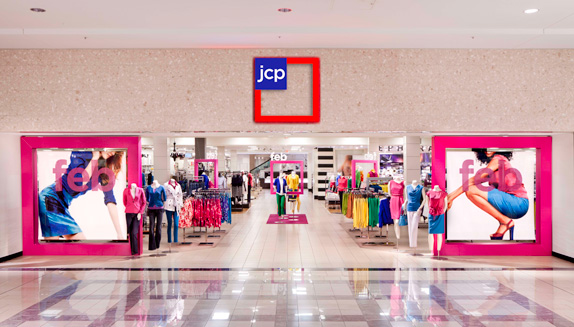
What do you think? Does it look cheap or is it an effective re-brand?
UPDATE: I need to do this story proper justice. There are very big changes afoot at JCPenney. Their current CEO came from Apple and was responsible for much of Apple’s current wildly successful retail strategy. They plan on redesigning and renovating all of their stores with a “Main Street” concept with many smaller stores-within-a-store, and standardizing pricing at full dollar amounts and eliminating most sales and promotions. Instead, there’ll be an everyday-low-price model (slashing prices on most goods around 40%) with items becoming marked down as they age. Forbes has gone out on a limb in calling JCPenney the “most exciting retailer of 2012.” Compared to the slow, laggard Sears refreshes under Eddie Lampert, it is true that this dramatic change will at least be an interesting one to watch. It remains to be seen whether it works or not.

What are they trying to do?
They need to keep the quality up. Target already does cheap hipster, and Walmart does just plain cheap (which means Kmart is pointless). JCP needs to be the store for the masses who want quality but think Macy’s is too expensive.
Just don’t take down the mirrored glass entrances at the older stores; the logo would look cool in front of those older stores.
They’ve begun airing commercials about the new jcp. The commercials show consumers driven crazy by missing yesterday only sales, ambiguous markdowns, and the flood of coupons they get in the mail. The words “ENOUGH. IS. ENOUGH” appear on the screen. They have 2/1/12 as the debut of new jcp.
I heard about this during one of those news breaks on the radio earlier today.
Since I still have a local store, I’ll be keeping up with the changes. The price strategy is an aggressive one for sure. You put it best…”Not cheap, but not Macy’s, yet hoping to distance themselves from Kohl’s.”
That logo looks odd though, and with so many older stores still open that at one time bore the “Penney’s” banner (like that mock-up image in this post)….those store facades are going to be looking rather bare.
That new logo is not sufficient for the storefronts. If they really wanted to be cutting edge, they would bring back the only 60s logo…
I’m already tired of the commercials. The main street concept only makes sense if they plan to bring back customer service, which has become pretty non-existent in their stores.
What are they up to now? This logo reminds me of the ill-fated Gap logo!
@Nordrike Field, I know, it seems fake. But keep in mind this is all coming from the person behind the Apple stores, so it’s dead serious. This won’t be a Lampert-like half-ass effort. They will be very aggressive with whatever concept they go with.
@Caldor, I agree, I mean it looks so… I have no comment I suppose, but you’re right, this guy came from Apple so who knows, maybe Penneys will go from bleah to va-va-voom!!!!
I’m sorry but that logo has to go. I loved the plain Helvetica logo better.
Another important thing I forgot in my original comment that applies to some malls, specifically my hometown stomping grounds, Forest Mall (Fond Du Lac WI). Unless the mall’s owners (Simon) are prepping another remodel in the coming year or two (highly unlikely…..I’m predicting in 5 years they dump the property off to some other investment firm or REIT….it’s a low-B / high-C tier mall…and big-name REITs are dumping these properties like dead carcass), there’s not enough room above the interior mall entry to make this sign big enough for that ‘jcp’ to be real visible from a distance.
Before 1985 it would have been big enough of a clearance, but it was in ’85 in the first mall-wide renovation, they stripped the interior entrance’s original 1973-era wood facade and showcase windows. The ceiling height was dropped down (to accommodate a ‘step-down’ ceiling pattern with surrounding mirrors and neon) and the signage area wound up being made lower and thus, more narrow from top to bottom.
That still allowed, of course, for the Helvetica logo, albeit in a smaller version from the exterior signage.
The original height was restored in the 1998 mall-wide remodel, but instead of a whitewash wall, they put tiling up, leaving only the same amount of area for the 1985-era sign (still installed to this day).
Like most mall Penney’s locations, ours is a leased store. Better allow a variance in the lease to modify the storefront enough to give enough height to this new logo. Otherwise one won’t be able to tell it’s Penney’s. They’ll just see the big red square, with a smaller blue one with even smaller ‘jcp’ initials in it.
Apple might have had success with their former retail division CEO, I’ll give him that, and also his crazy ‘no sales’ strategy that ‘may’ pay off…..time will tell. But this logo design is going to be ~insufficient~ at some malls without proper changes to leases to allow bigger areas for the new signs.
I say scrap it and break out the old 1960s ‘Penney’s’ logotype for a new generation. No disrespect at all to the man himself of course (his death being the one of the main reasons behind their inducting the ‘JCPenney’ mark in Helvetica back in 1971). I just base it on the fact that many folks (myself included) call it ‘Penneys’.
Kind of like how our H.C. Prange Co. eventually (when building out suburban locations in Madison, and then eventually updating the signage at all locations in 1979-1980 chain-wide) realized people were just calling the stores ‘Prange’s’, and thus that logo came into being and in use for 12 (’80-’92) years until the chain’s buyout by Younker’s.
I first saw the recently change logo at Roosevelt Field as the 1972 era store recieved a much needed renovation. I must say, what an improvement! Now they are changing the logo again?
JCPenny had a challenging holiday season last year, but this may put them on the right track.
As for Simon & other large REITS, they need to perge themselves of marginal properties. At one time carrieing smaller marginal malls was OK since the top performers would mask the troubled assets. Now mall owners are defaulting on loans tied to these assets & saying to the morggage holders go ahead & take the property, it’s no longer viable for us.
@SEAN, I JUST HOPE THIS NEW STRADEGY THIS RON JOHNSON IS DOING WILL WORK IN ALL THEIR STORES. PEOPLE HERE IN ROCKLAND CANNOT ACCEPT CHANGE, SO I HOPE THE PALISADES STORE WILL SURVIVE THIS. ITS LIKE PEOPLE ARE HAPPY THAT SOMETHING IS BEING DONE TO NANUET BUT THERE ARE SOME THAT ARE NOT BECAUSE OF THE MALL NOT BEING BE ENCLOSED THERE ARE COMMENTS FROM PEOPLE SAYING THAT JC PENNEY WILL TURN INTO A TARGET TYPE STORE.AS I SAID ITS BETTER THEY ARE DOING SOMETHING THAN A 1,000 STORES FULL OF EMOLYEES CLOSE AND OUT OF WORK..
Ugly. Ugly ugly ugly.
I like to think that that new commercial they have of people screaming is finding out the logo changed.
Can’t say I like the logo, really, but it is distinctive. The last incarnation was not, as most department store logos are not these days, so at least it has that going for it.
This change in strategy hopefully also means that I’ll be getting less….inbox harrassment…from JCP. They have my email address because I shop online there sometimes, and oh my goodness. Every other day is their BIGGEST SALE EVER. They’ve started going directly to my spam folder because I get so many I can’t even be bothered to read them. I’ll be very happy to see this change. Your marketing is meaningless when you saturate me with it.
But I do shop at JC Penney, even if I don’t read their emails anymore. Most of the clothes I buy at Target are utter crap, and nothing seems to fit right at Macy’s and Kohl’s is usually mobbed. As a consumer, there is room for JC Penney in my life.
The amount of pink I see in that image up there kind of worries me, too – “pink” screams “we want youth!,” and though I’m only 33, my gut instinct seeing that picture is that this is a store for women in their 20s and teens. Even though Apple stores have bright, open entryways and are full of slick gadgets, I don’t feel too old to shop there. Nothing about that JC Penney entrance up there tells me that this would be a good place for a grownup woman to buy professional but not terribly expensive work clothes, though. And that is what I mostly go to JC Penney for. But maybe they don’t want to be the company you go to for sensible work outfits. That is kind of a boring label.
(Also, I’ve never called or thought of it as “Penney’s,” but I do know what store people are talking about when they use that name.)
TRAINWECK it’s a BAD idea i think this will be jcp’s deathkneel
@rob, I seriously doubt that the Palisades store is going anywhere.
Like Sears, the issue with Penny’s real estate is the number of marginal stores in B & C level malls & NOT the total number of stores in opperation. If the number of marginal stores & malls decreased, things would be far healthier then they currently are.
I think the logo would look much better on both sides of the store entrances rather than over the top like how it’s displayed in the picture. I think they should look into redesigning every mall store entrance by making the entryway higher, eliminating that dead space where the “JCPenney” logo would normally go.
@Gary Nelson;
I never thought of this. I still am not too big a fan of the new logo design, but if stores were reconfigured where the entryways went from floor to ceiling, and the signs were affixed to one side (the other being re-opened up for a display case….like how the old stores in the ’60s and ’70s used to have on both sides), it would make the signage more legible in situations like that of my local Penney’s which I detailed above, and really open up the store’s space more.
The new logo is awful!
Most department store logos are rectangular & horizontal. If they insist on using a square logo they should at least ditch the red frame and just use a larger blue square with JCP.
I still think the 1960’s logo was the best one ever.
This looks like the designer just threw this together and convinced the management to approve it by a talking a lot of gobbley-gook about negative space and clean modern lines.
What were they thinking? Can they not SEE??
JCPenney just completed opening a spate of new stores while extensively renovating others. I can’t wait to see how concepts such as a linear ‘Main Street’ and increased number of vendor shops will function in an environment designed a racetrack layout.
I really have the feeling this is going to be a major failure. Success with the Apple store does not = success in the department store field.
The new logo just doesn’t work as it would have to be huge for the “jcp” to be seen from a distance. The logo introduced last year was a nice refreshment……why throw that new one into the dust bin?
The Town Square idea makes no sense! I mean, move “center core” and use the area where cosmetics, jewelry and accessories are sold for “gatherings” and to sell Hot Dogs and Coke on holidays (I read that’s the plan!!!) It’s crazy.
I was in a local store yesterday. Having pricing rounded to the dollar makes me feel like I am in a dollar store…….that’s their tactic.
They are no longer going to release monthly sales figures. That is a red flag right there.
Macy’s has a contract with Stewart. They are suing her company for breach of contract. Not so sure Stewarts wares will be sold in JCP any time soon.
@STEVE, My thoughts, exactly.
The current CEO needs to understand, JC Penney is an entirely different beast than his former fronting job with Apple’s retail sector. It’s not a specialty retailer. It’s a department store…a chain that spans some 800+ stores that encompass downtown anchors, mall anchors, and freestanding ‘big box’ stores (like the three that sit as anchors to centers in Ashwaubenon, Menomineee Falls, and Kenosha WI, respectively)…..not just those in downtown Ashland, or as a charter anchor to Forest Mall in my hometown, Fox River Mall, Southridge Mall, etc etc. One that has deep roots in shopping center development and further back into the fabric of American retailing.
I understand the whole logo redesign, but it just needs to be implemented in a way where it’ll be what you see whether you go to Woodfield in the Chicagoland area, Southridge in the Milwaukee area, my hometown (Fond Du Lac)-area location @ Forest Mall, or any of the other remaining stores in the chain.
I don’t think the “sale” strategy is a failure entirely. They can’t compete against Kohl’s, who does sales every week and has been for a good 20-25 years. (basically ever since spinning off from BATUS), and Macy*s? In Wisconisn, Macy’s is ‘high end’, so forget that. Penney is competing with Kohl’s here, basically. I welcome some of the changes.
I say, let it pan out and see where it goes. It may work in some markets, not in others.
It’s good that JCPenney is trying to evolve, stay fresh and keep up with the times, On the other hand, I’m worried that all the proposed alterations are so drastically extensive, that if this concept were to be deemed unsuccessful, it wouldn’t leave much room to revert back or into something else. No room for failure on this one! If this costly concept doesn’t work, this will be the last transformation we see of JCPenney before its death knell.
It’s the equivalent of throwing a hail mary pass on fourth and long. What other choice do you have? Tweaks weren’t going to get it there. I think they may be on to a few things here, but to achieve a successful, radical reinvention of this tired-old retailer is a very tall order.
http://www.youtube.com/user/jcpenney?blend=3&ob=0
“No Sales!” as a rallying cry for changing how Americans buy? Good luck with that strategy on Black Friday 2012…
@STEVE, I think one of the huge problems is this former Apple guy wants the “jcp” logo to be “simple and iconic” like Apple’s. It won’t work. Apple’s trademark has been more or less unmodified since 1976 (although the colorful stripes have gone away). Even Macy’s logo, as much as we hate the “Red Star of Communism”, has been around in some form or another since day one (late 19th century).
JCPenney had an iconic logo: the name they’ve had since 1971! Just work that to its advantage and re-vamp that way.
Not a fan of the new look. I personally like the logo from the 60’s.
@Ashley, iT DOESENT MATTER HOW THE LOGO LOOKS ISNT IT BETTER WE DONT SEE 1100 STORES CLOSE AND 1100STORES FULL OF EMPLOYEES OUT OF WORK.TtHIS MAY END UP WITH SEARS. AT LEAST JCPENNEY IS TRYING TO IMPROVE THE COMPANY SEARS RELIES ON THEIR NAME.
if the new logo is supposed to represent the American flag, why didn’t they make it rectangular instead of square?
JCPenney in many ways is riskier than Sears. Granted, Sears is doing worse but Sears also has a substantial war chest of cash (that it uses poorly, but it still has) while JCPenney doesn’t.
@Pseudo3D, Penney’s hasn’t experienced as much erosion of its sales as Sears and as a softline retailer, they are in a more profitable business.
Why not make the logo look like Stride Rite’s logo, as in with the colors? I’m sorry if I mentioned it.
I sort of agree with Matt from WI.
Our local JCPenney started out life as a Kmart in the early 90s and closed during their bankruptcy in the early 2000s. It sat vacant for several years before getting a remodel (one entrance instead of two, new signage — garden center is just a barren outdoor area attached to the store and the real only indication that something else was there) and opening as JCPenney. Penney’s has some mall locations, too. That said, I wonder if this redesign would work at all at my local store.
The JCPenney store that opened recently at the Manhattan Mall (33rd & 6th) in Manhattan is very impressive: shiny floors, pretty stylish clothes, etc. If JCPenney can do a store like that, it’s definitely one that I’d shop in. Sorry, won’t win me away from Lord & Taylor for good, but I’d certainly consider JCP for a lot of purchases.
@Chris, When Garden State Plaza was expanded in 1996, the JCPenny was enlarged so that the mall completely encircles it. You can sort of figgure out the old parts from the recent adition, but they fit together nicely.
Having said all that, they still need to remoddle the store to look similar to the Roosevelt Field location wich I must say is quite impressive.
As for sign location, (LL Nordstrom side) has the sign to the left of the entrance do to it being slightly elevated compared to the rest of the mall. The remaining signs are overhead as usual. This elevation change mentioned above created another design querk, there are staires, aramp & what could be regarted as the shortest escalator ever found in a mall leading in to this J C Penny, I’m guessing around 3 or 4 feet long.
Looks like a Gap blue square with the old lower-case gap font stuck on a square Target logo.
There’s nothing original here.
Just wonder how much they’re going to be allocating for store remodels? Can’t imagine they’re going to go around and replace outside neon signage that quickly because that’s beaucoup buck$ (even some remodeled Walmarts here still have the old logos)
@spudri, their old Helvetica logo was original but what you have here isn’t.
@Kirb, I agree. The 60’s logo is cool and retro, this new logo is bland.
Our JCPenney was remodeled ahead of this “reboot.” It looks fantastic; clean, spacious, and with perhaps 1/3 less racks of merchandise. There are central checkout stations and bigger dressing rooms. Before, the lighting was dour and dark in this store, but is now bright and pleasing. It reminds me of he lighting in Apple stores. The lighting seemed…optimistic. I was shocked actually. I’ve been making fun of Penney’s for years. It was the store of ugly polo shirts, cheap Levis, and seizure inducing children’s clothes. All the trashy coupons didn’t help the image. I only went there as I had a huge gift card (took me 3 years to spend $500!)
I bought two dresses from the store within a store “MNG by Mango.” It felt like shopping in an independent dress boutique, not in a staid, cheap department store. I usually shop in our town’s boutiques, or at BCBG. I detest Kohls (cheap, cheap, cheap) and have lost interest in Target (too many things didn’t last.) If JCPenney was trying to lure female shoppers like me in, it worked. It will now be my first stop at our mall.
@Tanya, I agree, Tanya. I’m pretty picky about clothes and don’t shop at discount stores much at all anymore (and agree totally about Target stuff wearing out fast or fitting weird) but there’s a brand new JCPenney near me and it’s just like you describe. I find that I go there a lot to pick up decent stuff for good prices, and the shopping experience itself is quite nice. I would say it’s definite heads above Kohl’s (who they are clearly emulating), whose stores always feel a bit like they’re made for my in-laws. I wouldn’t go so far as to say the newer JCPenneys are cool, but it’s pretty decent and functional.
I like the new concept and I think the commercials they have been running (“67% off”) were funny.
Two problems for me, though:
1. While red, white and blue look great on a flag, they tend to clash and be hard on the eyes when illuminated (such as signed, computer screens, mobile devices, etc.). I’m happy with the look, but no the choice of colors.
2. In regard to the new color-coded pricing, they are using red as regular priced and blue as the discounted price. With the exception of Kmart (blue light special), I think most folks associated red with discount or clearance. I like the color-coding idea, but feel the color meanings are wrong.
@Caldor, I do like Target for clothes (sorta: that and Academy), I don’t think I’ve bought clothes at Walmart in years, except for maybe underwear and socks.
I bought a pair of dark blue Denizen jeans recently from Target, wore them a few times, including in a huge rainstorm. They bled.
As for JCPenney, I went inside one last Christmas to buy a gift for my mother. As with the other stores in the mall, the Penney’s was small (~80,000 square feet) and rather dated. The scarf selection (which I was looking at) was rather pitiful. Only maybe five choices, all on clearance. They didn’t even ask me if I wanted it gift-wrapped (apparently it was cut just WEEKS before I came)
AP Interview: JC Penney CEO tries to transform Penney, borrows from Apple’s playbook
Article by: ANNE D’INNOCENZIO , Associated Press Updated: January 30,
@SEAN, news 12 has story on nanuet mall. i am so so on this transformation of jc penney. i hope this price concept will work i am one of those consumers who knows their prices between lord and taylor, kohls,macys and belk when i shop their web or store. sears is starting to be unable to pay their vendors. jc penney discontinued gold toe and jockey because of this new concept and that macys and lord and taylor carry it as well and goes on sale at all dept stores across the u.s. from time to time.
@rob, Lets see if JCP can turn things around. As for Sears, they are holding on by a thred. Or should I say a power cord.
If either Sears or J C Penny or perhaps both go under, the impact would be swift & desasterous for malls across the country. Hudsons Bay of Toronto could fill some locations in the better centers in the colder climate areas of the US, but I don’t know how many locations that would add up to.
Will see what happens with Nanuet especially with Sears being such a wild card.
@STEVE,
You realize that Ron Johnson was at Target before Apple, right? It’s not as if Apple stores are all he has done, and while Target isn’t really a department store it has a lot of similarities.
@SEAN, let’s not get too carried away. Even though both Sears and JCPenney (though moreso the former) are struggling and behind the times somewhat, neither is in immediate danger of going out of business. It’d take years yet of failing to get to that point.
Store closures? Yes, especially for Sears/Kmart. But neither of these companies is truly on death watch yet, and I would even argue that JCPenney isn’t close.
@Caldor, NOT SAYING RIGHT AWAY WITH JCP,BUT I AM ONE OF THOSE PRICE CONCIOUS SHOPPERS. I THINK WHO HAS THE BEST DEAL, KOHLS, MACYS,LORD AND TAYLOR OR BELK ON LINE. I HAVE ALREADY HAVE SEEN A FEW ITEMS IN JCP THAT I USED TO GET WHEN THEY HAD SALES A FEW DOLLARS MORE NOW.. I WANTED THEM TO IMPROVE THEIR MERCHANDISE NOT TAKE AWAY THIER SALES.
@Caldor, Sorry I didn’t intend to come off that harsh. I did say above lets see what happens first with Ron Jonson’s stratagy. For all we know JCP could very well be on it’s way to it’s place among the retail leaders a year from now. Only time & the ecconemy can tell.
I don’t share your opinion with Sears though. Will they be done next year? I don’t think so, but I don’t think that they have too much time left unless drastic changes are made. My perrents worked at the Sears buyers office in NYC before I was born & it was a mismanaged company even then they told me.
Off topic; perrent of The Avenue United Retail group filed for bankruptsy protection according to Bloomburg News. As a result, they will be closing 14-stores next month.
Logo changes always take awhile to get used to.
Even 50 years ago, when I was in school, JCP was never considered “the coolest place to shop” but always had a good selection of basics; jeans, socks, work clothes etc. so it had an important place in retail environment.
I think they missed the boat on one opportunity however. Many people I know are frustrated because they can no longer find American made clothing. What if JCP, with their buying power and reputation, put a large amount of USA made clothing and other products into their stores, and promoted it. I feel people would go out of their way to shop there. JCP was one of the first stores to sell New Balance shoes (majority made in USA) back when everyone else was selling just imported shoes. That brand has made huge gains in market share in the past few years. I think it could be a win-win for JCP, American manufacturers, and customers!
@sally, I know what you mean about the pink, it is certainly different from their regular decor. However, it is my understanding that the store will set monthly and be decorated with a new color every month. It’s February, hence the pink 🙂 I’ve just been to the store today and I must say it is a massive improvement from before between the new graphics and monthly color sets!
From Retail Traffic
Department Store Sector Split Between Winners and Losers
Feb 2, 2012 12:15 PM, By Elaine Misonzhnik, Senior Associate Editor
The department store sector is remaking itself for the new era of retailing, continuing the resurgence it experienced over the past two years with the return of the mall.
But while department stores as a concept no longer seem headed for oblivion, there appears to be a sharp divide between those chains ready to embrace change and those unwilling or unable to reinvent themselves. The latter retailers will likely disappear from the landscape, either through consolidation or bankruptcy, according to Jason S. Baker, principal of Baker Katz, a Houston-based commercial real estate services firm and a partner with X Team International, a retail real estate brokerage alliance.
Given that the U.S. currently has more regional malls than there are customers to shop at them, those department stores that anchor the bottom 20 percent of malls are headed for closure, notes C. Britt Beemer, chairman and CEO of America’s Research Group, a Summerville, S.C.-based consumer behavior research firm.
“The department store sector is challenged and one of the big reasons is that most months only 28 to 32 percent of consumers go to a mall versus 90 percent of consumers who go to shopping centers and strip centers,” Beemer says. “I think there are some retail chains that are going to be vulnerable in the long term.”
The big picture
For the fiscal year 2011, department stores posted collective growth of 3.5 percent. Nordstrom and Macy’s turned in the best performances, at 7.2 percent and 5.4 percent respectively. JC Penney, on the other hand, ended the year with only a 0.9 percent increase in same-store sales. And sales at Kmart and Sears have been so dismal that even before the 2011 holiday season ended the retailer announced plans to close up to 120 stores.
The reason for such a mixed performance is that some chains, most notably Macy’s, have been making major strides in grabbing more market share by focusing on exclusive merchandise offerings and more convenient layouts. In 2010, Macy’s signed exclusive design partnerships with Kenneth Cole Reaction and Karl Lagerfeld. Last year, it teamed up with Madonna. And it’s been adding more private label linesin an effort to provide its customers with products they wouldn’t be able to find elsewhere.
Plus, Macy’s has been pruning its portfolio to get rid of underperforming stores in both its Macy’s and Bloomingdale’s divisions and rethinking the look of its stores. These are exactly the kinds of changes department stores need to make to distinguish themselves in a market currently dominated by discounters and warehouse clubs, according to Craig Johnson, president of Customer Growth Partners, a New Canaan, Conn.-based retail consulting firm.
“For many, many years, the specialty chains were where the excitement was in retail, they were bringing out the newness and fashion and the department stores were bland. There was no particular reason to go to a department store,” notes Johnson. Now “there is uniqueness and value that, if you want to get it, you have to go to a particular department store.”
The JC Penney way
Like Macy’s, JC Penny is also trying to improve its image. The chain has been underperforming for some time, but new CEO Ron Johnson —previously an executive at Apple and, before that, Target—unveiled several new initiatives last week meant to raise the brands’ value in consumers’ eyes.
To begin with, Johnson wants to do away with constant discounting, in order to make pricing less confusing for consumers and cut down on the air of desperation such discounting engenders. Instead, JC Penney will offer shoppers regularly-scheduled monthly discounts and best value pricing on merchandise that hasn’t sold well.
In addition, the chain will redesign its layout in a Main Street style, with eventually up to 100 brand boutiques lining a main thoroughfare in the middle of the store.
But while retail industry insiders praise Johnson for his willingness to try something new, they express major doubts about the ultimate success of the campaign, especially on the pricing strategy. In the past few years consumers have gotten so used to offers of 30, 40 or 50 percent off regular prices that JC Penney might have a difficult time luring them away from competitors who plan to continue offering discounts.
“I know Ron Johnson is brilliant, but the fashion world is a different animal from Apple,” says Baker. “Apple determined that they would not compete on price, but on quality. But with department stores the first stop is savings and value. His competitors are going to continue to operate on the promotional model and I don’t know if he’s accounted for that.”
“Penney’s is going to find itself in hot water when all of a sudden their [merchandise] is not going to be on sale and the consumer is not going to get it,” says Beemer. “And since Penney’s has such huge shopper overlap with Kohl’s, Kohl’s is going to love this.”
The idea of a Main Street layout and designer boutiques, such as Liz Claiborne and Nanette Lepore, gets more enthusiastic reactions, but even there, Penney’s management has to stay aware of redesign costs, says Baker. He estimates that a complete redesign might end up costing $1 million per store. If Johnson ends up redesigning 100 stores over the next few years, as he plans, that means a price tag of $100 million—not an inconsiderable amount at a time when most retailers are on a tight budget.
“At this point in the economy, $100 million is no longer a rounding error, it’s a big gamble,” Baker notes. “It makes me wonder if it doesn’t make more sense to experiment with 20 or 30 stores first and see how they do.”
Going away
When it comes to talk of which department store players might not make it in the long term, however, the names that come up are Sears and Kmart, not Penney’s.
While Penney’s has acknowledged it has problems and is working to solve them, Sears Holding Corp. has done virtually nothing to fix its stores, according to James C. Bieri, principal with Detroit-based Stokas Bieri Real Estate.
“It’s tough to think that Kmart is going to be around for a long time and Sears is not likely to survive in its current form,” he says.
Like Beemer, Bieri believes that a number of existing class-B and class-C malls are headed for extinction, and with them will go the department stores that anchor them.
“It wouldn’t surprise me that if stores don’t hit a certain volume threshold, department store chains are just going to close them,” he says. “The new growth of department stores is going to be targeted because the poorer performing malls are going to close.”
@SEAN, Avenue stores were often stodgy and unkempt, so good riddance to that retail brand.
One thing I didn’t know about JCPenney is the plan to “re-design the chain’s stores to resemble a Main Street experience, with anywhere from 80 to 100 stores-within-a-store for customers to choose from”. Now, I don’t know if that will work. It didn’t work in the long-range at Montgomery Ward, and I don’t know if that design will really click. Instead of browsing for clothes in the women’s aisle (or men’s, depending on gender), they’ll have to visit dozens of stores-within-a-store.
To re-iterate, if Sears pulled this off instead of Penney’s, people would accuse it of doing the exactly the same thing Montgomery Ward did.
People just aren’t fair to Sears. mygofer had definite problems, but some people compared it to Service Merchandise: even though IKEA has features that are shockingly similar to catalog showrooms (like tablets to write down things), and no one bats an eye.
@sally, The color pink is base on marketing/presentation for monthly event. As for Febraury is Fushia (a color between pink and purple). Each month have different color. For example, March is orange/melon color. Don’t know exact color terms, but i had seen the color for each months this year (2012).
As for most people talk about the new logo is ugly. i know it their opinion, but understand why Ron Johnson choose this logo. To make it simple and clean. For example, logo like Apple, Target, Shell, Chevron, Nike, Superman, etc. There more information online, why Ron Johnson made this change/transformation.
FYI – i am associate of JCP (aka Penney’s). All the information i provide are made out to public. (JCPenney’s website).
@J-Man, JCPenney kept their logo as square because the last two logo have a red square logo. That the only reason to stay square. the blue square was added as American’s color (Red, White and Blue).
@JIM,
I totally agree with you !!! However and sadly for every one person who is really interested in buying things that are made in the USA there will be 3 or 4 really could give a rat’s ass about it. In other words..they just don’t care as long as its cheap…period.
Its kinda like radio. For every one who wants radio to be live and local with local disc jockeys around the clock…there are many more who could care less if their local radio was nothing more than Ryan Seacrest around the clock.
Sears Up For Sale?
by Elaine Misonzhnik February 8th, 2012
Eddie Lampert might be ready to leave the sinking ship that is Sears/Kmart, according to a report in The New York Post.
Though the rumors that Lampert is looking for a buyer are for now “unsubstantiated,” the move would make sense given Sears Holdings’ long-term struggles, its intention to close up to 120 stores and retail industry insiders’ skeptical outlook on Sears’ future.
The question now is who would be interested in buying the bottom rung player in the crowded department store space? Whoever buys Sears would likely do so for the value of its real estate rather than for the value of its retail brand, given that the company owns properties in many of the nation’s oldest and best malls.
I think Hudson’s Bay AKA The Bay, maybe a good option especially in the colder climate areas of the US.
On another note, Retail Traffic has an interesting article on the worlds largest shopping malls with photo galleries.
I think it would be better to let Kmart and Sears go their separate ways. I was thinking it would be neat if Amazon.com actually snapped up Sears, putting the world’s best Internet retailer with the once-famous mail order store together for the first time. It would give Amazon exclusivity in Sears brands, and could make for some awesome integrations, with Sears becoming more like a showroom.
Kmart on the other hand probably could survive. It has no-frills stores, some more American-made products than Walmart or Target, and if Walmart’s “simplified shopping” shenanigans continue, it could provide an outlet for Kmart to expand their customer base. It’s plausible, though unlikely, that Meijer could buy up Kmart and keep the name as general merchandise-only stores. Super Kmart on the other hand, would be converted to full Meijer stores, but Meijer did try experiments with Meijer Square (et. al.). Anyway, I hope that Eddie Lampert DOES sell, I hope the new owners can revive it to their former glory.
It’s funny that people want to the see 1960s logo again. Yes its iconic and yes I like it myself but it was actually a disaster for the chain back then. Which is why it officially only lasted seven years until the 1971 logo when. The 60s logo is from the days of when JCPenney was trying to compete with Sears and Montgomery Ward.
Best of luck to JCP on their new gamble. I hope it pays off in the long run. It may sound crazy but it sounds like it would actually work.
@Pseudo3D, As several stock analysts pointed out in 2005, taking two poorly run companies & merging them doesn’t work. I share your sentiment on seperating Sears & K mart, but my idea comes with a twist.
Purchase NY based NRDC equities owners of Lord & Taylor & The Bay could be an interesting play for bringing The Bay’s signiture products to the states as well as expanding the Lord & taylor brand beyond the northeast & the midwest regions.
The twist is to convert Sears locations in A level locations to The Bay& either sell or close stores in B or C centers. This more or less follows what NRDC did with The Bay’s discount arm Zellers & how Target was able to get a foothold into Canada rather quickly.
As for K mart it self, sell it off in whole or in pieces. There are chains out there that want to expand & this could open some good oppertunities for them.
@Pseudo3D, Agreed about that, totally. I’d rather see Sears Holdings spin off Kmart, but I sadly doubt they’ll do that. I do have to say that I wish Sears would implement the new look logo at a quicker page, a la the one implemented at Friendly Center in Greensboro, NC. If you go to Sky City on facebook, you can see pic examples of what that store looks like.
I like the new look and Kudos to JCP for kicking it in gear and getting into the 21st century. Sears on the other hand is such a joke. There are two Sears stores near me, one is older than dirt and it is obvious that they are letting it go down the tubes. It’s dirty, old, the employees are horrible and it is obvious they are there for a paycheck only. The other Sears is newer and in a nice mall, but it is still empty! when all the other stores are crowded. I think its time for Sears to close up their stores, they are just horrible, I don’t shop there anymore, its depressing.
Sears Sells 11 Anchor Pads to GGP; To Split Off Some Businesses
Feb 23, 2012 12:21 PM, Staff Reports
Sears Holdings Corp. made two big announcements as it continues its attempts to reverse its flagging fortunes. It will sell 11 anchor pad locations to General Growth Properties in a $270 million deal. In addition, the company has announced plans to separate its Sears Hometown and Outlet Businesses and certain hardware stores through a rights offering.
In the anchor deal, Sears will sell Sears full-line store locations at 11 General Growth Properties assets to the mall REIT. The transaction is expected to close in the next 45 to 60 days, subject to customary closing conditions. The stores in the transaction include Sears-owned properties at the Coral Ridge Mall in Coralville, Iowa; The Woodlands Mall in The Woodlands, Texas; West Oaks Mall in Ocoee, Fla.; Fashion Place in Murray, Utah; Quail Springs Mall in Oklahoma City and Provo Towne Centre in Provo, Utah. The leased locations are in Ala Moana Center in Honolulu; Bellis Fair in Bellingham, Wash.; Mall of the Bluffs in Council Bluffs, Iowa; Apache Mall in Rochester, Minn. and Market Plae Shopping Center in Champaign, Ill.
The stores will continue to operate as Sears locations into 2013 with final closing dates to be determined and announced later this year.
“This portfolio represents a significant opportunity to recapture valuable real estate within our portfolio,” General Growth COO Shobi Khan said in a statement. “This acquisition also enhances several expansion and redevelopment opportunities including re-tenanting the anchor space and adding new in-line GLA.”
Splitting off sectors
In other news, Sears said it intends to separate its Sears Hometown and Outlet Businesses and certain hardware stores through a proposed rights offering that is expected to raise approximately $400 million to $500 million.
The rights will entitle holders to purchase shares in the combined Sears Hometown and Outlet Stores businesses and certain hardware stores and will be transferred to holders of Sears Holdings common stock. The record date, subscription price, subscription ratio (the number of rights needed to acquire a share in the newly formed company) and other terms of the rights offering have not yet been determined by the Sears’ board.
Proceeds from the share subscription will provide additional liquidity to Sears Holdings and are expected to be used for general corporate purposes. Edward S. Lampert, chairman of the board of directors of Sears Holdings and Chairman and CEO of ESL Investments Inc. (together with its affiliated funds, ESL), has said that ESL, which is Sears Holdings’ largest shareholder, intends to exercise its subscription rights in full at the anticipated valuation, subject to the successful completion of the transaction process.
This is the second major announcement from Sears Holdings in the past 60 days. On Dec. 27, 2011., the firm revealed plans to shutter 120 underperforming Sears and Kmart stores.
@SEAN, WHAT DO YOU THINK THEY WILL DO WITH NANUET SEARS I WAS IN THERE LAST WEEK IT LOOKS LIKE A JUNK HOLE. THEY ARE SAYING ON CNBC THAT PEOPLE ARE STILL SO SO ABOUT JCP. I WAS ON THEIR WEB SAW A PAIR REEBOK SNEAKERS SAID ALSO IN STORES 21.00 I GO TO THE STORE THEY ARE 35.00. THE PRICING ON THE THIRD FRIDAY IS VERY CONFUSING. I HOPE THEY WILL SURVIVE ESPECIALLY WHEN IT COMES TO HOLIDAY WEEKENDS AND THE HOLIDAY SEASON .TO ME THEY NEEDED TO IMPROVE THEIR PRIVATE LABEL MERCHANDISE/ THEIR SALES WERE .ALWAYS GOOD.
@rob, I’m not sure what will happen to the Nanuet Sears, it’s still to early to tell. There was another article in the NYT’s business section today related to the one I posted above. In a nutshell Sears will be gambling by selling it’s most valuable real estate assets to get a quick cash infusion. As my father told me this morning, Alexanders went down the same route & you know what happened to them.
Did you verify the price difference with a sales person when you went to JC Penny? They should have given you the lower price without question.
I feel that Sears might not make it pass this year; it will be a shame if they do go under, selling their stores back to the mall owner? Jeez, we’ll see what happens I suppose.
@SEAN, OH JCP GAVE ME THE PRICE BUT THEY NEED TO BE MORE CAREFUL OF THEIR PRICING. ITS FUNNY YOU MENTIONED ALEXANDERS I REMEBERED WHAT HAD HAPPENED TO THEM AND J.W MAYS DEPT STORES AS WELL, THIS COULD BE THE SAME WAY SEARS IS HEADED. ONE DAY ALL SEARS EMPLOYEES WILL COME TO WORK AND FIND THE STORES CLOSED LIKE ALEXANDERS DID.THEY REOPENED FOR LIQUIDATION THEY CLOSED IN 1992. THEY WERE GREAT BACK IN THE DAY.
@Nordrike Field, I have the same concerns you do, but I view things differently. You need to seperate the different classes of malls. The higher quality A level centers will mostly survive if they lose there Sears anchor, but the B & C assets will have a tougher go at it if Sears ends up Closing stores.
@SEAN, Sears leaving would kill some malls for sure. Unlike just ten years ago, though, what anchors are available to fill the void?
@SEAN, I WOULDNT MISS SEARS, BOSCOVS COULD REPLACE SEARS IN NANUET OR PARAMUS PARK MALL. EVEN BONTON. I THINK MOST DEPT STORES ARE HOLDING BACK AN EXPANDING.THERE WOULD BE ALOT OF EMPTY ANCHOR STORES IN MANY MALLS.
@SEAN, I agree with all of you guys, my local mall; Temecula Promenade would not be in danger if Sears closes but another local mall, Hemet Valley Mall might be, they already lost Gottschalks and about 7 inline stores out of like 20 though they still have a really small Penneys store; class A malls would be able to fill-in the void Sears might leave; but class B and C would really struggle, specially in small towns where Macy’s, Bon-Ton, Boscovs or what have you would not do business in would really suffer; in the other hand, if Sears Holdings were to close all Sears BUT keep Kmart what they could do in smaller B and C class malls specially in town’s Wal-Mart is not close by they could convert some stores to their Kmart brand, only time will tell what’s going to happen with Sears; growing up with a Sears in my hometown I have fond memories of them and if they do go under it would be the end of a once mighty fine American brand.
@Raymie, I thaught of one that our Canadian readers know well, The Bay. The Bay is similar to Macy’s, but they have signiture products that you don’t find in the states. They would do well in the northern climate areas like Boston, Washington DC, Detroit, Denver & alike. in the South, Belk might be able to pick up some of the slack in the stronger markets. However as I already pointed out, A class malls will weather far better despite the loss of Sears than B or C class malls.
@Raymie, Another store that might work is Von Mour wich is similar to Neiman Marcus, but based in the midwest.
@Nordrike Field, well said.
@rob, The loss of Sears in some markets could be a benefit to A class centers & regional department stores who will have expantion opertunities put in front of them. See my comments towards raymie above.
@SEAN, I SEE WHAT U MEAN IN THE SOUTH BELK AND DILLARDS MAY HAVE SOME OPPORTUNITIES.LORD AND TAYLOR IS LOOKING TO RETURN DOWN SOUTH AS WELL. THE NORTHEAST MAY HAVE SOME PROBLEMS UN LESS THAT BAY WILL COME OR OPPORTUNITIES FOR NORDSTROM, BOSCOVS OR BONTON.
@rob, Bon Ton could work in some markets as can Belk. Remember The Bay & Lord & Taylor are both under NRDC ownership. It just depends on wich center you are talking about.
The Bay has a larger footprint to work from since they are national as aposed to Lord & Taylor wich is regional & a bit more upscale.
Cities like Boston, Detroit, Seattle, Portland OR, Chicago, Minneapolis & Buffalo would be logical locations to bring in The Bay first to see if US consumers respond favorably to a new department store opening. If so, then extending down towards DC,Indianapolis, Nashville, Denver & San Francisco would be next logiclly.
Chicago, Detroit & the northeast already have Lord & Taylor stores, so The Bay would be a better option.
In the south, that is where Belk, Dillards & Bon Ton could make headway by picking up stores with good leasing terms.
There’s plenty of room for Boscov’s to get in on some choice anchor spaces if they are a bit agressive. Especially in the northeast where L & T already have stores. Los Angeles & San Diego could end up with Dillards.
@SEAN,
I can see that. However, I would suggest that the HBC make a minor name change for the Detroit market (the first i would pick for them as it is right across the border from their stores in Windsor). Call it the “Hudson’s Bay Co.” with a bit of emphasis on “Hudson’s”.
I’m glad they’re at least trying something new. JCPenney often has stuff I’d like to buy, but checking out of the place is a nightmare (at least, it is at my local store). If they’re going to make the layout less confusing and more friendly, I’ll shop there more often.
I worry about the pricing strategy though; when you say “NO MORE SALES”, people flip out. Sadly, some people may not be, er, observant enough to notice the color-coding. Personally, I think it’s a good idea, because I hate ambiguous markdowns. I’m more likely to put the marked-down item back than take it with me to the register only to find out it’s over my budget. But that’s just me.
Oh yeah, and the new logo is ugly, but most logos these days are pretty lackluster, so what do you expect?
@Brandon, Understood. Knowing that Hudson’s was based in Detroit, that would make sence.
@rob, Eddie Lampert to spin off more than 1,200 Sears stores and sell 11 in bid to raise up to $770 million
By JAMES COVERT
Last Updated: 3:51 PM, February 24, 2012
Eddie Lampert finally opened the kimono yesterday — and revealed some shrinking assets.
The number-crunching hedge-fund tycoon — who took control of Sears in 2005 by merging it with Kmart — said yesterday he will spin off more than 1,200 stores to investors and sell 11 department stores in a bid to raise up to $770 million in cash.
In a rare move, the notoriously secretive Lampert allowed Sears execs to hold a conference call with analysts to quell recent concerns about its liquidity, which came to a head last month when the retailer warned it expected to post a steep loss for the year.
Those fears, which prompted commercial-lending giant CIT to abruptly stop extending credit to Sears suppliers, were confirmed yesterday as Sears disclosed it lost more than $3 billion in 2011.
Sales in the crucial fourth quarter fell 4 percent, to $12.48 billion, capping the retailer’s eighth straight year of declining US same-store sales.
Nevertheless, Sears shares yesterday surged nearly 19 percent to close at $61.80, as Lampert took pains to quash speculation that he might throw the aging chain into bankruptcy.
“Despite our explanations to analysts, credit rating agencies and the media regarding our liquidity… many have chosen to ignore these facts, focus exclusively on our earnings performance and exaggerate the potential for any liquidity problems,” Lampert griped in a letter to shareholders.
Lampert also signaled that he wouldn’t rule out selling more real estate, the company’s 90 percent stake in Sears Canada or even the Lands’ End clothing line.
While the news about the retailer’s near-term health came as a relief to investors and suppliers, the asset sales will cut into Sears’ long-term profitability.
The 11 department stores to be sold to a mall developer for $270 million “are among the best” in the chain, according to Credit Suisse analyst Gary Balter.
“We do not believe that a bankruptcy filing near term is in the cards, but we believe the equity valuation is well out of line with comparable retailers,” Balter said, reckoning Sears shares are worth $20 — less than a third of yesterday’s close.
The 1,200 stores to be spun off are smaller-format outlets and other off-mall shops, including hardware stores, in a rights offering to investors that’s expected to raise up to $500 million.
“Our fourth-quarter earnings were unacceptable,” Sears CEO Lou D’Ambrosio said on yesterday’s conference call.
CIT, which has more than $200 million in exposure to Sears accounts, is selectively approving new deliveries to the retailer, said a source close to the situation.
jcovert@nypost.com
Come on, who on this blog didn’t see this one comeing.
Having gone to my local Penney’s and seen the changes, I think the strategy will work. It strikes me that this is more of a pricing change than a branding change. Most items were on sale, promoted, anyway at 30 to 50% off, so slashing the prices by 40% makes the old promotion price the new regular price (which is what one paid for the items anyway). The sale prices are easy to find, and the clearance items are also marked and findable.
We have both a Penney’s and a Kohl’s here, and having been to both within the week, the Penney’s seems more “with it” and up to date. Kohl’s seems kind of staid to me. It might help that Kohl’s is away from the mall, and Penney’s is in a mall with 95% occupancy.
@SEAN, Sears shutting the last Great Indoors
Home Textiles Today Staff — Home Accents Today, 2/29/2012 9:49:04 AM
HOFFMAN ESTATES, Ill. – The Great Indoors is going to the great beyond.
Buried in the recent announcements of store closings by Sears Holdings in the wake of major losses for the year was the A recently remodeled Sears store in Greensboro, N.C.news that it would shut down the last remaining nine Great Indoors locations. No specific closing date was given.
Launched in the late 1990s, The Great Indoors units were mammoth, 100,000-sq.-ft. home superstores, containing most major furnishings classifications from textiles to furniture to consumer electronics to kitchen and bath. There were 20 stores at the peak of the operation, merchandised and bought separately from traditional Sears stores.
Established concurrently with launch of a similar concept by Home Depot called Expo, these giants were viewed as the next big trend in home furnishings retailers, but it was not to be. Depot shuttered its Expo operation in the mid-2000s and other oversized home operations such as Garden Ridge and Incredible Universe have been substantially pared back or closed.
After the merger of Sears and Kmart to create Sears Holdings, not much was ever mentioned of The Great Indoors and the stores were never believed to be big money-makers.
According to published reports, the last nine stores are located in Scottsdale and Chandler, Ariz..; Lone Tree, Colo.; Lombard, Ill.; Gaithersburg, Md..; Novi, Mich.; Columbus, Ohio; and Farmers Branch and Houston, Texas.
Those mega stores were great for browsing, but not fun when you really needed to find something. The former Expo design Centernearest me was turned into a ShopRite.
Hmmm, interesting.
Bed Bath, Cost Plus Deal is a Surprise, But a Pleasant One
May 10, 2012 12:00 PM, By Elaine Misonzhnik, Senior Associate Editor
Few people had seen it coming, but Bed Bath & Beyond’s decision to acquire Cost Plus Inc. might prove a boon for both the retailers involved and the retail real estate industry.
On May 9, the Union, N.J.-based Bed Bath & Beyond Inc. announced it entered a definitive agreement to buy Cost Plus Inc., an Oakland, Calif.-based retail chain, for $22 per share or approximately $520 million in an all-cash transaction. Cost Plus, which operates under Cost Plus and World Market brands, carries a wide selection of home furnishings, accessories, gifts and nonperishable food procured from around the world and competes against such retailers as Pier 1, Crate & Barrel and Pottery Barn. It operates 259 stores located throughout 30 states.
The retailer might not be an obvious acquisition choice for Bed Bath & Beyond, which focuses on basic home furnishings and appliances and already operates 965 stores in the U.S., but it should help the company diversify into new merchandise categories at a time when the housing market remains weak, says Doug Stephens, president of Retail Prophet, a specialty consulting firm. Bed Bath & Beyond reported that its same-store sales rose 5.9 percent during fiscal 2011, but opportunity for growth in its core business is still limited, according to Stephens.
“Despite risks associated with a relatively lackluster record of profitability at Cost Plus, we think Bed Bath’s culture and operating model will have a net positive impact on the Cost Plus and World Market businesses over the long run,” wrote Morningstar analyst Peter Wahlstrom in a note. “For the Bed Bath concept, which is already (arguably) approaching saturation in the domestic market at nearly 1,000 sites, the home furnishings bolt-on represents another leg of growth.”
Cost Plus Inc. reported same-store sales growth of 5.4 percent in fiscal 2011. Approximately 39 percent of its sales last year came from consumables, including spices, gourmet meats and cheeses, candy and chocolates, cookies and cakes and coffee and tea. Cost Plus’ expertise and connections with vendors in the gourmet foods sector could help Bed Bath & Beyond add a new department to its stores. This would be similar to the strategy Bed Bath & Beyond employed when it acquired Harmon Stores Inc. in 2002 and added shelves of health and beauty products to its merchandise selection, notes Howard Davidowitz, chairman of Davidowitz & Associates Inc., a New York City-based retail consulting and investment banking firm.
“One way to increase comp sales is to add new business,” says Davidowitz. “I believe Bed Bath will be able to integrate the specialty foods into their stores and I think the departments would fit because Bed Bath and Cost Plus customers come from the same psychographic and demographic.”
In addition, Cost Plus’ international bazaar retailing model is less susceptible to competition from Amazon.com and other online retailers than Bed Bath & Beyond’s more mainstream products, adds Bob Phibbs, the Retail Doctor, a Coxsackie, N.Y.-based business strategist and retail consultant. Cost Plus does carry home furnishings and accessories, but it sells niche products that can’t be found elsewhere.
Closed for Business?
In the short-term, the acquisition could still spell trouble for retail landlords, as Bed Bath & Beyond will likely close at least a few of the Cost Plus stores. Most likely these will be underperforming Cost Plus stores or Cost Plus stores in markets where the smaller retailer and Bed Bath are located in close proximity to each other.
“I think they would probably need for Cost Plus to become boutiques in some of the Bed Bath & Beyond stores,” says Phibbs. “I don’t think you’ll see it the other way,” with Bed Bath locations closing down and Bed Bath merchandise transferred to Cost Plus stores.
Bed Bath & Beyond’s and Cost Plus’ real estate models are fairly similar. Both retailers prefer locations in or near large cities, and both lease, rather than own, most of their stores. Bed Bath stores range in size from 20,000 sq. ft. to 50,000 sq. ft. Cost Plus stores average 18,600 sq. ft.
The closures will likely come sooner rather than later, with Bed Bath & Beyond taking the opportunity to take the write-down on closed stores as part of the overall acquisition, says Davidowitz.
“They won’t close half the chain,” he notes. “I I had to guess, and this is strictly a guess, I would say maybe they will close 15 percent” of Cost Plus stores.
In the long-term, the transaction should improve the health of Cost Plus Inc. and ensure that the chain will be around for years to come, Davidowitz notes—not a certainty if Cost Plus would remain an independent chain.
Bed Bath could potentially even grow Cost Plus. When the company acquired Harmon, the smaller retailer operated 27 stores in three states. Today, Harmon operates 45 stores.
*looks up*
I see one Cost Plus that’s going to be closing: literally in a strip across from a BBB. (It’s the one closest to me, as well.)
@Raymie, As the above article notes, Cost Plus items could be placed in Bed Bath & Beyond stores. Also up to 15% of CPWM stores couuld close if they are lower volume locations or near BBB stores.
Fun, there’s a World Market literally storefronts away from a Bed Bath & Beyond in my town. Who knows if they’ll close or not: both offer a unique mix of products.
J.C. Penney Stock Drops As Questions On Strategy Grow
By Karen Talley
Of DOW JONES NEWSWIRES
NEW YORK (Dow Jones)–J.C. Penney Co. (JCP) is seeing its shares tumble in the aftermath of the chasm-sized first-quarter loss the retailer posted after Tuesday’s close, out of concern that its transformation may, at the very least, take longer than planned and, at the very worst, not work.
Given that shoppers aren’t accepting Penney’s non-promotional approach to selling merchandise, there is no near-term catalyst for sales, analysts said. The 18.9% drop in same-store sales that Penney reported came on a 10% drop in customer traffic, as the retailer failed to draw people in.
The concerns sent shares down 18% to $27.49 in recent trading. Investors who bought in when Chief Executive Ron Johnson disclosed the retailer’s plans in late January and the stock surged had already lost that gain before Penney posted first-quarter results after Tuesday’s close, so they are now losing money and perhaps patience.
Investors are also losing their dividend, at least for a time. J.C. Penney said it is suspending its dividend, the first Standard & Poor’s 500 company to do so since February 2010, when Tesoro Corp. (TSO) halted its payout, according to S&P. In fact, no retailer has suspended its dividend going back to at least 2003.
Penney’s decision to suspend its dividend came as the retailer posted abysmal first-quarter results and, according to S&P, suspending its quarterly payout of 20 cents a share will save the retailer roughly $116 million a year. But the move has also sent a message. “You are telling the last two types of people that you want to–your owners and your competition–that you are having a cash-flow problem,” said Howard Silverblatt, senior index analyst at S&P. “You’re putting blood out.”
Some investors are staying far away. “We were not convinced of their story and the earnings call confirmed our suspicions,” said David Abella, who helps manage about $4.5 billion in assets at Rochdale Investment Management. “It’s tough to turn around retailers in general and it’s not clear that their new strategy will work.”
Others are looking from the sidelines in anticipation.
“I will eventually (take a stake) but I am not ready to jump into that murky pool yet,” said Patricia Edwards, chief investment officer at Trutina Financial, a wealth management firm in Bellevue, Wash. “I think they will eventually be able to turn things around. You have some of retail’s best people at J.C. Penney now and they have the brain power and the ability to make this happen.”
Edwards said she needs to see “some revenue growth that’s driving earnings growth and people in the stores with shopping bags on their arms” before she will act.
To be sure, what J.C. Penney is trying to achieve is daunting. The company has undertaken “the most-significant restructuring and repositioning of a major retailer” in some time, Credit Suisse analyst Michael Exstein said.
But whether J.C. Penney will succeed in its transformation is coming into question. The first-quarter report “left more questions than answers,” said Matthew Boss, retail analyst at J.P. Morgan.
Questions for J.C. Penney include how will the company be able to show improvement as it comes up against back-to-school and Black Friday sales periods, both of which were very promotional last year, and how will it drive higher-income customers into the store and, if it does, will it alienate its core customers, who already appear to be dwindling.
J.C. Penney swung to a loss in its fiscal first quarter, with customers failing to embrace the retailer’s new pricing strategy. CEO Johnson said “sales and profitability have been tougher than anticipated” as the company tries to “educate” consumers about its new approach. However, he expressed optimism, saying that ultimately J.C. Penney will become “America’s favorite store.”
Virtually every metric in J.C. Penney’s earnings report came up short of expectations and, in some cases, woefully so.
The report came after J.C. Penney spent the first quarter beginning to put in place a vast transformation program that Johnson outlined in late January. Johnson, the former retail chief at Apple Inc. (AAPL), envisions a department store made up of a myriad of “shops-within-shops” with a town square at its center.
The first quarter was about putting in place Penney’s new pricing strategy, perhaps the most-difficult component to sell. The three-level plan does away with scores of sales events in favor of more-stable pricing. The approach involves everyday prices, sales that last a month, and certain merchandise marked for clearance the first and third Friday of each month and kept at promotional levels until sold.
The strategy didn’t catch on with customers and, for the quarter ended April 28, Penney reported a loss of $163 million, or 75 cents a share, compared with a year-earlier profit of $64 million, or 28 cents a share. Excluding markdowns to reduce inventory levels, restructuring costs and pension-plan expenses, the latest quarter’s loss was 25 cents a share, compared with a year-earlier profit of 36 cents.
Total sales declined 20% to $3.15 billion. Same-store sales dropped about 19%, when analysts expected a 13.3% decline. Analysts polled by Thomson Reuters had projected a per-share loss of 11 cents and revenue of $3.41 billion.
Gross margin narrowed to 37.6% from 40.5% due to lower-than-expected sales and the impact of deeper seasonal markdowns to clear inventory.
-By Karen Talley, Dow Jones Newswires; 212-416-2196; karen.talley@dowjones.com
This was the 2nd update to this story.
From Yahoo Finance:
“J.C. Penney (JCP) shares tumbled Wednesday after the retailer reported a much wider-than-expected first-quarter loss, suspended its dividend and saw weakness across all core metrics.
In an apparent rebuke to new CEO Ron Johnson’s strategy to change the company’s focus from discounts to everyday low prices, total sales fell 20% while same-store sales declined 19% and gross margins fell to 37.6% from 40.5% as foot traffic in the stores dropped 10%.
“Our marketing isn’t doing the work,” Johnson said in a conference call. “We’ve got to get our pricing across. Coupons were a drug, they really drove traffic. [Customers] need to understand the value we’re offering.”
But it’s Johnson, not J.C. Penney’s customers, who has a problem understanding what the retailer needs, says Howard Davidowitz, a veteran retail banker and CEO of Davidowitz & Associates.
“He’s caused incalculable damage,” Davidowitz says of Johnson, who joined J.C. Penney last year after running Apple’s (AAPL) retail operations. “The customers are everything. They don’t know what the hell he’s doing.”
In a nutshell, Johnson wanted to wean customers off one-time discounts — notably coupons — and get them to look at J.C. Penney as a place for everyday low prices. (See: J.C. Penney CEO: We Can Become America’s Favorite Store)
But that’s “a very tricky thing to get customers to believe,” Davidowitz says. “What is a ‘fair’ price? Who’s to determine it?”
Using Target’s (TGT) multi-year rollout of groceries as an example, Davidowitz says “experiments” are good in retail but need to be done on a test basis and introduced slowly to get customers comfortable with a new concept.
“J.C. Penney didn’t need a revolution, it needed an evolution,” he says. “You can’t take an old line company that’s been operating the same way a very long time and throw everything out the window and say ‘now we’ve reinvented the company.'”
Davidowitz does have a flair for the dramatic, as you can see in the accompanying video. But he was also one of the few who didn’t buy into the hype last year when Johnson was named J.C. Penney’s CEO, as you can see here.
After calling J.C. Penney shares a short last June, Davidowitz remains glum about the company’s prospects following its dismal quarter, predicting the company will now slash inventories — limiting customer choice — cut staff and eliminate all promotions.
In other words, Davidowitz says J.C. Penney is going down the same path as Sears Holdings (SHLD), another retailer that has fallen on hard times. As with Eddie Lampert at Sears, J.C. Penney has come under the influence of financial heavyweights, hedge fund manager Bill Ackman and Vornado Realty Trust’s Steven Roth.
Lampert, Ackman and Roth are all incredibly accomplished investors and brilliant by all accounts. But the early returns at J.C. Penney suggest once again that being a great investor does not necessarily make for a great retailer.
Aaron Task is the host of The Daily Ticker. You can follow him on Twitter at @aarontask or email him ataltask@yahoo.com”
Guess they didn’t think this thru, I kind of like the whole “fair and square” thing and the little shops inside Penneys are kind of cool but only time will tell
@Nordrike Field, This turnaround for JCP is in a word… desasterous & I know who called it up the thred munths ago.
He Shoots! He Scores! Nordrike Field!
I have to wonder if JC Penney’s pick of Ellen DeGeneres could be another reason for the chain’s problems ?? Yeah I know, Ellen is gay SO WHAT !! But then again Ellen is married to another woman and with gay marriage and civil unions being such hot topics right now it does make one wonder.
@SEAN, I SURE SEE IT CUSTOMER TRAFFIC EVEN IN THE PARAMUS STORE IS NOT LIKE IT USED TO BE. IF THINGS DONT TURN AROUND BY CHRISTMAS WE WILL SEE DISASTER AFTER CHRISTMAS.
@rob, I know, I been to my local mall (Temecula Promenade) JCPenney and they do have customers, but it’s not like it used to be; I just hope that they do manage to turn around, otherwise Penneys will be gone before Sears and that day will be a sad day for retailers and malls around the country!
@SEAN, Oh thanks, (embarrased) but yeah, Yahoo seems to have gotten it right, Penneys did away with all their sales and coupons in all their stores, the guy in the yahoo article is right; they should have tested this new Penneys in some stores; maybe 100 to 150 stores and see if it sticks, I can only hope Penneys will manage to get themselves back in track before they become another retail memory.
@Nordrike Field, embarrased? What for, you called it on JC Penny a while ago. If this sucker goes down, it will take numerous malls with it. How many centers across the country have a combonation of Sears, JC Penny, Macy’s & Dillards if not all four.
@Nordrike Field, Too Much, Too Soon Proves an Error for JC Penney
May 31, 2012 10:28 AM, By Elaine Misonzhnik, Senior Associate Editor
Ron Johnson and team might have had the right idea in trying to shake up JC Penney’s image in the minds of consumers, but they attempted to change too much at once and are now paying the price, retail consultants say.
The former Apple exec announced a whole slew of new strategies in January, from streamlined pricing to the expansion of the store-within-a-store idea. But so far, instead of fixing Penney’s problems, the changes have had a disastrous impact on the company’s first quarter performance.
During the three months ended Apr. 28, same-store sales fell 18.9 percent. Total sales fell 20.1 percent. Internet sales went down 27.9 percent. And that’s during a period when department stores as a group posted a same-store sales increase of 3.4 percent, according to ICSC.
What’s more, according to the Consumer Equity Index (CEI) tracked by BIGinsight, a research service, JC Penney lost 5 percent of its preference share among female shoppers from April 2011 through April 2012, while Macy’s increased its share by 43 percent and Kohl’s by 14 percent.
JC Penney’s largest shareholder Bill Ackman has told news outlets that he’s confident the turnaround will prove successful—it will just take time for consumers to recognize and adapt to a new JC Penney’s.
Others in the retail industry, however, point out that Johnson has been in too much of a rush, unveiling too many changes at the same time, confusing both employees and customers. In a business where so much depends on brand equity, that’s a dangerous move.
“The way you turn around a retail company is evolutionary, not revolutionary,” says Howard Davidowitz, chairman of Davidowitz & Associates Inc., a New York City-based retail consulting and investment banking firm.
“These hedge fund guys are very smart people, but in managing a retail enterprise with a huge number of employees, you have to have an understanding of how long things take. I agree they’ve got excessive promotions. I agree their store experience can be improved. I agree that the stores are cluttered. But I would test a lot of their ideas first because maybe the customers like cluttered stores.”
Timing is everything
It’s a given that in a market where department stores face so much competition from online sales channels JC Penney’s management had to try some new strategies to derive value from its brick and mortar holdings, says Adrian Weidmann, principal with StoreStream Metrics, a business consultancy. To that end, exploring ideas such as adding stores-within-a-store makes sense because it creates a novel experience for customers who are used to seeing the same things over and over again when they go to the mall.
Streamlining pricing was also a worthwhile idea since JC Penney had been doing so many promotions so often customers were losing track of what was going on sale when, Weidmann says.
“To Mr. Johnson’s credit, he and his team realized that if they didn’t shake it up and do something, they would drift away as a brand,” he notes.
The management’s greatest mistake has to do with execution, Weidmann and others say.
First, JC Penney is a publicly traded company and informing analysts that it was going to change drastically the way it does business put an unnecessary spotlight on the chain and made Wall Street eager to see quick results. Implementing those same changes gradually, without creating fanfare, might have made a better impression, Weidmann notes.
It would have also allowed management to test its ideas at a handful of stores first and roll them out company-wide after they have been proven to work, according to Davidowitz. That would have safeguarded JC Penney from losing its existing customers if the new strategies didn’t deliver desired results.
Instead, what happened was that a sudden departure from the experience people have come to expect from the retailer came as a shock to its most loyal shoppers, says Pam Goodfellow, consumer insights director with BIGinsight. This problem was compounded by the fact that in today’s environment, consumers have become picky about the price/quality proposition.
“Consumers are not just about price anymore. We’ve seen shoppers head more toward quality [of merchandise] and customer service,” Goodfellow says. “So with JC Penney going into this everyday low pricing strategy, they’ve really downgraded themselves in the eyes of consumers. When you think of that strategy it’s connected with Wal-Mart and Wal-Mart is a discount store.
“JC Penney is kind of in this grey area right now, where they are not really a discounter, but they are having a hard time maintaining themselves as a department store,” adds Goodfellow. “I just don’t think it was the right time for them to do such a drastic overhaul of their strategy. It took their shoppers by surprise and other shoppers don’t seem to really gravitate toward them as a result either. It just wasn’t the million dollar idea they were hoping it would be.”
@SEAN, YIKES I AM VERY LEARY WHATS GOING TO HAPPEN FOR THEM FOR THE NEXT THREE CRUCIAL SHOPPING TIMES FATHERS DAY, BACK TO SCHOOL AND THE HOLIDAY SEASON ESPECIALLY BLACK FRIDAY WHEN CONSUMERS LOOK FO FOR BIG SPECIALS. NOW THE JOB SECTOR IS SHAKY AGAIN AND WALL STREET.I SEE BANKRUPTCY FOR JCPENNEY BY YEAR EN IF SALES DONT TURN AROUND.
@rob, Yeah I agree with you on this one. The bigger issue is how many mid-level malls will be effected when JCPenny will be forsed to shed marginal stores. I think I made a verry similar post on this thred a few months ago.
Now I’m going to add another twist to this story. As posted a while ago on this thred, Sears isn’t exactly the picture of good health in retailing either. In that light, what will be the impact when Sears also ends up shedding stores nearly around the same time as Penny’s? I’ts going to happen no doubt, it’s just a matter of both where & when. There are hundreds of mid-tier properties across the US with both Penny’s & Sears & most of them have either Macy’s & or Dillard’s or likely both. How many of them could withstand the loss of up to two anchors? Honestly, only a fraction could & that assumes that the urban or suburban area near those stores is finantially strong like a New York, Chicago, Dallas & alike.
I could see at some point the Penny’s at GSP closing & being turned into aditional mall space just like Tysons Corner Center. I’m sure there are other properties that could end up in a situation not all that different from that.
@SEAN, I just hope Penneys makes it, y’all are right, Penneys needs a strong stronger sales and hopefully will be okay, as for malls with the big 4 stores, if Sears closes followed by JCPenney it would ruin lots of malls with those 2 stores, if they have Macy’s, Dillard’s or Belk/Bon-Ton or others they might stay afloat, in our case; Temecula Promenade has 2 Macy’s (one men’s, home kids etc. one women’s) and both Penneys and Sears, if one of those 2 closes we would be okay, Nordstrom might be interested in coming to our town but in Hemet Valley Mall; where there was a Gottschalks with both Penneys and Sears, they would be in a dire situation if one or God help us both were to close, that would probably be the end for that mall it’s not to late for JCPenney, they just need to realize that this strategy is working but they need to bring back coupons and sales, yes customers will get use to their new JCP but it’ll take time but if they play it right they will survive
@Boyd, I don’t see Ellen as the problem, and besides, they just released a gay couple with their children on one named of their catalogues for Father’s Day; it’s a real couple Todd Koch and Cooper Smith, seen with their kids, Claire and Mason and according to adweek.com; the company isn’t backing down against the threats from “one millon moms” so I really don’t see what the big deal is; the ad has them playing and the text reads: “What makes Dad so cool? He’s the swim coach, tent maker, best friend, bike fixer and hug giver — all rolled into one. Or two.” so I don’t see it as a problem, besides people will chose to shop there or not if they want to “gay” controversy or not, as for Ellen, I think she’s really funny, I like it when she shows pictures f bad prom dresses, odd wedding photos, etc.
@Nordrike Field, I think Penny’s will survive, but their store count will shrink dramaticly as leases on marginal locations expire & don’t get renewed. Same for Sears, although that situation is far different than what JC Penny is facing.
From the shopping center perspective, this doesn’t look good with two national department stores on the brink of cadistrofic failure. Yeah I know those words seme a bit strong at the moment, but how else could you describe this two pronged problem that mall owners will be facing in one form or another.
@Nordrike Field, Too the above point, read this RT article.
Development Won’t Pick Up For At Least Two Years, RECon Attendees Predict
May 22, 2012 5:30 PM, By Elaine Misonzhnik, Senior Associate Editor
It might not be what retail professionals were hoping to hear going into this year’s RECon, but the pace of new development is not likely to pick up speed until 2014.
Most of the country’s largest mall developers don’t plan to build any new regional malls in the next three years, according to Glenn Rufrano, CEO of global brokerage firm Cushman & Wakefield. In fact, in the coming years, some of the existing regional malls that can no longer compete in today’s marketplace will likely go away, reducing the total number of U.S. malls by more than one fourth.
In spite of increased momentum on the leasing front, demand from tenants outside the major urban markets is still not strong enough to satisfy most lenders pre-leasing requirements for new projects, according to Thomas W. Gilmore, executive vice president with Washington, D.C.-based Madison Marquette. Plus, with both 20-somethings and their empty nester parents moving to the cities, outlook for population growth in suburban areas doesn’t look too promising, he adds.
“There are about 1,300 malls in the U.S. The question is a few years down the road will there be more or less? I think it will be less,” says Rufrano.
Michael Glimcher, CEO of Glimcher Realty Trust, holds a similar view. The country’s retail real estate market has reached a state of maturity, he notes. That means that companies that specialize in pure development plays will have to find other areas of growth.
“Very little ground-up development will happen in the next five years,” Glimcher says. “On a risk-adjusted basis it just doesn’t make sense. There is no need for exuberance.” In fact, “most of what has been built in the last 10 years shouldn’t have been built.”
Shopping center developers might be able to build some new projects if they have anchor tenants who are anxious to open stores in specific locations, according to Rufrano. But even in that space the volume of new ground-up construction will remain limited. “Our story is portfolio enhancement,” confirms an executive with DDR Corp. The only segment of the market where there is still room for growth is outlet centers, and developers are racing each other to take advantage of the few opportunities that exist.
A notable exception to that trend is Taubman Centers. The firm opened City Creek Center in Salt Lake City, Utah, earlier this year and has other projects in its pipeline, although some of those are outlet centers. It has four projects where construction has begun or is close to starting and others that it is continuing to pursue.
“We’ve been more active than others,” says William Taubman, COO of Taubman Centers. “It has to do with our stability and longevity. And we worked on many of these projects [throughout the downturn].”
What to do?
In the absence of new construction projects, what most developers have been concentrating on has been repositioning and redevelopment of existing centers. In certain cases, the population that lives within a center’s trade area might have changed and property owners can upgrade their center’s design or tenant mix to reflect those shifts, according to executives with Forest City Enterprises.
In other instances, the weaker retailers at a center might have lease terms coming up and that gives the owner an opportunity to get those tenants out and bring better retailers in, says Richard K. Green, professor with the Real Estate Marshall School of Business and the University of Southern California.
“Good locations are not easy to come by, so if leases are coming up, people are repositioning” their properties, he notes. “That’s happening a lot more.”
An added benefit of redevelopment as opposed to ground-up construction is the fact that it requires a lot less capital, adds Rufrano. And so landlords are able to bring in better tenants and more dining and entertainment options into their centers at relatively little cost.
“Ten million dollars goes a long way,” when it comes to repositioning, he says.
Thaughts…
1. This is another way to look at both Penny’s &sears & look objectively at the problems each one faces.
2. I wouldn’t get so rapped up in the outlet center craze since these same developers were touting the evelution of the lifestyle center a few years ago. Some did really well like Easton Town Center, while others fell flat after only a short time. The same will happen to the outlets as the weaker players get weeded out.
@SEAN, WELL I KNOW GSP WILL SURVIVE THEY HAVE NORDSTROM MACYS LORD AND TAYLOR AND NEIMANS. BOSCOVS WOULDNT FIT IN GSP BUT WOULD AT PALISADES AND THEY WOULD SURVIVE THEY HAVE MACYS LORD AND TAYLOR TARGET. THEY COULD TRY TO GET BONTON OR BOSCOVS IF THEY HAD TO. AS LONG AS MOST MALLS HAVE A MACYS DILLARDS BELK OR LORD AND TAYLOR THEY WILL SURVIVE. AS ALSO BOSCOVS NORDSTROMS ETC.
@rob, As I said above, the JCP space is most suted for aditional inline retail stores. Boscov’s could work at Palisades quite easily.
http://www.foxbusiness.com/…/jc-penney-michael-francis-stepping-down/ –
From Chain Store Age,
Report: J.C. Penney CEO discusses departure of Francis; marketing wasn’t resonating
By Marianne Wilson
New York — J.C. Penney CEO Ron Johnson is taking over direct responsibility for marketing in the wake of the departure of Michael Francis, who left the company abruptly on Monday, Women’s Wear Daily reported.
Speculation has been raging about the reasons behind Francis’ sudden exit after just eight months on the job. In the article, Johnson blamed it on the fact that J.C. Penney’s marketing had not resonated with its core customer and that he “had to get involved.”
“My job as CEO is to really take responsibility for everything. I felt compelled to dive in and help with the new strategy. Michael and I both concluded we didn’t need two hands on the same steering wheel. The marketing I largely left to him. The fact that it hasn’t resonated [meant] I had to get involved,” Johnson said in the report.
The J.C. Penney CEO also said it was “mutually agreed” that Francis should leave.
“It’s really hard to see him go,” Johnson told WWD. “He’s really well liked. It was very tough.”
Johnson made it clear in the report that he will be overseeing marketing.
“At this point, I am going to take direct responsibility. I will not be searching for a replacement,” he said.
Industry analysts were surprised by the sudden departure of Francis, who was recruited from Target, where he served as chief marketing officer, and was credited with enhancing the retailer’s fun and hip image. He brought a quirky style in J.C. Penney’s marketing, although some critics complained it did not do a good job of communicating the chain’s new pricing strategy.
“What they were doing hasn’t worked. [Francis] is the fall guy,” said Walter Loeb, New York-based retail consultant, in an Associated Press report.
Ultimately, Loeb said, people have to look at Johnson, who drove the new pricing plan. Loeb believes the plan is out of touch with shoppers’ current mindset.
jcp is a mess these days- the quality of items has gone down and the make over is blaaa. I find better deals at Sears these days.
When they told me I could not use my coupon that had no expo date- thats when I knew the new concept at JCP was going to chase its core customers out.Went to Sears with the JCP Coupon asked them if they might be able to match it= No problem.
Are JCPenney Store Closings on the Horizon?
Feb 7, 2013 9:37 AM, By Elaine Misonzhnik, Senior Associate Editor
With reports swirling that J.C. Penney Co. executives might be about to announce a new round of layoffs at the company headquarters, some in the retail real estate industry are questioning whether store closing announcements are not far behind. After all, it’s been more than a year since former Apple exec Ron Johnson took over the reins at the department store chain, and the results so far have been dismal.
J.C. Penney reported that in the third quarter of 2012, ended Oct. 27, same-store sales declined 26.1 percent, while total sales fell 26.6 percent. Results for the all-important fourth quarter have not been released yet, but same-store sales are rumored to be down 30 percent for the period.
Department stores as a group posted a 4.5 percent increase in same-store sales in December, including a 4.1 percent increase at Macy’s and a 3.4 percent increase at Kohl’s.
Given such uninspiring performance, it’s difficult to imagine how J.C. Penney might continue to operate its massive store portfolio, according to Howard Davidowitz, chairman of Davidowitz & Associates Inc., a New York City-based retail consulting and investment banking firm. As of January 2012, the company had 1,102 stores in the U.S. and Puerto Rico, totaling 111.2 million sq. ft. It reported approximately $305 million in net rent expenses for fiscal 2011.
“No retailer in the world could be sustained this way. They are going to run out of money,” Davidowitz says. “You can’t be down 30 percent comp—what it means is half your stores are now losing money. It’s just arithmetic. They are going to have to close a massive number of stores.”
Question of when, not if
While J.C. Penney closing hundreds of stores in 2013 might be a bold prediction, many retail industry insiders admit they are expecting some store closings from the retailer—either this year, or in 2014.
For example, Dr. Robert K. Passikoff, president of Brand Keys Inc., a New York City-based research firm specializing in customer loyalty, notes that by now J.C. Penney has been on the bottom of shoppers’ loyalty lists for department store sector for years. He adds that store closing announcements would be the logical conclusion to the chain’s downward spiral, though how many or how soon they will come will depend on the kinds of same-store sales results J.C. Penney will deliver though the next several quarters.
Doug Stephens, president of Retail Prophet, a consulting firm, says that the company might want to give Ron Johnson more time to get things right, and so would probably avoid near-term store closing announcements in order not to spook Wall Street analysts and investors.
“I don’t think [management] will institute any significant store closings and put an aura of failure around J.C. Penney just yet,” he notes. “But then again, it all depends on where the sales go and by mid-year I may be telling a different story.”
Stephens acknowledges that at this point, the chances of Johnson being able to turn J.C. Penney around are slim.
“The problem is that nobody has the courage to really let him do what needs to be done,” he says. “In order to attract a new customer to J.C. Penney, he has to disenfranchise the existing customer. Will he be given the authority to do it? I am not sure. Investors like to see returns.”
Even Paul Swinand, a Morningstar analyst who has been bullish on J.C. Penney, admits he wouldn’t be shocked to see some store closings this year. From expiring leases to falling shopper traffic, there are plenty of reasons for retailers in the shrinking department store sector to trim their real estate holdings, he notes.
“Given that their sales are declining and they have a number of old stores in their portfolio, chances are there are several malls where they’ve got to either relocate or close,” Swinand says. At the very least, landlords should be prepared for conversations about rent concessions, he adds.
J.C. Penney owns 426 of its stores; the rest are leased. Virtually all of the company’s leases are set to expire within the next 20 years.
@SEAN, I wouldnt doubt it between Paramus Manhattan or Palisades I think Palisades would be one of the store closings especially there have been alot of coming and goings in Palisades lately. I have been in all three recently palisades had the lowest customer traffic than the other two stores. Boscovs may have a shot to come back to Rockland.
@rob, The issue with Penney’s closing stores is not a matter of if, but when. This was the first article I’ve sene in several months on this topic wich semes to indicate a with hold of judgement until quarterly results came out. And by the look of things, they must be really bad.
J.C. Penney CEO Ron Johnson says changes will return retailer to growth
By MARIA HALKIAS
MARIA HALKIAS The Dallas Morning News
Staff Writer
mhalkias@dallasnews.com
Published: 09 February 2013 04:48 PM
Ron Johnson hasn’t lost his confidence.
The J.C. Penney Co. CEO says this is the year to judge his vision of turning the 110-year-old department store into a collection of branded shops.
Beginning in March, shoppers will see last year’s hard work start to unfold in stores, he said, with big changes coming in May, when the home department gets a complete makeover.
“The first year was tougher than I expected, but I would do it over in a heartbeat,” Johnson said in an interview last week. “Our courage to disrupt made us stronger.”
For 2013, “returning to growth is our No. 1 priority,” he said.
Johnson said he’s not planning to close stores, which has been a constant rumor. And he wouldn’t elaborate about “an unfounded rumor” that there may be more staff cuts at the company’s Plano headquarters.
Penney’s transformation is about to pick up speed.
Last year, Penney opened shops from familiar names such as Levi’s, Izod, Arizona, jcp and Liz Claiborne. This year’s additions will be new to Penney’s customers and include unique products designed for the chain.
Joe Fresh, Canada’s largest apparel brand, and home designers Jonathan Adler, Terence Conran and Michael Graves bring credibility to Johnson’s vision. But will they bring in the new customers Penney needs to be successful and plug the sales declines?
Penney plans to spend the largest chunk of its marketing dollars this year on “the world’s largest housewarming party,” a campaign to launch its new home departments.
Johnson also believes new comparisons will help shoppers put Penney’s everyday low prices in context. Last year, manufacturers started adding their suggested prices on national brands, and this month, marketing and signs for private-label items include the comparable “elsewhere” price. Fine jewelry prices list the appraised values for insurance purposes.
But Johnson has other challenges that marketing can’t help.
Year 2 of his Penney transformation starts with two legal threats. The holders of almost $400 million in Penney corporate bonds believe it is in default because it pledged merchandise as collateral for its $1.5 billion bank line of credit.
A Delaware court is reviewing the issue, which surfaced last week, and the repercussions could extend to all of Penney’s $2.9 billion in debt. Penney isn’t in a position to pay debt early — cash is a priority as it continues to build out the inside of almost 700 stores, and its debt rating is already in junk status. Johnson said the default charge is without merit.
The other legal challenge is a lawsuit Macy’s brought against Martha Stewart Living Omnimedia over its celebrity founder’s participation in the Penney transformation. Lawsuits between Macy’s, Martha Stewart Living and Penney were consolidated last year, and the case goes to trial Feb. 20.
For now, Martha Stewart’s name is on rugs, window coverings and two new lines, Martha Stewart Pantry, a collection of food mixes, and Martha Stewart Celebration, a large selection of paper party products.
The 1,100-store chain also has a new private label called Everyday that includes bed, bath, tabletop, cookware and furniture, categories that Stewart must avoid due to a court order.
Penney plans to open its Martha Stewart shops by Mother’s Day in 536 stores.
Joe Fresh shops, with clothes that appeal to juniors and women, will open March 15 in almost 700 stores. The collection, which is the same as the clothes at Joe Fresh’s free-standing stores in Manhattan, will be available at jcp.com a few days earlier.
Shoppers can get a peek at Penney’s new brands at its Collin Creek Mall store in Plano. The store is being set up about a month ahead of other stores so that Penney can see which items shoppers like and test the effectiveness of the layout. That store will influence all Penney stores.
Penney has also been offering tours of a prototype store that isn’t open to the public on the second and third floors of its Valley View Center store. Penney is showing off its future to analysts, retail consultants, shopping center landlords, its employees and other opinion makers.
Surrounded by new product in Penney’s future store environment, Johnson says the space gives him positive energy. He picks up a Michael Graves slotted spoon and describes the detail that he hopes others will appreciate in the cooking utensil: “a perfectly proportioned handle and space for any size thumb.”
Johnson met for an interview in his laboratory last week, and here’s an edited excerpt:
Years ago, Penney’s home business was a healthy 20-plus percent of total sales. Last year, home sales dropped 30 percent by some estimates to 12 percent of sales. What are your expectations for home? I understand you have brought back financing to help your furniture salespeople.
Yes, we did. It’s going to be as big as we are good. We’re expanding furniture to 300 stores from 150. Our timing is good. The housing market is coming back. We think that is an opportunity. But we’ve got to earn the business. It’s part of the American dream.
We see beautiful apparel shops all the time, but home tends to be bought in places like Bed Bath and Beyond and Target, where the shopping is very functional. It’s not merchandised with this level of creativity. When you walk through here, you think you are in a specialty store.
Are you worried about the limitations that the lawsuits concerning Martha Stewart have on your plans?
Martha has done beautiful window products for us and in lighting, rugs, food, olive oils, celebration products. She told me there are 183 holidays a year. Seeing how successful our jcp brand is in apparel, we think we can have that in home with our own Everyday brand.
We still have all the other national brands, like Fiesta, Black & Decker and Calphalon, with really unique product for a balance. We’re doing that throughout the store. And we’re broadening our home categories with floor care and home organization. We’re also going to compete with services like monogramming, design, financing.
You had talked about getting smaller to get bigger, but financial performance has been worse than anyone imagined.
We had diminishing returns when we were a promotional department store. We needed a new growth platform. We knew jcp would start from a smaller base to be unique in every dimension in service, value, presentation. It’s a whole new way to shop. To reach long-term sustainable performance, we had to go backwards. This is the year we return to growth.
When?
Well, it will be easier with a new home store. But it will be under construction in the first quarter. Later in the year, we will have 40 percent of the store filled with new product. We’re adding 30 more shops this year. That’s when we’ll return to growth.
Periodically a report pops up about store closings, specifically Penney’s 400 smaller stores in smaller markets.
We value every store we have. We have no intention of closing any store. We need to develop a strategy for the smaller stores. We want those stores to thrive as well. They’ve always provided strong cash flow. We have a lot of ideas but they’re not ready yet.
Follow Maria Halkias on
Twitter at @MariaHalkias.
@SEAN, Interesting, i have to admit i was in palisades penneys and they seem to be getting a little more in the mens dept. I hope the ceo is true of what he is saying about not closing any stores,
@rob, I seriously doubt that there won’t be store closings as they have locations in so many marginal malls. Over time that problem catches up with you regardless of your retail stratigy. A great example of this is the Gap, as they over expanded in the 1990’s & the same for Starbucks more recently, but both companies have been on up trends lately.
Penney’s for a long time has been on a downward trajectory & despite press reports, shows no sign of reversing. I hope to be proven wrong.
@SEAN, We’ve already seen waves of JCPenney closings. There will be more…doubt we’ll see them in NJ, but they will be seen elsewhere around the US
@mallguy, One of those early waves of store closings took place in 2001. Fifty locations closed including White Plains NY & all DC area stores. Most of the DC outlets I think were former Woodwards & in the case of Tysons Corner, that is where Barns & Noble & AMC are located as that area of the mall was reconfiggured.
@mallguy, Your timing was perfect as usual,as the following Retail Traffic article reveals.
Are JCPenney Store Closings on the Horizon?
Feb 7, 2013 9:37 AM, By Elaine Misonzhnik, Senior Associate Editor
With reports swirling that J.C. Penney Co. executives might be about to announce a new round of layoffs at the company headquarters, some in the retail real estate industry are questioning whether store closing announcements are not far behind. After all, it’s been more than a year since former Apple exec Ron Johnson took over the reins at the department store chain, and the results so far have been dismal.
J.C. Penney reported that in the third quarter of 2012, ended Oct. 27, same-store sales declined 26.1 percent, while total sales fell 26.6 percent. Results for the all-important fourth quarter have not been released yet, but same-store sales are rumored to be down 30 percent for the period.
Department stores as a group posted a 4.5 percent increase in same-store sales in December, including a 4.1 percent increase at Macy’s and a 3.4 percent increase at Kohl’s.
Given such uninspiring performance, it’s difficult to imagine how J.C. Penney might continue to operate its massive store portfolio, according to Howard Davidowitz, chairman of Davidowitz & Associates Inc., a New York City-based retail consulting and investment banking firm. As of January 2012, the company had 1,102 stores in the U.S. and Puerto Rico, totaling 111.2 million sq. ft. It reported approximately $305 million in net rent expenses for fiscal 2011.
“No retailer in the world could be sustained this way. They are going to run out of money,” Davidowitz says. “You can’t be down 30 percent comp—what it means is half your stores are now losing money. It’s just arithmetic. They are going to have to close a massive number of stores.”
Question of when, not if
While J.C. Penney closing hundreds of stores in 2013 might be a bold prediction, many retail industry insiders admit they are expecting some store closings from the retailer—either this year, or in 2014.
For example, Dr. Robert K. Passikoff, president of Brand Keys Inc., a New York City-based research firm specializing in customer loyalty, notes that by now J.C. Penney has been on the bottom of shoppers’ loyalty lists for department store sector for years. He adds that store closing announcements would be the logical conclusion to the chain’s downward spiral, though how many or how soon they will come will depend on the kinds of same-store sales results J.C. Penney will deliver though the next several quarters.
Doug Stephens, president of Retail Prophet, a consulting firm, says that the company might want to give Ron Johnson more time to get things right, and so would probably avoid near-term store closing announcements in order not to spook Wall Street analysts and investors.
“I don’t think [management] will institute any significant store closings and put an aura of failure around J.C. Penney just yet,” he notes. “But then again, it all depends on where the sales go and by mid-year I may be telling a different story.”
Stephens acknowledges that at this point, the chances of Johnson being able to turn J.C. Penney around are slim.
“The problem is that nobody has the courage to really let him do what needs to be done,” he says. “In order to attract a new customer to J.C. Penney, he has to disenfranchise the existing customer. Will he be given the authority to do it? I am not sure. Investors like to see returns.”
Even Paul Swinand, a Morningstar analyst who has been bullish on J.C. Penney, admits he wouldn’t be shocked to see some store closings this year. From expiring leases to falling shopper traffic, there are plenty of reasons for retailers in the shrinking department store sector to trim their real estate holdings, he notes.
“Given that their sales are declining and they have a number of old stores in their portfolio, chances are there are several malls where they’ve got to either relocate or close,” Swinand says. At the very least, landlords should be prepared for conversations about rent concessions, he adds.
J.C. Penney owns 426 of its stores; the rest are leased. Virtually all of the company’s leases are set to expire within the next 20 years.
@Rob,
Chief Talks of Mistakes and Big Loss at J.C. Penney
By STEPHANIE CLIFFORD
J. C. Penney’s chief executive admitted on Wednesday that he had made “big mistakes” in his turnaround effort, as the retailer reported a startling fourth-quarter loss of $2.51 a share, compared with the 24-cent-a-share loss analysts had expected.
In the year since the chief, Ron Johnson, introduced his ambitious new strategy, the company has lost $4.28 billion in sales and its stock is down about 55 percent. In his quest to “be the favorite store for everyone,” Mr. Johnson said the retailer had gotten some areas wrong, including marketing and an assessment that customers wanted simple pricing without constant sales.
Penney’s quarterly sales reflected little customer enthusiasm for the new approach. Revenue in the quarter, including the crucial holiday shopping season, fell 28.4 percent to $3.8 billion. Its net loss amounted to $552 million compared with $87 million in the year-ago period.
Sales at stores open at least a year, a measure retailers use to gauge like-for-like demand, fell by 31.7 percent. And Internet sales, which have been increasing at a fast clip industrywide, fell by 34.4 percent.
While Mr. Johnson’s strategy makes “great intellectual sense,” he is running out of time, said Chris DeRose, co-author of the business book “Judgment on the Front Line,” in an e-mail message. “If customers don’t embrace the changes in the next two quarters, the key investors will need to decide if they’re willing to sign up for another questionable holiday season,” he said.
In January 2012, just months after he took over the struggling department store chain after running Apple’s retail operations, Mr. Johnson outlined a turnaround that would add stores-within-a-store, step away from sales and promotions, and adhere to a three-tiered pricing plan. He suggested then that Penney needed a little bit of Apple’s magic.
From the start, there were questions then about whether Penney’s customers, who were used to sales and coupons, would be willing to give them up.
“Apple stores are destinations with must-have merchandise; JCP doesn’t have those benefits,” Mr. DeRose wrote.
Since then, Mr. Johnson has backed away from some of those goals, saying that Penney will hold some sales and admitting that the pricing plan confused shoppers.
On Wednesday, he went even further.
“I had a personal conviction to deliver everyday value beginning with truth on the price tag,” Mr. Johnson said. “We worked really hard and tried many things to make the customer understand that she could shop anytime on her terms.
“But we learned she prefers a sale, at times she loves a coupon, and always, she needs a reference price,” he said, referring to items like “compare to” prices on price tags.
He said the company would be running sales “each and every week” going forward, along with offering coupons.
He also said that the company’s marketing last year “failed to communicate our unique value proposition,” but that new ads, which started last week and focus on price comparisons, led to an immediate jump in traffic and sales.
“We are highly confident that as we return to some level of promotion, we’ll get the customer back in the store,” Mr. Johnson said.
Shares of the company, which reported the loss after markets closed, dropped 14 percent, or about $3, to $18.19 from $21.16 in after-hours trading. The stock is down 55 percent since the announcement of the turnaround plan.
Penney had been trying to cut down on inventory, and that was a success, with inventories declining almost 20 percent from a year ago.
The company said that its adjusted loss, which excluded charges for restructuring, management transition and some pension plan expenses, was $1.95 a share. On that basis, analysts expected a loss of 18 cents a share, according to Bloomberg data.
Gross margin also plummeted, to 23.8 percent of sales from 30.2 percent of sales from the same quarter a year ago, as Penney made aggressive merchandise markdowns.
In a news release on Wednesday, Mr. Johnson focused on the future, saying that the “ambitious transformation plan” remained under way. A key part of that is the stores-within-a-store approach, with dedicated floor space and signs and shelves designed by a brand. The strategy is popular with other retailers, and last year Penney added boutiques for Levis, Arizona and other brands.
Mr. Johnson said the company would open 20 new shops-within-shops in spring 2013, focusing on the home department.
Last year, we “learned that shops work, and we have more on the way,” he told investors on Wednesday.
Ken Hannah, chief financial officer, said that the shops-within-a-shop were outperforming the company as a whole.
Investors were eager to hear about the first weeks of the current quarter, where “the company is now cycling these changes in pricing,” as the Citi analyst Deborah Weinswig wrote. Mr. Johnson, however, said the company would not comment on current sales trends.
He did say that the company was “thrilled” with the visits to stores on recent holidays, saying there had been more traffic on Valentine’s Day this year, and that Presidents’ Day had traffic similar to a year earlier. In the fourth quarter, traffic dropped 17 percent from a year earlier.
@ Rob,
What Would Be the Fallout of J.C. Penney Store Closings for the CMBS Market?
Mar 7, 2013 10:47 AM, Staff Reports
As J.C. Penney gets hit with more and more bad news, Chicago-based research firm Morningstar has published a report on the potential impact of J.C. Penney store closings on existing CMBS loans.
Morningstar researchers estimate that there are approximately 262 unpaid CMBS loans that are secured by properties where J.C. Penney is one of the three anchor tenants. The department store chain occupies 100 percent of GLA at four of the properties on the list, 50 percent of GLA at 13 properties and approximately 26 percent of GLA at 95 properties.
What’s more, 98 of the CMBS loans that are secured by properties occupied by J.C. Penney stores are already on Morningstar’s watch list, including 38 loans that are specially-serviced. In addition, 13 of the properties involved in the securitizations are less than 80 percent occupied today and 26 properties expect J.C. Penney lease expirations this year. Morningstar projects that 20 of the latter properties will experience occupancy of less than 80 percent if J.C. Penney decides not to renew its leases.
“Although its continued financial troubles have yet to prompt the company to announce a new round of store closures, we do have concerns about the ongoing viability of the business operations,” Morningstar’s report reads. “As an example of such, a recent report suggest that the J.C. Penney located at the Palm Beach Mall in Palm Beach, Fla. is set to close on May 1, 2013. The mall secures a specially-serviced loan in JPC03PM1. The $44.1 million loan has been in special servicing since April 2009, when occupancy declined to 69 percent and former owner Simon Properties walked away from the loan. A loss of up to $20 million is expected.”
Footnote…
Another news brief indicates that Vornado just sold ten million shares of JCP stock acounting for half of their stake in the company. A real estate developer doesn’t do that unless there’s something really wrong.
J. C. Penney REIT–Viable Solution for a Struggling Retailer?
Mar. 18, 2013 by Elaine Misonzhnik in TrafficCourt
RSS
EMAILinShare.Comments 0 …It’s a road William Ackman, one of J.C. Penney’s largest shareholders, has tried to explore in the past, when he proposed spinning the land under Target stores into one of the country’s largest REITs. Now, an analyst with the ISI Group has proposed undertaking the manuever in order to save J.C. Penney.
According to a report by Bloomberg, ISI’s analyst Omar Saad believes that at this point, J.C. Penney’s most valuable asset is not its retail concern, but its real estate. Spinning the properties into a REIT would allow the company to sublease its space to other retail chains and could potentially drive its stock price up to $40 per share. J.C. Penney’s shares currently trade at $6 per share.
Investors seemed to respond favorably to Saad’s proposal:
J.C. Penney, based in Plano, Texas, rose 9.6 percent to $16.96 at 12:15 p.m. in New York, after reaching $17.17 for the biggest intraday gain since Sept. 19. The company was the biggest gainer in the Standard & Poor’s 500 Index.
I recall reading that Sears wanted to do the same thing, but canceled such plans.
As a follow up to the above article… Turning Stores into REITs is No Easy Feat, Analysts Warn
Elaine Misonzhnik
Wed, 2013-03-20 15:50
The idea that J.C. Penney could benefit from spinning its real estate holdings into a stand-alone REIT has gotten a lot of media attention this week, but REIT analysts say it’s a dead-end.
While this is certainly not the first time that someone has floated around the idea of turning stores into REITs—hedge fund investor Bill Ackman proposed the strategy to Target in 2008 and department store Dillard’s attempted a similar spin-off in 2011—there are fundamental challenges to spearheading a REIT IPO concurrently with operating an ongoing retail concern, according to Rich Moore, a REIT analyst with RBC Capital Markets.
If the retailer in question has no plans to vacate most of the stores, one of the major issues for potential REIT investors would be buying shares of a real estate company that relies on a single tenant for all of its revenue. Typically, REIT shareholders don’t want to see a single tenant account for more than 10 percent of a REIT’s space, Moore points out.
“A captive REIT with a 100 percent of the revenue coming from one tenant is not going to appeal to anyone,” he says. “The conversations I’ve had with some of these retailers [who thought about filing for REIT status], they think they are going to be like apartment REITs, with a 40x cap. They are shocked to find out it’s going to be more like a 10x cap.”
Even if the retailer manages to strike agreements to sublease some of its stores or sections of its stores to other chains, the rent revenue would most likely not be enough to justify a spin-off, according to Howard Davidowitz, chairman of Davidowitz & Associates Inc., a New York City-based retail consulting and investment banking firm. He notes that in mid-20th century, many U.S. department store chains, including K-Mart, would lease out various departments to third-party sellers. But the practice disappeared from the retail industry after these chains realized they were not making enough money and needed the gross margins dollars.
And the strategy would be less viable for J.C. Penney at this point because its lenders likely view its real estate holdings as collateral and would not want to let a struggling retailer spin off its most valuable assets, Davidowitz adds. What’s more, a REIT conversion might take months or years to accomplish and J.C. Penney doesn’t have the time or money to undertake it.
“How will they get from step A to step B and not go into bankruptcy?” Davidowitz asks. “Can you imagine going to the banks and telling them they are going to take new losses? If you are J.C. Penney, you can’t get there.”
Value still exists
That’s not to say that a retailer’s real estate holdings don’t offer other options for cash generation if the stores are owned outright or come with below-market rents.
Cedrik Lachance, managing director with Green Street Advisors, a Newport Beach, Calif.-based consulting firm, points to the deal Sears Holdings Corp. struck with General Growth Properties last year, when it sold 11 anchor pads to the regional mall REIT for $270 million. The deal included both owned and leased stores.
“I think the most likely course of action is to sell boxes directly to landlords,” Lachance says. “The value of these boxes is now entirely dependent on what else can go into [them] and that value is far, far great in class-A malls than in class-B malls. And it’s questionable in how many class-C malls you can replace J.C. Penney with a value-accretive proposition.”
Both Davidowitz and Moore view this strategy as the most profitable and logical one as well.
“Selling real estate is actually a better solution because you’ve got a lot of landlords who’d like to buy it,” Moore says.
The idea of spinning J.C. Penney stores into a REIT, on the other hand, was created by someone “who knows nothing about real estate.”
No shocker here…
Johnson Out as CEO of JC Penney
Plano, Texas — After less than 18 months, Ron Johnson is stepping down as CEO of JC Penney. He is being replaced by Mike Ullman, who previously served as CEO of the company from 2004 to 2011 before Johnson replaced him.
Johnson was brought in to turn around the struggling company. Previously the senior vice president of retail for Apple, Johnson introduced several efforts including a redesigned store logo, new store design and, most notably, new pricing that eliminated sales in favor of everyday discounts.
The changes failed to right the ship. JC Penney reported a $552 million loss in its fourth quarter 2012 conference call and a drop in share value of $2.51.
“While JC Penney has faced a difficult period, its legacy as a leader in American retailing is an asset that can be built upon and leveraged,” said Ullman in a press release. “To that end, my plan is to immediately engage with the company’s customers, team members, vendors and shareholders to understand their needs, values and insights. With that knowledge, I will work with the leadership team and the board to develop and clearly articulate a game plan to establish a foundation for future success.”
J.C. Penney Might Sell the Family Silver
Apr. 16, 2013 by Elaine Misonzhnik in TrafficCourt
A day after drawing $850 million on its revolving credit line, J.C. Penney appears to still be in dire enough financial straits that it would consider cashing out on its real estate assets. Bloomberg reports the department store operator is working with its financial advisers to come up with ways to turn its undervalued stores into capital, including sale-leasebacks and spinning a subsidiary company that would be able to issue debt.
A few weeks ago, the retailer also brought on The Blackstone Group to help it raise $1 billion through a private equity investment.
In the past, some retail analysts called for J.C. Penney to spin off its real estate into a REIT, but REIT analysts shot the idea down as too challenging to execute.
In adition, another Traffic Court entry sights the NY Post as reporting that several private equity firms including KKR are interested in taking a majority steak in J C Penney. Hense the REIT spinoff.
@SEAN, I was at GSP JC Penney they seem to have more selection of merchandise than Palisades. They are redoing the third floor home dept. I have a feeling that they will close palisades jcp. I hope they do so Boscovs can come back.
@rob, Why do you think the Palisades Penney’s will close. My father thinks that Penny’s is near the end, but I told him that they could stay in business if they shrink dramaticly, wich is what I told you & Mallguy up the thread. To be fare, my Parrents both once worked at Sears & my dad told me that they were in trouble back then do to mismanagement & that was in the late 1960’s. Penney’s on the other hand is following the Alexanders path & we know that story ended in liquidation. I mentioned that to you up the thread as well.
J. C. Penney $1.75B financing said to be arranged by Goldman Sachs
April 28, 2013 by REUTERS
Goldman Sachs has arranged a $1.75 billion financing package for J.C. Penney Co Inc JCP.N, backed by the department store chain’s real estate and other assets, a source familiar with the situation said on Friday.
Shares of the ailing retailer closed 11.5 percent higher at $17 on Friday, having touched their highest levels in nearly two months, after CNBC first reported the financing had been arranged.
Penney spokesman Joey Thomas said the company does not comment on speculation or rumor. Goldman did not respond to a request for comment.
advertisement | advertise on newsday
The retailer has not yet agreed to a deal and there is no guarantee it will, said the source, who did not want to be identified because the information was not public.
Penney, which ended the last fiscal year with less than $1 billion in cash, has been exploring various options to shore up capital after a steep sales slump followed a botched turnaround attempt by former CEO Ron Johnson.
“The debt will buy them time and get them through Christmas. Then you take each day at a time and try to win back customers slowly,” said David Berman of Durban Capital, a hedge fund firm focused on retail and e-commerce.
While a debt deal of this type “would allow them to live for this year,” Berman said, “it’s hard to know what they’ll need.”
Under Johnson, Penney tried to eliminate coupons and turned off its core shoppers, leading to a 25 percent decline in sales last year. He was recently replaced by his predecessor, Myron Ullman, who is expected to return to the chain’s previous strategy of discount pricing.
“Ron Johnson was doing things that were just mind-boggling and didn’t make any sense, like raising prices on products, then discounting them. It’s going to take time to turn that around,” said Berman.
Penney recently borrowed $850 million from its $1.85 billion revolving credit facility to help buy inventory and revamp its business strategy. CNBC’s David Faber, who first reported the possible financing on Friday, said Penney would repay that quickly if it decided to take the Goldman package.
News of the fresh financing package came a day after billionaire investor George Soros reported a 7.9 percent passive stake in the company. Soros has not commented on what drew him to invest in the retailer.
Thaughts…
Oh boy, the vampire squid strikes again.
latimes.com
J.C. Penney to cut 2,000 jobs, close 33 stores
Bloomberg News
2:11 PM PST, January 15, 2014
J.C. Penney Co. plans to close 33 stores and eliminate about 2,000 jobs to help save $65 million a year as Chief Executive Mike Ullman tries to turn around the money-losing department-store chain.
In California, only one store is on the closure list – in Rancho Cucamonga.
Ullman, who returned in April to replace Ron Johnson, has restored promotions, brought back popular private-label brands and reinstated commissions for some sales staff while ending his predecessor’s strategy of remodeling the stores into collections of boutiques. The chain has gone nine straight quarters without a profit, and analysts surveyed by Bloomberg are estimating it will post a $207 million loss for the current quarter.
“The closing of 33 stores sounds like not all is well,” said Paul Swinand, an analyst for Morningstar Inc. in Chicago. “It’s also not a massive restructuring.”
Many of the stores on the list are in small markets at regional malls that most likely have declining visitors, so the closings may boost results, he said.
The closings, which will be completed by early May, represent about 3% of J.C. Penney’s stores, and the job cuts would be about 2% of its workforce.
The closings and cuts will result in pretax charges of $26 million in the fourth quarter and $17 million in future periods, the Plano, Texas-based company said Wednesday.
J.C. Penney shares fell 0.9% to $6.95 in extended trading. The stock tumbled 54% last year, compared with a 30% gain for the Standard & Poor’s 500 Index.
Of the stores being closed, two are owned by J.C. Penney, and the remainder are leases, Daphne Avila, a spokeswoman, said in an e-mail. The majority are the chain’s smaller formats, she said. These locations, which total about 400, didn’t get remodeled under Johnson with branded areas for such brands as Joe Fresh and Izod.
The company in November reported its first gain in monthly same-store sales in almost two years amid rising demand for home products, men’s apparel and women’s accessories.
Last week, J.C. Penney reiterated its forecast that same-store sales would improve in the fourth quarter and that it would have more than $2 billion in liquidity at the end of the period. Still, the company failed to provide December sales data it had made public the previous three months. The shares dropped 10% that day and have fallen by more than half since the company announced Ullman was returning as CEO.
Macy’s Inc. said last week that it would eliminate about 2,500 jobs and close five stores to help save $100 million a year. The cost reductions entail combining its Midwest and North regions, eliminating some merchandise planning and store positions as well as central office and administrative jobs.
@SEAN, See Sean Jcp is closing unprofitable stores that are not making money for the company. This what Iam talking about Macys Nanuet that locationisnt making them money either as palisades or Paramus does, They waste money macys keeping stores open that are not making them money. wHAT BOTHERS ME THEY SPEND MILLIONS ON THE RENNOVATION OF HERALD SQUARE AND BUILDING A NEW STORE IN THE BRONX. AND NOW CUT JOBS IT DOSENT MAKE SENSE.
@rob, All retailers close unprofitable stores – even Macy’s. They did so a few years ago including a stand alone location in Pasadina CA. One reason why Sears & Macy’s kept their Nanuet locations was do to the intisapation of the malls redevelopment. If the mall had closed, you know what would have happened.
The thing with JC Penney is that they should have closed numerous stores in 2011,, 12 & 13 & not wated so long But as is, those stores may end up closing anyway once leases come due.
@rob, Here’s a list of stores being closed.
State City Shopping Center
AL Selma Selma Mall
CA Rancho Cucamonga Arrow Plaza
CO Colorado Springs Chapel Hills Mall
CT Meriden Meriden Square
FL Leesburg Lake Square Mall
FL Port Richey Gulf View Square
IA Muscatine Muscatine Mall
IL Bloomingdale Stratford Square Mall
IL Forsyth Hickory Point Mall
IN Marion Five Points Mall
IN Warsaw Marketplace Shopping Center
MD Salisbury The Centre at Salisbury
MI Marquette Westwood Plaza
MN Worthington Northland Mall
MS Gautier Singing River Mall
MS Natchez Natchez Mall
MT Butte Butte Plaza Shopping Center
MT Cut Bank (N/A)
NC Kinston Vernon Park Mall
NJ Burlington Burlington Center
NJ Phillipsburg Phillipsburg Mall
OH Wooster Wayne Towne Plaza
PA Exton Exton Square Mall
PA Hazleton Laurel Mall
PA Washington Washington Mall
TN Chattanooga Northgate Mall
VA Bristol Bristol Mall
VA Norfolk Military Circle Mall
WI Fond Du Lac Forest Mall
WI Janesville Janesville Mall
WI Rhinelander Lincoln Plaza Center
WI Rice Lake Cedar Mall
WI Wausau Wausau Mall
Sources: J.C. Penney
@SEAN, I see what you are saying in Macys case i think the ceo of macys is looking for extra money so they cut 2500 jobs. AFTER SPENDING SO MUCH MONEY ON RENNOVATING HERALD SQUARE.MANY FEEL IN NANUET NOT JUST ME FEEL THEY SHOULD SELL THE STORE TO SIMON PROPERTY AND MAKE MONEY FOR THE COMPANT. THEY SOLD THE BUILDING TO BOSCOVS WHEN IT WAS OCCUPIED BY A&S AND STERNS.AT THE OLD MALL.
@rob, Perhaps Macy’s may sell the Nanuet store to Simon, but I don’t think they will in the shortterm.
The real issue is the total number of stores in each chain across the country that is located in big box power centers, strip malls, triditional malls, lifestyle centers & outlet malls. There’s a place for all of them, but how many of each is enough before canablisation takes it’s ugly toll. Also geography, density & demographics play a huge roll in a centers viability as in the old saying “count the rooftops,” but JC Penney along with most of the other large format retailers are finding out the hard way that a large number of stores won’t make it & will need to close.
@rob, Sears is in the news again.
http://www.chicagotribune.com/business/breaking/chi-
Sears to close flagship Loop location in April
By Samantha Bomkamp and Ellen Jean Hirst
Tribune reporters
Sears Holdings said Tuesday it plans to close its flagship location in the Loop this spring.
The troubled Hoffman Estates-based retailer will start its liquidation sale at the location at 2 N. State St. on Jan. 26 and shut its doors in April.
“The store has lost millions of dollars since opening and we can no longer continue to support the store’s operating losses,” a spokesman said in an email.
The store has about 160 mostly hourly employees, who will be given severance and the chance to apply for open positions at other Sears or Kmart stores.
The spokesman added that the store’s closure is part of the company’s ongoing effort to cut costs.
Chief Executive Officer Edward Lampert, the company’s largest shareholder, has been shedding assets, selling locations and spinning off the smaller-format stores and part of the Canadian business amid a continuing sales decline. He’s also investing in technology in hopes of stemming years of losses at Sears Holdings, which owns both Sears and Kmart.
Last year, Sears announced plans to separate the Lands’ End clothing unit and its auto-service centers.
The company has been raising cash by selling stores and leases.
Also on the block: the chain’s automotive unit, a chain of more than 700 service centers offering repairs and routine maintenance such as oil changes.
While Sears has a storied history tied closely to Chicago’s identity as a center of business, the business has been on the decline for years, unable to keep pace with discounters, big box retailers and traditional department stores.
Revenue at Sears Holdings, the retailer’s parent, has fallen every year since 2005, when Lampert, a hedge fund manager and billionaire, merged Kmart and Sears in an $11 billion deal.
The company just ended another disappointing holiday season, failing to show the improvement over last year that many of its competitors did.
Sears will report full fourth-quarter results at the end of next month.
“Hopefully this company stabilizes and it can reach the long term strategy (Lampert) put in place,” said Neil Stern, senior partner at Chicago-based retail consulting firm McMillanDoolittle. “But as you go though one disappointing year after another and one bad Christmas after another you begin to lose hope.”
Michael Edwards, executive director of the Chicago Loop Alliance, said it’s disappointing to lose the Sears flagship, but he said he thinks the property will get picked up by another retailer quickly.
“State Street is performing at the highest level that it has in decades,” Edwards said. “Retail volume, retail sales, everything’s up… There’s real demand for retail space on State Street and those corners are even more valuable than the mid-blocks.”
Chicago Public Schools is taking space in the building, moving its headquarters from 125 S. Clark St. as a cost-saving measure.
CPS will occupy the entire basement level, part of the first and ninth floors, and the entire second and third floors. CPS said the move to smaller digs will help it save $60 million over 15 years. Sears will keep some back office workers at the site.
The State Street store re-opened in 2001, spanning five floors of the building in the heart of the Loop after an 18-year absence.
The news of the State St. store closing was first reported by Crain’s Chicago Business.
@SEAN, The writing is on the wall with Sears one of these days we are going to see the nanuet or paramus park stores history and see Boscovs i think more so in Paramus than Nabuet. Boscovs would be a ggod fit with Paramus Park Mall. sTAY wARM
@rob, Oh don’t worry, staying in today.
Depending on the location, I could see several Sears locations getting picked up by other department store companies. Some of the big winners could be Belk, Bon Ton, Von Mour, Dillard’s & Maybe The Bay from Canada. The Bay could be the best option since they could either expand Lord & Taylor or bring The Bay stores in, it just depends on wich location you are talking about.
@rob, Read this. I edited from an CNBC piece.
‘tsunami’ of store closings expected to hit retail
Published: Wednesday, 22 Jan 2014 | 12:58 PM ETBy: Krystina Gustafson
Get ready for the next era in retail—one that will be characterized by far fewer shops and smaller stores.
On Tuesday, Sears said that it will shutter its flagship store in downtown Chicago in April. It’s the latest of about 300 store closures in the U.S. that Sears has made since 2010. The news follows announcements earlier this month of multiple store closings from major department stores J.C. Penney and Macy’s.
Further signs of cuts in the industry came Wednesday, when Target said that it will eliminate 475 jobs worldwide, including some at its Minnesota headquarters, and not fill 700 empty positions.
Experts said these headlines are only the tip of the iceberg for the industry, which is set to undergo a multiyear period of shuttering stores and trimming square footage.
Shoppers will likely see an average decrease in overall retail square footage of between one-third and one-half within the next five to 10 years, as a shift to e-commerce brings with it fewer mall visits and a lesser need to keep inventory stocked in-store, said Michael Burden, a principal with Excess Space Retail Services.
Getty Images
“I believe we’re going to hear a lot more announcements in the coming months,” Burden said. It’s “an indication that there is a shift in the retail environment and it’s one that will continue.”
January is typically a busy month for retailers to announce store closings. According to the International Council of Shopping Centers, 44 percent of annual store closings announced since 2010 have occurred in the first quarter. But this year’s closings are likely indicative of a new trend, sparked by more and more shoppers turning to the Web, experts said.
This holiday, online spending increased by 10 percent on desktop devices—a number that will likely grow another 2 percentage points when factoring in the role of mobile devices, according to data tracker comScore. Paired with a compressed holiday shopping calendar and a spate of freezing weather across much of the U.S., online shopping contributed to a nearly 15 percent decline in foot traffic this past holiday season, according to ShopperTrak.
“Stores are making a long-term bet on technology,” said Belus Capital Advisors analyst Brian Sozzi. “It simply doesn’t make strategic sense to enter a new 15-year lease as consumers are likely to continue curtailing physical visits to the mall.”
Sozzi said that after a profitable but below-expectations holiday season, the retail industry will face its second “tsunami of store closures across the U.S.,” only a few years after what he called the “fire sale holiday season of 2008.”
During the recession, the number of shopping center vacancies rose by 5.5 percentage points to 11 percent, according to ICSC data, and has since recovered only 2.1 percentage points.
In addition to J.C. Penney—which announced last week that it will close 33 stores—there are about a dozen retailers that still have too many stores, Sozzi said. Among them: American Eagle, which needs to move some of its aerie lingerie locations into its main stores; Aéropostale, which is on track to close 175 stores over the next few years; and Wal-Mart, which has about 100 stores in the U.S. producing same-store sales declines deeper than 3 percent, Sozzi said.
As for Penney’s, Wells Fargo analyst Paul Lejuez said that its store closures are a step in the right direction, but they barely scratch the surface of how many are needed.
“With mall traffic trends very challenging and J.C. Penney facing its own significant company-specific issues, we do not believe a 1,000-plus store fleet is appropriate,” Lejuez said in a research note. “In our view, the company needs to close several hundred stores to operate more efficiently, but that is not easy to accomplish overnight.”
Retailers need a new approach
That’s not to say there aren’t a number of young retailers who still have plenty of room to build their store base, Lejuez said. Among them: Lululemon and the fashion-forward Michael Kors and Vince brands, which both recently went public. Kors, which increased its store base by nearly 100 stores last year, is on track to open 50 U.S. stores in 2014.
In a separate note, Lejuez said that the ideal way for young brands to build a retail business today is very different than it was 20 years ago. These days, he said, it makes more sense for a retailer to have half the number of stores they once thought appropriate, and instead concentrate on a small store network and e-commerce business. This will take time to accomplish, however, as the vast majority of store locations are leased and not owned, making them harder to unload, he said.
“There is often a mismatch between the number of stores retailers operate today compared to how many they would choose to operate if they had to do it all over again,” Lejuez said.
But it’s not just the number of stores that are shrinking—it’s also their size, said David Birnbrey, chairman of retail real estate advisory group The Shopping Center Group. As fewer shoppers buy items at the physical store, retailers don’t require the same inventory levels to be kept in an attached storage room.
“I think stores are typically downsizing right now, and I think they’re doing it because they had unsustainable inventory levels,” Birnbrey said.
Steering clear of traditional malls
One big shift in store closings has come from retailers shying away from indoor malls, instead favoring outlet centers, outdoor malls or stand-alone stores. Although new retail construction completions are at an all-time low, according to CB Richard Ellis, the supply of new outlet centers has picked up in recent quarters.
“There’s no question that mall stores are closing quicker than open air, as far as the department stores,” Birnbrey said.
(Read more: Showrooming left in the dust as shoppers go online)
Rick Caruso, founder and CEO of Caruso Affiliated, said at the recent National Retail Federation convention that without a major reinvention, traditional malls will soon go extinct, adding that he is unaware of an indoor mall being built since 2006.
“Any time you stop building a product, that’s usually the best indication that the customer doesn’t want it anymore,” he said.
But retailers aren’t throwing in the towel just yet. Turning brick-and-mortar shopping into a retail experience was one of the main topics discussed at the NRF convention this month, with retailers brainstorming ways to integrate targeted mobile couponing and high-tech gadgets to entice shoppers who may have been lost to the Web.
“They’re not giving up at all,” Birnbrey said.
—By CNBC’s Krystina Gustafson. Follow her on Twitter @KrystinaGustafs.
UPDATE: This story was updated to include a comment from Target.
@rob, This artical is tied to the one above.
Without rebirth, malls face extinction: Developer
Published: Monday, 13 Jan 2014 | 7:16 AM ETBy: Krystina Gustafson
“At one point [the indoor mall] may have met the developer’s needs—and even for awhile, the consumer’s needs—but it has outlived its usefulness,” Rick Caruso, founder and CEO of Caruso Affiliated, said in a keynote address Sunday at the National Retail Federation’s annual convention in New York.
In order to compete with the growing presence of online retail—which, according to comScore, saw desktop sales increase by 10 percent this holiday—physical stores need to focus on delivering an experience that customers cannot find on the Web, Caruso said. What’s more, physical stores cannot only consider themselves to be in the retail industry, but need to embrace the hospitality industry as well.
“It’s easy to get distracted by the relentless conversation of the Internet versus brick-and-mortar, but now more than ever what we need to do is focus on what has always been and what will always be essential to our customer: creating an experience that is magical, creating an experience that is memorable,” he said.
For Candace Nelson, founder of Sprinkles Cupcakes and a speaker on the panel, this has meant the invention of a cupcake ATM machine, where consumers can swipe their credit card at a machine and get a freshly baked cupcake at 2 a.m.
At Caruso’s properties, which include the Grove in Los Angeles, it’s meant features such as a trolley, which makes children want to visit the shopping center, or offering dining options so husbands don’t rush their wives while they browse.
“Embrace your advantage, which itself is disruptive to the technology that thinks it’s so disruptive to you,” Caruso said.
Blake Nordstrom, president of upscale department store Nordstrom, said that while it’s obvious that the customer is beginning to expect more from brick-and-mortar stores, the challenge lies in finding the capital and wherewithal to properly execute on these principles. It’s also riskier for retailers to pour investments into physical properties because they don’t have the ability to be as nimble as they are when making changes to their online presence.
Nordstrom said that in a world where shoppers have everything at their fingertips, physical retailers need to make consumers’ experience across mobile, desktop and in-store as seamless as possible, or risk losing their business.
“We’re all striving to stay as close as we can to the customer and make sure that we’re in lockstep with her expectations,” Nordstrom said, “because if not, they’re moving on to the other great alternative.”
—By CNBC’s Krystina Gustafson. Follow her on Twitter @KrystinaGustafs.
@SEAN, I called jcp headquarters on why the palisades store dosent have as much selection in mens has alot to do with how muich the headquarters sends for each store. The store manager has fought them for 15 years to give this locarion the even amount they send to garden state. Macys and Lord and Taylor go through the same thing because palisades has gotten to be more of an entertainment destination than shopping he saiid. The weekends they only see a difference. Again i blame the frugal lazy locals who have a mental block about the mall.Sometimes its not economically the locals go to Paramus. I go to Gsp because the selection iisnt enough but if these stores would increase their inventory i woild not go as often to Paramus. If Jcp is in lower markets in smaller malls i can see them closing and Macys as well but what i said about Palisades isbt because of the stores its Rockland County being a bunch of idiots for 15 years. Yhe jcp manager said to me if the LOCALS wouldnt bE that way they would do just as much as GSP.
@rob, In 2006 I remember reading something regarding malls in Prince Georges & Montgomery counties in Maryland. Several current & former retailers either scaled back their PG locations or wouldn’t send the better product lines to stores there. It semes the same issue is being played out here in a slightly different mode as Palisades moves ever closer to discount/ outlet & Nanuet & GSP focus on a higher end customer base. One of the warning signs I noticed was the fact that Burlington Coat Factory moved in, Legal Sea Food pulled out & was replaced by Tony Romas. You are now seeing this in the merchendise mix in J C Penney & Macy’s. More importently, Apple an importent staple in any successful property jumped ship & most likely will relocate to Nanuet. Other retailers may follow as the dynamics change.
@SEAN, Apple did close at Palisades and opened at Nanuet. So did Banana Republic.
@Tim, READ MY REPONSE TO YOU ON NANUET PATCH I WAS TALKING ABOUT SIMON PROPERTY NOT BOSCOVS IN GENERAL.SIMON PROPERTY DOES NOT COMPETE FAIRLY WITH PALISADES AS THE PARAMUS MALLS DO.
@Tim & Rob, Yeah I know . Saw Paula yesterday & she told me the news. Curious if there will be other defections from Palisades to Nanuet. In adition, keep an eye on both Sears & J C Penney to see if there are larger scale closings beyond those previously anounced. I posted the closings below.
Sears Canada to lay off 624 employees
Company says cuts, affecting mostly middle management positions, will improve communication
The Canadian Press Posted: Jan 29, 2014 8:28 PM ET| Last Updated: Jan 29, 2014 8:34 PM ET
Sears Canada Inc. has announced a round of layoffs for the second time this month, eliminating 624 workers.
The struggling company said Wednesday the cuts will help improve communication and encourage more consistency within its operations.
Most of the reductions will be in middle management at Sears department stores, affecting an average of five employees per location, Sears Canada said in a release.
The company also said it will rework its regional and head office structure to reflect the latest changes and to align it with the smaller business.
Two weeks ago Sears Canada said about 1,600 positions would be affected as it moved ahead with plans to shutter its three Canadian call centres and reduce staff at its warehouses.
Sears Canada is trying to reduce costs and improve its overall business as part of a three-year turnaround plan. Last year, the company made a similar round of cuts that has lowered its overall employee count to around 20,000 people.
“The changes we are making in stores will not affect the number of front-line associates, and service to our customers will not be impacted,” president and CEO Doug Campbell said in a release.
“Our current structure results in inefficiencies and barriers to effective communication among store associates and the changes we are making are designed to result in better store execution and consistency of presentation and standards.”
Campbell added that the layoffs are part of a broader effort that will allow the company to continue serving customers countrywide.
Sears Canada has been dealing with heavy competition within the retail sector that appeared to intensify over the holiday shopping season.
Earlier this month, Sears Holdings Corp., the department store retailer’s U.S. parent, said sales at its Canadian stores dropped 4.4 per cent between Nov. 3 and Jan. 6.
Sears Canada has made an effort to shrink its operations by selling off leases for some of its most prominent locations and has been more aggressive in cutting the number of employees across its operations, from head office positions to customer service.
As a footnote, Best Buy Canada is also cutting about 950 jobs.
chicagotribune.com
Sears chief: Store closings will continue, make company stronger
By Alexia Elejade-Ruiz
Tribune staff reporter
4:50 PM CDT, May 6, 2014
Citing examples of companies that have successfully undergone transformations despite seemingly damning financials, Sears Chairman and CEO Eddie Lampert told shareholders Tuesday that “sometimes you need to go backwards to go forwards.”
“We’re very focused on the future,” Lampert told shareholders at their annual meeting at the company’s Hoffman Estates headquarters. “We know we have a storied past. … Looking back at what used to be doesn’t give us a chance to transform.”
The $30.8 billion company has had 28 straight quarters of declining sales as it closes stores and sells or spins off assets. Lampert has been trying to steer Sears toward becoming “the No. 1 integrated retailer,” largely through its Shop Your Way loyalty program, which he says represents more than 60 percent of sales at Sears and Kmart.
Sears has closed 305 stores since 2010 and has spun off Orchard Supply Hardware, Sears Hometown and Lands’ End. As of February there remained 1,152 Kmart stores and 778 full-line Sears stores in the U.S. Closing stores would continue to be part of the company’s future, Lampert said, though “we want to make our bigger and better stores bigger and better.”
Sears in recent weeks launched a pilot shop called Connected Solutions, a 2,275-square-foot shop within Sears at Woodfield Mall in Schaumburg showcasing “connected living” devices such as fitness watches, heart rate monitors, connected garage door openers and smart locks.
Two more such shops will open at Sears Vernon Hills and Sears Oakbrook Center, on May 12 and May 19, respectively, aiming to help people experience the devices with well-trained associates on hand to explain them.
Other initiatives highlighted were in-vehicle pick-up, which lets customers order online have their product brought to their car so they don’t have to get out; mobile checkout so that shoppers can ring items up as they go; a shopping recap summarizing the products a customer had been considering; and member assist, which connects online shoppers to an in-store associate to ask questions.
Shop Your Way has grown to include a rewards program that gives shoppers relevant deals; shopyourway.com to research products and share or seek advice; an online marketplace with 120 million products sold by third-party vendors; and Shop Your Way Max, a shipping program similar to Amazon Prime that charging $39.99 annual fee for “free” two-day shipping.
Lampert, a hedge fund billionaire who merged Sears and Kmart in 2005, said Sears is “building a better mousetrap, we’re building a better way for people to manage their lives when they’re shopping” that will get to know customers through more than just stores and company products, but also partnerships with other brands.
“Retail has been very controlling,” Lampert said. He said he is “inspired by what’s happening in the technology industry, more and more you have to be part of a network.”
He added: “There are a lot of local small and medium sized business. We can be an advertising platform for them, a fulfillment platform for them.”
The slow death of Sears continues.
Sears explores sale of stake in Canadian arm, no quick deal seen
Reuters
4:31 PM CDT, May 14, 2014
Chicago-based Sears Holdings Corp said on Wednesday it was looking at selling its 51 percent stake in Sears Canada Inc, a move that could trigger a deal for the entire Canadian operation, though a quick and easy sale was seen as unlikely.
Sears Holdings, which operates more than 2,300 stores in the United States and Canada, said it will hire an investment bank to explore options for its share of Sears Canada.
Shares of Sears Holdings, which is controlled by hedge fund billionaire Eddie Lampert, dropped nearly 6 percent on Wednesday while Sears Canada stock rose 3.4 percent.
The move comes as Sears Holdings, which operates Sears and Kmart discount stores, tries to engineer a turnaround.
Sales have declined since 2005, when Lampert merged the two U.S. chains in an $11 billion deal, and the company has closed about 300 U.S. stores since 2010, but still struggles to generate cash.
While such a large package of retail space is rarely available in Canada, industry experts said buyers may be put off by the health and composition of Sears Canada’s operation, especially after the sale of leases for some of its most valuable locations.
“The pieces are likely worth more than the whole, particularly as we consider that the Sears brand has been allowed to decay,” said Jim Danahy, chief executive of consultancy CustomerLAB and director of the Centre for Retail Leadership at York University’s Schulich School of Business.
“This is carrion. The vultures are circling and they’re not interested, no one’s interested, in the whole thing.”
Another Canadian retail analyst said he didn’t expect a speedy deal because he didn’t see an obvious single buyer for the entire company.
Potential suitors may also be chilled by the frosty reception Canada has given to Target Corp. Last year, Target reported an operating loss of nearly $1 billion in Canada after opening 124 stores and three distribution centers.
“The Target deal has taken the bloom off the Canadian rose,” said Danahy.
FALLING SALES, AGGRESSIVE RIVALS
Sears Canada, which traces its Canadian roots back to the early 1950s, has fallen on hard times in recent years as competition intensified in the department store sector.
The company, which said it would cooperate with its parent company “to achieve value for all shareholders,” has already sold several of its most valuable leases over the past year, including one for its flagship store at Toronto Eaton Centre, raising about C$591 million ($541.9 million).
Sales have declined for six straight years as Sears Canada lost market share to such rivals as Wal-Mart Stores Inc and Target, which have been aggressively expanding.
Target considered acquiring Sears Canada when it studied expansion into the country, a 2012 British Columbia labor board document showed, but it decided that Zellers stores were more attractive.
Sears Canada has 176 corporate and 234 Hometown stores, 1,400 catalog and online pick-up locations, 97 Sears travel offices and a nationwide repair and service network.
Earlier this year, the company said it would have about 20,000 employees after a string of job cuts, including some 3,000 positions eliminated since November.
While the bulk of Sears Canada’s stores are in smaller and suburban markets, that could still underpin a healthy retail operation, said Antony Karabus, President of Hilco Retail Consulting.
“There is full, significant business volume. Don’t for a minute think that there isn’t, because there is significant volume in those suburban malls,” he said. “There is a real business there, for sure.”
Desjardins Securities analyst Keith Howlett said potential buyers could include major landlords and pension funds that want to better use mall space occupied by Sears Canada, along with private equity and retail turnaround groups, such as Sun Capital, Hilco and Gordon Brothers.
Large-format retailers, such as Macy’s Inc and Kohl’s Corp, are also potential suitors, he said in a note to clients, as are Canadian operators, such as Hudson’s Bay Co , that may want to expand and fend off new rivals.
A Hudson’s Bay spokeswoman said the company would not comment on speculation.
@SEAN,
Everyone on Wall Street seems to be cheering for the death of Sears, but what they don’t understand is that once Sears goes, Macy’s (their #1 darling) will really suffer, because that chain will be forced to close hundreds of locations (currently in malls that will die if Sears leaves).
@Max, I agree with you, but is it at all possible that those on Wall Street assume that those macy’s locations & associated malls are going to die anyway? Or at least they are lost causes & aren’t worth saving? Of course the impact on the effected communities will be huge.
Also pay atention to what’s been happening lately in the real estate sector as far as malls are concerned. Both Simon & General Growth created secondary public companies for there less desirable malls & in Simon’s case there strip centers as well. For Westfield, they have a joint venture with Starwood Capital of Greenwich CT. Starwood took a 90% stake ownership stake in several Westfield centers that were underperforming & got them off Westfield’s books.
What you are witnissing is the beginning of a titanic shift in the mall industry – companies will no longer hide dieing assets if value can be had for them or they will just default on the loans & let the banks assume ownership of the property with a tax wrightoff.
@SEAN, Malls like GARDEN STATE PLAZA BERGEN TOWN CENTER PALUSADES MALL ALL DO NOT HAVE SEARS. PARAMUS PARK I BET BOSCOVS WOULD GO IN THE SEARS THERE,. SHOPS AT NANUET WHO KNOWS. STORES SUCH AS BOSCOVS LORD AND TAYLOR NORDSTROM BONTON BELK COULD TAKE OVER SOME SEARS STORES. SOME CAN BE TURNED INTO SHOPS AS THEY DID WITH THE FORMER FILENES IN DANBURY FAIR MALL.
@rob, Remember as they say in real estate circles, “all real estate is local.” In this case you cant draw absolute conclusions nationwide on what will be the effect with the failure of Sears. In some areas the effect will be small where the building or the footprint will be repurpused while in other areas the center ends up in dire streights.
The real issue is if a property depends on Sears & or JC Penney & doesn’t have a stronger anchor to draw from. You don’t see that much in ecconomicly stable areas like the northeast, but it’s not impossible. The upshot in some markets is that stores like Boscov’s can if they wish fill in some of the voids, but it wont work everyware.
@SEAN, I AGREE WITH YOU SEAN BUT I THINK ONE PLACE WOULD BE PERFECT FOR BOSCOVS IS PARAMUS PARK TO REPLACE SEARS ITS A MIDDLE CLASS MALL NOT AS HIGH END AS GARDEN STATE AND WOULD BRING SHOPPERS FROM ROCKLAND AS WELL. I DONT THINK THEY WOULD COME BACK TO NANUET. NANUET WOULD PROBABLY TURN NANUET SEARS INTO SHOPS OR ANOTHER RESTAURANT ETC.
@rob, I don’t know about restaurants alone, but what could be done is to subdivide the Sears with a junior anchor on top such as The Container Store with smaller shops below. Boscov’s may work in the Paramus Park Sears, but the mall is a bit higher end than that.
Perhaps some good news…
JCPenney “un-reinvention” a success, executives say
Publish Date: October 15, 2014
Category: SCT Newswire Articles
Topics: jcpenney
JCPenney’s sales are back on track now that the department store chain has un-reinvented itself, executives told investors last week during a tour of the retailer’s new prototype store in Brooklyn, N.Y.
Sweeping changes initiated by former CEO Ron Johnson, including killing coupons and reconfiguring the home goods department, have been reversed in the past two years. Since the fourth quarter of 2013 the retailer has had three straight quarters of sales growth. Same-store sales are up 6.6 percent so far this year, gross profit margin is up by 430 basis points, and the chain’s number of active customers for the trailing 12 months is within 1 percent of its 2011 number.
Penney has also hired a new CEO — former Home Depot executive vice president of stores Marvin Ellison. Ellison will join Penney in November as president and co-CEO alongside interim CEO Myron Ullman, the longtime CEO who emerged from retirement 18 months ago to guide Penney’s return to form. Ellison will officially become CEO on August 1, 2015 and Ullman will become executive chairman of the board for one year.
The company has a slew of new plans to grab more dollars from its existing customer base, which still includes half of America’s families, according to Ullman.
Penney plans to grow sales by adding more Sephora boutiques in existing stores, Ullman said. “We initially thought we would have about 5 percent of our store sales with Sephora when Sephora is in a store. Today it is in high single-digits, much higher than our original expectation and it is growing,” Ullman said, adding that Penney also plans to expand many of its existing 500 in-store Sephora boutiques. “Our Sephora customer comes more often, is the second most cross-shopped customer in the store, so she shops other categories. So we truly believe that Sephora is a differentiator. It is currently comping double digits.”
Penney will also continue its relationship with Disney, which opened about 500 in-store boutiques in Penney stores last year. “It is basically the only major brand that was done during the previous strategy that has survived and prospered,” Ullman said. “We are way over our original plan. We just agreed with Disney to open an additional 116 locations as the result of our success.”
Another way Penney is trying to differentiate itself and squeeze more dollars from its existing customers is to upgrade and re-brand the chain’s 900 in-house beauty salons, Ullman said. “We are the largest beauty salon operator under one name in the U.S.,” he said. “A beauty customer tends to come to the store eight times a year and she spends twice as much per visit as the average customer, so it is twice as many visits, twice as much spending when they are in the store. You can’t get your hair done online. So we think the salon business is an opportunity for us to get additional visits in bricks-and-mortar.”
Fashion accessories, jewelry and footwear are all merchandise segments where Penney has an opportunity to grow and grab market share, to the tune of an extra $1 billion in annual sales, Ullman said. Penney is also revamping its struggling home goods departments, re-instating brands that were abandoned during the previous turnaround efforts and signing a deal to operate Hallmark boutiques out of some of the home goods space in its stores.
Penney also hopes to convert more of its shoppers to omni-channel shoppers who visit the retailer’s stores and Web site, while using its smartphone app. Simply by converting 10 percent of our store-only customers to omni-customers, that represents a potential of $1.2 billion in incremental sales,” said Mike Rodgers, senior vice president of omni-channel strategy and execution. “That’s because omni-channel customers spend 3 times more than a store-only the customer and they visit our stores or online 2.5 more times per month than store-only customers. Quite simply, omnichannel customers are much more loyal.” Same-day delivery, in-store pickup, and ship-from-store capabilities are all part of the retailer’s plan to make omni-channel shopping as seamless as possible, Rodgers said.
And the retailer has no store closing plans in sight. “We don’t see any wholesale change in the store base,” Ullman said. “The vast majority, if not 90 percent of our stores in regional malls are well situated with a strong developer who wants us to be prosperous and is helping us be in a strong position. We have said maybe three or four years ago there might be 50 malls that are at risk over time but we could manage that with the portfolio.” Even some small-town stores that do a low sales volume are still contributing to EBITDA, Ullman said, because rents are so low and the connection to the community so strong. “Conventional wisdom might be a small store is not as profitable,” he said. “It is quite the opposite in many cases.”
@SEAN, Sean there is an article on yahoo about sears they are near the end. we will see if paramus or nanuet or both close see who will take them over. i can see boscovs in paramus only because they may not want to deal with simon property again. i could maybe see century 21 to come to nanuet.i have been reading and the writing is on the wall. so we will see. jc penney will survive. i am more of a jc penney shopper than i was with sears.
@rob, Boy oh boy, haven’t read a post from you in a very long time.
Here’s another piece on Sears I just found.
Sears’ Lender Of Last Resort May Spell Trouble
Sep. 16, 2014 1:59 PM ET
About: Sears Holdings Corporation (SHLD)
Summary
•Shares of Sears Holdings fell more than 8% in afternoon trading on Sep. 16 after the retailer announced plans to borrow $400 million from its largest shareholder.
•While the terms can be quite high if things go south, the cheap cash the business is getting smells a bit of desperation.
•Moving forward, it will be interesting to see what happens with Sears, but it looks like Lampert is trying to cushion his own fall while putting other stakeholders at risk.
After news broke on Sep. 15 that Sears Holdings (NASDAQ:SHLD) had struck a short-term lending agreement with ESL Investments, shares of the retailer fell more than 8%, nearing its 52-week low. Although seeing a lender come into the fray might seem like there’s confidence in the retailer to succeed, the source of the money provided and the terms of the agreement imply that the picture at Sears is worse than some might have expected.
A look at Sears’ lender of last resort
In the 8-K filed by management, Sears Holdings announced that it would be borrowing $400 million from two entities affiliated with ESL Investments, a hedge fund managed by Eddie Lampert. There is, however, one problem with this; Eddie Lampert is also the Chairman and CEO of Sears Holdings, a holding company that was created in 2005 during the merger of Sears and Kmart.
@rob, One more on Sears.
Sears to close stores, lay off about 5,500: Seeking Alpha
Thu Oct 23, 2014 3:03pm EDT
(Reuters) – Sears Holdings Corp (SHLD.O) is shuttering more than 100 stores and laying off at least 5,457 employees, investor website Seeking Alpha reported on Thursday, indicating the struggling retailer may be stepping up store closures.
Sears said in August it had closed 96 stores in the six months since February and planned to close a total of 130 underperforming stores during the full fiscal year. It added at the time that it may shutter additional stores beyond the 130 target.
Sears spokesman Chris Brathwaite declined to comment on the number of planned closures, saying the company would provide an update when it reports quarterly earnings next month. Reducing operations to the best performing stores is key to Sears’ revival strategy, he said.
“While this has resulted in store closures where appropriate – decisions that we do not take lightly – we continue to have a substantial nationwide footprint with a presence in many of the top malls in the country,” Brathwaite said.
Sears shares rose 5.9 percent to $36.46 on Nasdaq at mid-afternoon.
Since August the company has moved to close at least 46 Kmart stores, 30 Sears department stores and 31 Sears Auto Centers, Seeking Alpha said, citing local media reports and liquidation notices.
Sears is closing stores to cut costs as it shifts to an “asset-light” business model. The company lost nearly $1 billion during the first half of the fiscal year in a downturn that has worried some vendors and prompted a series of moves by the company to generate cash.
On Monday Sears said it would raise as much as $625 million through an unsecured loan and equity warrants, about half of which will be purchased by Chief Executive Eddie Lampert and his hedge fund. It was the company’s third fundraising in a little over a month.
It also said on Monday that it would lease seven stores to discount fashion chain Primark for an undisclosed amount, reflecting its effort to use generate rental income from better performing retailers.
Sears had 1,077 Kmart stores and 793 Sears stores in the United States as of Aug. 2. The company had 226,000 U.S. employees as of Feb. 1.
(Reporting by Sruthi Ramakrishnan in Bangalore and Nathan Layne in Chicago; Editing by Kirti Pandey and Richard Chang)
While this is happening, the larger REITs such as Simon & GGP are creating secondary companies for there less desirable & riskier centers. Most of them focus somewhat heavily on mid-market retailers including JC Penney & Sears.
@SEAN, Yes Sean this the article i was referring to. Sears at nanuet and paramus wont have a problem getting replaced like i said i think Boscovs for paramus park mall and century 21 for shops at nanuet.
@rob, The thing that we need to pay attention to is how Simon, GGP, Westfield & others are dumping or splitting off there lesser quality centers into a secondary company. In Simon’s case, Washington Prime Group was created in 2013 & for GGP, Rouse was relaunched. Nearly all these malls are dependent on Sears, Penney’s, Macy’s & Kohl’s.
@rob, another piece on Sears.
Sears Continues Sinking
Jennifer Duell Popovec
Thu, 2014-10-30 12:04
The recent news from Sears regarding more store closings, layoffs, leasing agreements with other retailers and capital raising efforts is a sign that the end is near for the troubled retailer, according to several industry experts. Few, if any, hold out any hope that the 128-year-old company can recover.
“I call Sears ‘the Titanic,’” says Robin Lewis is CEO of The Robin Report and co-author of The New Rules of Retail: Competing in the World’s Toughest Marketplace. “It’s taking a long time for it to sink, but it won’t be long now until it hits the bottom and stays there. In this day and age, where the consumer has hundreds of equally compelling brands and retailers at their fingertips and across the street, once you lose consumers, you aren’t going to get them back.”
A recent report from Seeking Alpha claims that Sears Holdings Corp. is laying off at least 6,067 workers and closing over 110 Kmart, Sears and Sears Auto Center locations, many before Christmas. The company hasn’t commented on the accuracy of Seeking Alpha report, but the retailer announced it had closed 96 stores during the first half of fiscal 2014—more than the 93 locations it stuttered for the entire fiscal 2013 fiscal year.
Gary Balter, a research analyst with Credit Suisse, recently wrote a research note about Sears Holding titled “Thinking About ‘The End.’” In the report, he writes: “Unless it sells off real assets while somehow maintaining the cash flow from those assets, this story is not likely to have a happy ending, and that ending continues to depend on suppliers.”
Sad spiral of retailing giant
Sears’ move to close stores and lay off employees shouldn’t surprise anyone. Revenue at the Hoffman Estates, Ill.–based company has declined for 30 straight quarters (that’s 7.5 years). It has posted losses of over $1.8 billion over the past four quarters, and its stock has lost more than a third of its value over the past year.
Lewis says Sears Holding Corp.’s CEO Edward Lampert is “managing the company down” by selling off assets and raising money. “He’s trying to keep it afloat as long as possible, but at this point, he’s just buying time.”
Given the current state of Sears, it’s easy to forget that at one time it was the “unparalleled master” of retailing, according to Lewis. He dedicated an entire chapter of The New Rules of Retail to Sears, dissecting the retailer’s successes and failures. He points out that in the 1960s, Sears was the equivalent of today’s Walmart.
Sears was bigger than the next five-largest retailers combined with 900 large-format stores and more than 2,600 smaller retail and catalog outlets. It accounted for one percent of US gross national product, and more than half the households in the country had a Sears credit card. A survey at the time confirmed that the brand was the most trusted economic institution in the country.
“Interestingly, Sears was on the leading edge of vertical integration and total control over its value chain, a strategy we suggest is crucial just for survival today,” Lewis notes.
But then, the retailer’s success began to unravel. As Lewis writes in his book: “Though Sears spearheaded and built many of the early centers and malls, rising to its preeminent position as the largest retailer in the world by the mid 1970s, it ignored the new competitors, specialists and discounters alike, that were chipping away from every category of its business. It did not remain responsive to the changing consumer environment. Consequently, Sears continued to operate with a relatively high cost structure, failed to shed categories in which it had lost competitive advantage and began its slow descent in the early 1980s.”
Lewis points out that between 1998 and 2010, the number of competitors within a 15-minute drive from any Sears grew from 1,400 to 4,300 stores. During this period, Sears stumbled with its e-commerce strategy, too.
“Competitors such as Walmart, Kohl’s, Target, JC Penney, Home Depot, Lowe’s and the multiplicity of specialty chains have a major advantage because of their lower operating costs and real estate flexibility,” Lewis contends. “Thus they gain more pricing leverage and greater profitability, as well as better proximity to the consumer.”
Sears had multiple opportunities to reinvent itself, but failed, Lewis says. “Decade after decade it tried to do something different, but they could never get it right,” he notes. Lewis says other iconic retailers such as Macy’s and Nordstrom succeeded where Sears has failed. “It’s just a matter of who comes in to lead them and who has the vision and evolve them into the next century,” he explains.
Efforts to boost liquidity
Sears is squeezing cash from every available turnip, Lewis pointed out. Last month, the retailer received an infusion of cash in the form of a $400 million loan from CEO Edward S. Lampert’s hedge fund, ESL Investments. The loan is said to be securitized by Sears’ best real estate.
Earlier this month, it raised $168 million from selling Sears Canada stock to ESL earlier this month. And last week, it announced a $625 million bond offering announced, which ESL will also participate in.
Balter advocates Sears’ liquidation. “If the assets are worth that much, liquidate, as operating is taking over $10 a share of value away every year.”
These efforts to raise money have alarmed analysts, investors, and vendors. “Everyone is wondering if Sears needs nearly $1 billion just to get through the holiday season,” Lewis says.
In the meantime, Sears continues to lease its underperforming stores to other retailers. Earlier this month the retailer announced an agreement with Primark. The European retailer leased seven standalone stores totaling roughly 520,000 gross sq. ft. of retail space in mall-based stores located in the northeastern United States. Primark will take possession of the stores over the next 12 to 18 months.
According to a statement from Sears, it will continue to have a significant presence in six of these locations with a streamlined store format of up to 100,000 selling sq. ft. at each store.
Primark is expected to open the first of these stores at King of Prussia Mall in King of Prussia, Pa. Primark will join DICK’s Sporting Goods as a subtenant of Sears. Primark will occupy over 100,000 gross sq. ft. on the lower level, while DICK’s Sporting Goods currently occupies approximately 75,000 gross sq. ft. on the upper level. Sears will no longer operate a retail store or auto center at King of Prussia Mall, which is owned and operated by Simon Property Group.
Primark is also taking over Sears space in Staten Island Mall in Staten Island, N.Y. This mall is owned and operated by General Growth Properties. At this location, Sears will continue to operate in approximately 70,000 selling sq. ft. adjacent to Primark. Primark will lease approximately 70,000 gross sq. ft. and will join Lands’ End as a direct tenant of Sears.
“These lease agreements with Primark illustrate how Sears Holdings is strategically transforming one of the largest retail real estate portfolios in the United States over time while continuing to operate its existing stores in large, but rationalized selling space,” said Jeff Stollenwerck, president of real estate for Sears Holdings.
Jason Lail, a research analyst with SNL Financial, says the closures of K-Mart, Sears, and Sears Automotive stores will have a bigger impact on class-B and -C malls and shopping centers than class-A properties. “The closures might be the nail in the coffin for some of these properties that are just barely hanging on,” he predicts. “Finding a replacement tenant will be difficult, if not impossible.”
Sears is shrinking it’s Aventura Mall store to 20,000 square feet & redeveloping the rest of the 12.5 acre parcel. This new development will include dining, retail & a hotel. This along with the already announced project at King of Prussia Plaza shows that this is really the end of the once mighty Sears. They are transforming from a department store company into a REIT more ore less.
Sears targets REIT formation in May or June
By Michael Calia
Dow Jones Newswires
Posted: 02/27/2015
Sears said it would split off up to 300 of its best stores into a separate company by June, accelerating the dismantling of the struggling retailer by hedge-fund manager Eddie Lampert.
The move comes after Sears posted a $159 million loss over the holidays as sales plunged. Lampert, the CEO, said in a letter accompanying the company’s earnings report Thursday that he is focusing on profits, not sales growth, and is trying to create a new retailer built around customer loyalty regardless of how they shop.
In the process, he has been spinning or selling off prime assets to Sears’s shareholders, including himself, as he effectively owns 49 percent of the company’s stock. Last year, he sold off the preppy brand Lands’ End and shares held by Sears in Sears Canada.
Meanwhile, the core Sears and Kmart operations continue to deteriorate. Comparable-store sales at Kmart fell 2 percent from a year earlier in the quarter that ended Jan. 31, and fell 7 percent at Sears. The company’s cash pile shrank by more than half, to $250 million.
Sears closed about 234 stores, shrinking its store base to 1,725. The company’s revenue at the end of the year, at $31.2 billion, was down from $49.1 billion in 2005, when Sears and Kmart were merged.
Sears plans to raise more than $2 billion by selling off 200 to 300 stores into a so-called real-estate investment trust by May or June. Lampert said in a letter that Sears would hope to continue to occupy those stores but that they could be closed and rented to new tenants.
Notes…
To raise $2 Billion, Sears may sell some stores & lease them back.
ICSC
Sears cashes in on stores with a REIT and a venture with General Growth
Publish Date: April 01, 2015
Sears Holdings Corp. is getting serious about squeezing some cash out of its considerable real estate holdings. The retailer is forming a REIT, called Seritage Growth Properties, and launching a rights offering to back its $2.5 billion purchase of 254 Sears and Kmart stores. Sears Holdings plans to lease the stores back from Seritage. The rights offering is expected to close by the end of the second quarter.
In a separate deal, Sears Holdings will team up with General Growth Properties to redevelop 12 of its stores at General Growth’s malls. Sears Holdings has contributed 12 properties where it currently operates department stores (or leases former stores to third party tenants), and General Growth has contributed $165 million in cash. The transaction values these properties at $330 million in the aggregate. Sears Holdings will then lease back the stores for 10 years with two five-year renewal options. General Growth will have the right to re-develop and re-merchandise up to 50 percent of each property.
The transaction will raise cash for Sears Holdings and allow General Growth to boost the value of its malls, says Edward S. Lampert, chairman and CEO of Sears Holdings.
“This transaction provides an opportunity to potentially redevelop certain Sears Holdings locations within our portfolio and further strengthen each mall within its trade area,” said Sandeep Mathrani, CEO of General Growth Properties, in a prepared statement.
Sears Holdings expects to eventually sell its half of the General Growth venture to Seritage upon the successful formation of the REIT. General Growth has also agreed to invest approximately $33 million in Seritage when the REIT is formed.
As of Jan. 31, Sears Holdings owned or leased 1,725 Kmart and Sears stores combined. The retailer is transitioning from “a store-focused network to a more asset-light, member-centric retailer,” that will require less square footage of selling space than in past years, Lampert said in a prepared statement.